
They called the room a cell when the door shut. Its window sat high enough to turn every passer-by into a pair of shoes. In the morning a pale square moved across the floor. In the corridor, keys struck a belt, a porter dragged one ankle, and the night nurse's steps came in twos.
Katharina kept count. Two long notes in the draught meant the night nurse. Three quick ones meant the porter. A hush that stopped and started meant snow. The rules on the ward were written where she could not read them and spoken where she could not answer. So she made one of her own: count what repeats; touch what counting cannot keep.
On the third week, a curl of tin came loose from a tea caddy in the washing room. She folded it against the bed frame until one edge could part a thread. The mattress ticking gave way slowly. She worked at the seam after lights-out, drawing out straw a handful at a time and hiding it beneath her chair. When the bed sagged, the floorboards complained. She stopped each time the corridor changed its breathing.
She meant to make a cushion. Her hands had another plan. Her mother had taught her a stitch that crossed itself and held: pull, turn, pass the needle back through the loop. Katharina used it to bind the straw inside strips of worn shift. A knee came first, then a thigh, a calf and a foot. She worked with what the room surrendered: a strip from a blanket hem, thread from the mattress, three buttons she had saved from the mending basket.
The mouth took longest. A straight seam made the face look ordered. A crescent made it look pleased. She unpicked both. At last she left the stitches crooked, with one loop open as if the figure had stopped speaking to listen.
The nurse found it standing against the wall at dusk. She halted with one hand against her apron.
“What have you made?”
“Someone who stays,” Katharina said.
The nurse looked at the torn mattress. “They will ask about that.”
“They can ask me.”
The nurse's face changed, though not enough to name. She bent, picked up a fallen straw and put it on the table. “Then keep the loose ends off the floor.”
The doctor came the next morning. He asked what the figure was called. Katharina said she had not given it a name. A name would let them summon it away from her.
He examined the hands, turned one button over with his thumb and asked whether she understood that the mattress belonged to the ward.
“I understand whose bed it is,” she said. “I also know what I can make from it.”
He wrote something down. His pencil paused at the page's edge, then moved again. He told the nurse to keep the needle locked away after evening rounds.
For a week, the figure stood beside the wall. On clear mornings the window's light reached its shoulder. The straw settled with a small creak when the draught came through the door. Katharina led it through a waltz, shifting her feet on the bare boards. She had learnt the steps at a fair where the painted horses went round and round without ever leaving their posts. She hummed the tune under her breath and let the figure turn as far as its stitched joints allowed.
On the days when no letter came, or the broth wore the same pale skin, she pressed her palm into the mattress and struck it once. The figure took the sound without flinching. That was mercy until it became an accusation. She smoothed the place she had hit and said sorry, softly enough that the corridor could not decide who she meant.
The nurse sometimes stopped outside the open door. Once she said, “Keep your hands steady.” She did not look at the figure when she said it.
Then, on a Monday, two attendants came with the doctor. He kept his hat in his hands.
“It has to be removed,” he said.
“Why?”
“It is not appropriate to the ward.”
“You mean it is mine.”
He let the silence stand between them. The attendants waited for his next word.
Katharina reached for the figure. One attendant moved first. She twisted its arm at the shoulder; the seam opened with a sound like cloth tearing from a nail. The figure bent sideways. A button dropped against her palm. She closed her fingers around it.
“Don't,” the nurse said. She was at the door now, both hands empty.
Katharina could have pulled the whole body apart. For a second, she wanted the attendants to carry only loose straw, to have nothing left they could display or name. Then she heard the woman in the next room tap the wall: one knock, a pause, one more.
Katharina had heard that pattern for three nights. She had not answered. The rule she had made for herself returned: count what repeats; touch what counting cannot keep.
She let the attendants take the figure. At the door she pressed the button into the tear in her sleeve and worked one crooked stitch to hold it there. The doctor called it a symptom. The nurse looked at the torn arm in his hands and said nothing.
After they had gone, the nurse brought a needle and left it on the table. She also brought a strip of clean linen, narrow as a bandage.
“The mattress still needs mending,” she said.
Katharina looked at the needle. “I will mend the mattress.”
The nurse waited.
“And I need the rest of that strip.”
The nurse put the cloth beside the needle. Her eyes stayed on the floor.
Katharina stitched the mattress seam closed. Not to hide the opening: she left a short tail of thread at one end, a small mark only a hand at the bed's edge would notice. Then she cut a second length of thread and passed it through the button at her sleeve. The needle shook once. She steadied it with her other hand.
From the next room came the two taps again.
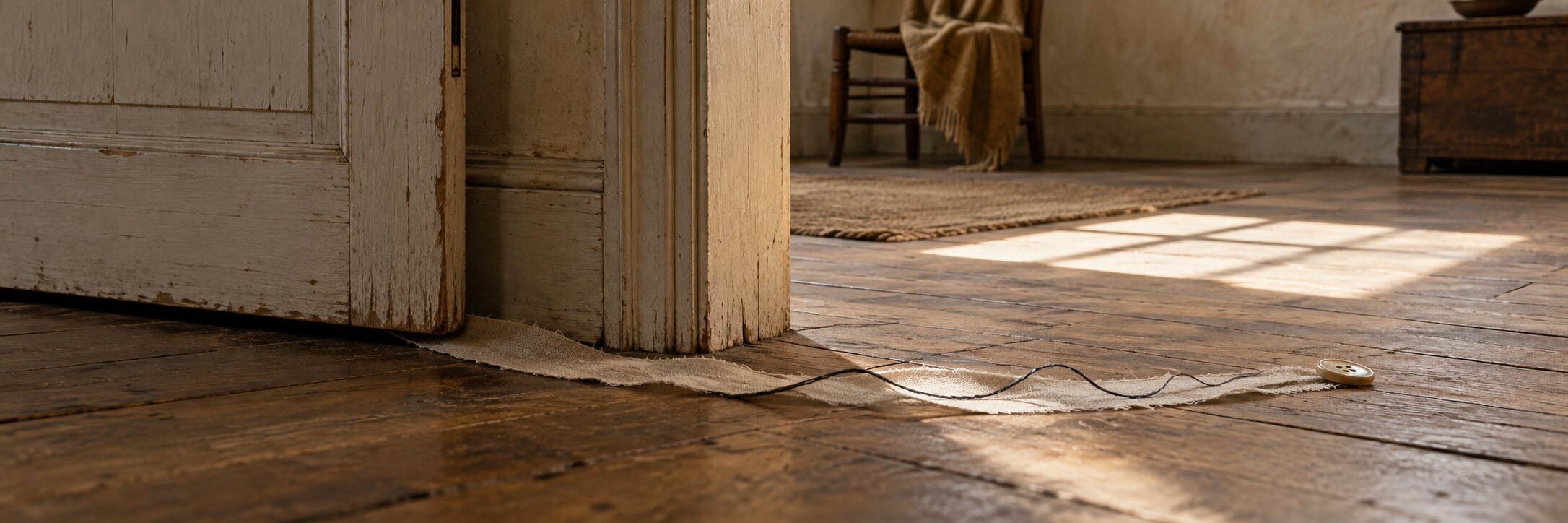
Katharina tied the button to the linen strip. She pushed the end beneath the door until the other room's darkness took it. For a long while, nothing moved. Then the strip drew tight. The button touched the floor on the far side with a small, hard click.
One tap came back through the wall.
Katharina sat on the bed. The window's light had left the floor and reached the stitched mattress. She set her palm there, over the closed seam. The thread held. The room did not open. Across the wall, the other woman tapped once more.
Katharina answered.

No published comments yet.