
Lerato had labelled six boxes when she found the seventh.
It was a shopping bag, not a box, and it sat under the sewing table with a folded note looped through its handles. Her mother had written RETURN on the note, then crossed it out and written ASK FIRST. The second instruction was in darker ink.
“Which one is it?” Lerato called from the passage.
“Neither,” her mother said. “That’s why it’s still there.”
The flat had to be empty by four. The movers had given them a window between a fridge delivery and a piano, and the man on the phone had said this as if a piano were a weather event. Thandi had chosen a smaller flat; Lerato had turned that choice into a list of things to keep, donate or throw away. Her mother had labelled each box with the room it belonged in. Anything more specific, she said, could be decided after the boxes came upstairs.
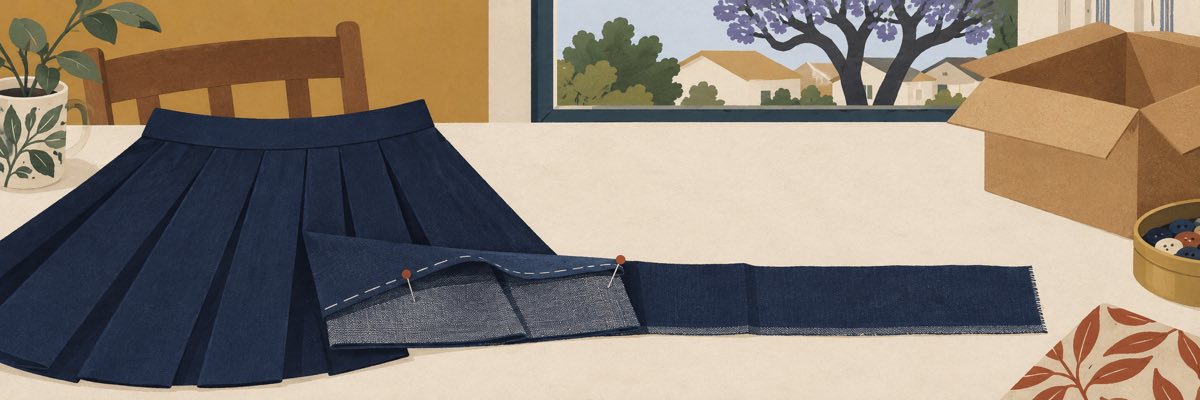
On the sewing table lay a school skirt, a packet of buttons, three folded strips of navy fabric and the order book from the dry-cleaning shop where her mother had worked before it became a vape shop. The skirt was turned inside out. Its hem had been opened and pressed flat, but not stitched again.
“Is this Naledi’s?” Lerato asked.
“If she still wants it.”
“She asked me if it’s ready.”
“Then she can ask me.”
“Kea’s skirt is in the car too,” Lerato said.
“Then bring her with it.”
“It only needs the hem taken up.”
“She can tell me what she needs.”
Lerato looked at the clock. “We have two hours.”
“Your daughter has a mouth.”
“She also has homework.”
“Then she can do both.”
Lerato folded the skirt over the back of a chair. “You’ve already done the difficult part.”
“I’ve done the part that doesn’t need her.”
Her mother, Thandi, was sitting at the kitchen table with a roll of tape and a marker. She had written the name of the new building on each box and added a room number. She had not labelled any box by contents. When Lerato asked, she said she knew what was in them.
The shopping bag under the table had a dozen garments in it. Each was folded around a small paper tag: a blue school shirt with its cuff opened; a grey skirt with the waistband let out; a pair of shorts with the inner seam still long. The notes had instructions in Thandi’s handwriting: Try before cutting. Check the left pocket. Do not shorten until asked. One tag said Four centimetres in reserve, though the skirt it belonged to was no longer in the bag. It hung over the chair.
“You can’t take all this,” Lerato said.
“I know.”
“Then what is it?”
“Work.”
“Work for who?”
Thandi pulled the tape straight across a box and pressed it down. “That is the question.”
The doorbell rang. Lerato looked at the clock again and went to answer it.
Mrs Maseko from upstairs stood in the corridor with a school jersey folded over one arm. She was wearing her gardening gloves, one green and one yellow, and held a jar of apricot jam in the other hand.
“I’m bringing the jersey back,” she said. “He’s grown out of it. I thought you could help me pass it along. The jam is for the cuffs you fixed.”
“You can keep the jam,” Thandi called from the kitchen.
“I made it from your fruit.”
“You picked it.”
“You planted the tree.”
“Then we’re both guilty.”
Mrs Maseko laughed and stepped into the flat. She put the jersey on the table beside the buttons. “I asked him. He wants the name unpicked before it goes.”
“Then the name comes out first,” Thandi said.
Lerato picked up the jar. “We’re packing.”
“I know. I thought I’d bring it round before you go.” Mrs Maseko glanced at the bag under the sewing table. “Are you taking the machine?”
“If it fits in the car,” Lerato said.
“It will fit,” Thandi said.
“I meant in the new flat.”
“I know what you meant.”
Mrs Maseko looked at the half-open boxes. “I don’t know who needs it yet.”
“Leave it there for now. We’ll send it upstairs before we go,” Thandi said.
Mrs Maseko left the jam on the counter and went back upstairs. Lerato watched her stop at the landing to adjust one glove. The jersey stayed on the table.
“You do know this is why you have a whole bag of things no one has collected,” Lerato said.
“Mrs Maseko has brought the jersey for someone else. That’s not the same thing.”
“I mean the rest.”
Thandi folded the jersey along its old crease and set it beside the order book, apart from the donation boxes.
“I’m the one carrying it,” Lerato said.
Her mother ran her thumb along the open hem. “You want to put them in the donation box.”
“I want to know what they are.”
Thandi raised her eyes. Lerato had spent the last two months making lists for her mother: moving company, address change, electricity deposit, keys to return. Every task had an owner and a date. Her mother had agreed to each one, then done them in a different order. Lerato had stopped asking whether she wanted help and started telling her what was next. It saved time. It also saved her from waiting for an answer.
The order book opened easily at the page where Thandi had left it. Rows of names, garment descriptions and prices, each in tight handwriting. On the last page, the entries changed. The lines were not dated. School skirt, let down. Two shirts, cuffs. One jersey, elbow. There were no prices, only small ticks beside some of the work.
Lerato turned back through the dated pages and found her own name. Navy skirt: leave hem. Let her choose. She remembered standing on the kitchen chair in her school shoes while Thandi pinned the cloth. Her mother had asked whether she wanted it shorter or wanted to wait until winter. Lerato had chosen to wait. She had not remembered the question, only that the skirt fitted again when she needed it.
“You were still taking work after the shop closed?” Lerato asked.
“People still had clothes.”
“Did you charge them?”
“Sometimes.”
“Sometimes?”
“Mrs Maseko helped me paint the new room. She brought jam when I fixed the cuffs. We trade what we have.”
“That’s not payment.”
“It was not always meant to be.”
Lerato shut the book. “You can’t keep doing work that nobody has agreed to pay for.”
“I can stop doing it.”
“Then why haven’t you?”
Thandi lifted the skirt from the chair and held it to the light. The fabric had thinned around the fold but not worn through. “Because sometimes I want to.” She laid it back over the chair.
Lerato heard the difference and disliked how simple it made the matter. She had been waiting for her mother to say she was trapped by habit, or had no choice, or did not know how to refuse. Any of those would have made a good entry in a list.
“What about this bag?”
“Some of it is finished. Some of it isn’t mine to finish.”
“Then why is it here?”
“Some asked me to hold it. I haven’t decided about the rest.”
The doorbell rang again. Lerato was closer this time.
A girl she knew from the upstairs flat stood outside, still in her school uniform. Her name was Naledi. She peered past Lerato at the skirt on the chair.
“Mma Thandi said it might be ready,” she said.
“It isn’t,” Lerato said.
“I know. I just wanted to see how much is left.”
Lerato looked over her shoulder. Her mother had not moved from the table.
“Come in,” Thandi said.
Lerato fetched the skirt. Naledi changed in the bathroom and came back holding the open hem away from her knees. Thandi asked her to let it fall, then measured from the hem to the floor.
“You’ve grown,” Thandi said.
“I know.”
“Your mother said you wanted it shorter.”
“I did. In January.”
“And now?”
“Now I want it to last.”
“Then we’ll leave the cloth.” Thandi marked a new fold with two pins.
Thandi checked the pins against each other. Below them lay enough cloth for another year, perhaps two.
Naledi glanced at the boxes. “Are you moving?”
“Today,” Thandi said.
“Will you still sew?”
“If I want to.”
“Can I bring it next week?”
“You can ask next week.”
Naledi nodded. She changed back into her uniform, left the pinned skirt on the table and went upstairs.
Lerato picked up the tag. Thandi held out her hand. Lerato gave it back. She had thought her mother needed help sorting an overfull bag. She had seen the unfinished work as an extra task, not as choices her mother had kept open.
“Do you want the machine in the new flat?” she asked.
Thandi looked at the machine, not at her. “Yes.”
“Then we’ll take it.”
“Where will it go?”
“We’ll measure.”
“After the boxes are in.”
“Fine.”
The movers arrived at three and carried the bed frame down first. Lerato wrapped the sewing machine in a blanket. Thandi packed the order book, the button tin and the tags. She put the shopping bag back under the table.
“That stays?” Lerato asked.
“Not all of it.”
“What do you want me to do with the unfinished things?”
“Nothing.”
“Nothing?”
“Leave them until I decide.”
The movers called for the last box. Lerato looked at the bag, then at her mother. “It can come in the car.”
“It can.”
“Do you want it to?”
Thandi folded the crossed-out note once, then opened it again. “Take the jersey upstairs to Mrs Maseko. Her son wants the name out before it goes anywhere else. Give Naledi her skirt tomorrow. The rest stays with me.”
Lerato wrote the two errands on the back of her list. She did not write “bag” or “unclaimed”. She took the jersey upstairs to Mrs Maseko, then came back for Naledi’s skirt. She lifted the shopping bag by its handles and carried both to the car.
At the new flat, the sewing machine fitted on a narrow desk beside the window. The shopping bag went on the shelf beneath it. Thandi unpacked the button tin and set the order book next to the machine. She did not open either.
Lerato stood in the doorway with Naledi’s skirt over her arm. “I can take this up now.”
“Tomorrow.”
“The building is two doors down.”
“Then it can wait until tomorrow.”
Lerato put the skirt on the chair. “Kea’s uniform still needs doing.”
“Bring her.”
“You can do it without her.”
“I can. I won’t.”
Lerato took out her phone and sent Kea the new flat number. Twenty minutes later the buzzer sounded. Kea had come from school with her bag. Lerato went down to the car and brought up the skirt she had left in the boot.
Kea changed in the bathroom. When she came back, Thandi asked, “What do you need it to do?”
“The front catches on my shoe when I run. I don’t want the whole skirt shorter.”
“We can lift the front and keep the cloth.” Thandi pinned a temporary fold and asked Kea to walk to the window and back. The hem cleared her shoe.
“Is that enough?”
Kea looked down, took three steps and pointed to a pin. “A little lower here.” Thandi moved it. Once Kea had changed back, Lerato held the skirt steady while her mother basted the fold with white thread. No one cut the spare cloth.
“Will you show me how?” Kea asked.
Thandi passed her the needle. “You can put in the next few.”
Kea’s first stitch caught the lining. Lerato reached to free it, then rested her hand on the table while Kea worked the needle backwards.

No published comments yet.