
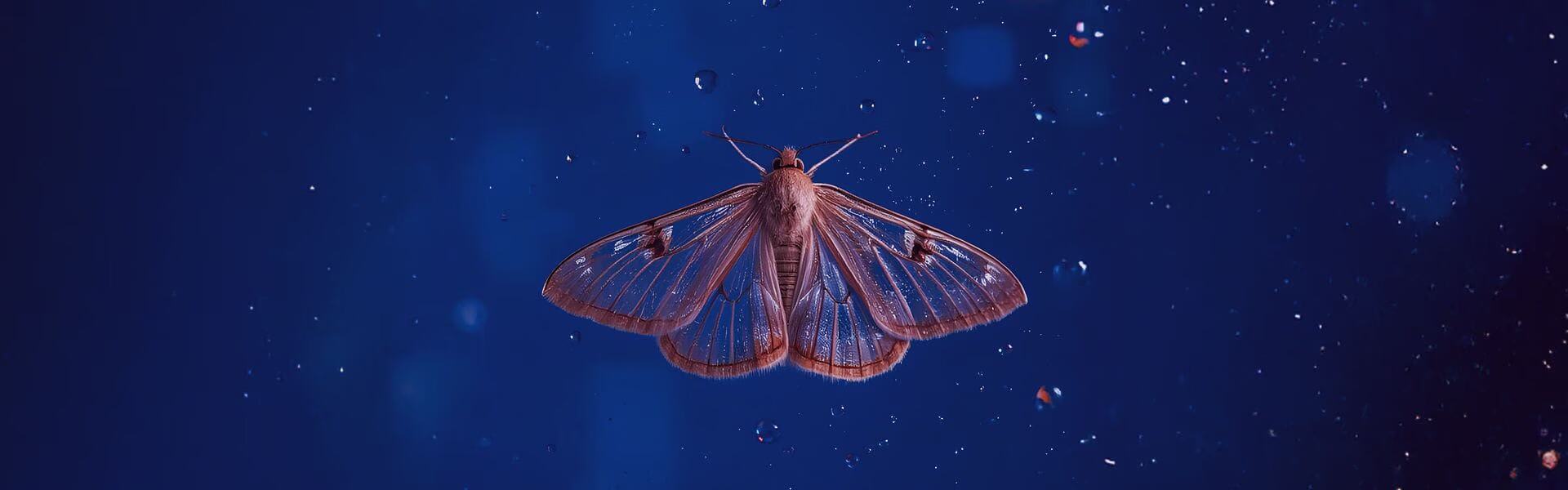
I have spent my life listening for instructions I cannot name. Corridors speak in draught, hedges in the soft arithmetic of leaf and shadow; a puddle argues moon into pieces. Tonight the room speaks the loudest. The lamp tells a story of a small sun confined to a paper cone, and all the furniture leans a little towards it, like plants with poor manners.
I am awake because brightness is a kind of tapping on the skull, a polite insistence. The people have left their cups, a ring of brown on the table, a spoon cooling its breath. The clock hardens each second with a click. Along the curtain a line of hooks grips like teeth. Moths aren’t meant for houses, someone once said to me with their shoe. It wasn’t unkind; it was an observation, the way weather is.
Still, I came in. I always do. A door yawns; a window forgets itself by a thumb’s width. I read the gap as invitation, as if the house were a hollow flower and I were to pollinate its corners.
The lampshade lifts in the draught and I see that the light is made of tiny knives—no, of threads, an invisible loom. I taste it with my antennae, that faint metallic tang light sometimes wears indoors, the smell of old filament and dust warmed back to life. My wings know the pattern: a narrow infinity, a helix of approach. The circle is not a mistake; it is rehearsal for courage. I begin, shivering a wake through the cool around the books and the picture of a seaside no one is at.
Do you think I don’t remember darkness? Field-black, hedge-black, the honest grammar of the moon. I do. But there is a difference between far commandment and near promise. The lamp says now. The moon says eventually. Every creature must surrender to its nature, and mine is the willingness to be persuaded by a smaller star.
The first pass is a kiss to the paper. You have not seen the lampshade from inside. The seam rises like a horizon of glue, a scar in the night. My wing brushes it and leaves a whisper of dust. I circle, an orbit narrowing by habit and hunger for heat. I do not eat light, but I have lived on the feeling of arriving.
‘Foolish,’ says the house, through the long throat of the staircase. The house is a chorus of old boards, fond of telling me which corners belong to who. ‘Foolish,’ says the small spider web strung between a paperback and the brass pull chain. The web is an instrument, tuned to footsteps; the spider waits like a punctuation mark. I bow around her geometry and feel the string-word thrumm against my leg. Even our mistakes have music.
On the third lap the heat opens like a hand. It is not cruel—only accurate. I lean away; my left forewing grazes the seam again, catches, frees, drops me into a slow leaf-fall that my body corrects with the old figures the air taught me in hedgerows. Below, the table’s ring of tea stares up at me as if I am the moon getting smaller, smaller, in its brown tide.
What am I rehearsing: endurance or surrender? There is a window. Beyond the lamp’s kingdom of warm and immediate things, the pane is a square of colder sky. The streetlight beyond it is a pale ancestor to the lamp, disinterested and municipal. Between me and that square is only the air and the faint, spiteful bite of winter coming through the frame. I remember hawthorn, I remember nights when the cold was an honest sentence, not a clause inside a house’s paragraph.
I take one more taste of brightness—call it a farewell sip from a cup that was never mine. The shade answers with a flake of ash from some earlier cousin, a petal that never lived. I see, then, the truth that has always been simple: the lamp is a made thing; the moon is a kept thing. One asks; the other abides.
Do not think I am noble. This is not a moral, but an angle. I turn. The arc I write is small and exact, a parenthesis closing. The curtain rustles to make way, embarrassed to be caught listening. The window makes no sound. Up close it smells of vinegar and old cloth, of the finger that polished it last week to a shine that is not quite a sky. The star outside—one, then none—lays itself over my eye like a coin.
I land. The glass is colder than any decision. My feet agree with it. I pledge to what will not love me back but will not lie. Behind me the lamp continues its story to no one; the spider resumes her patience; the cups go on cooling. My wings settle, and with them a century of nocturnes made by creatures like me, in barns and bathrooms, in bus shelters where moths palace themselves on timetable plastic like saints.
Here is my speech: I am not clever. I am precise. I have worshipped small suns and been burned, held to the room’s bright deceit by threads of my own weaving. But I have also known the honest cold and the stars that require nothing but distance. I choose the pane because it does not bend towards me; it lets me be a smudge in its ledger. Nature is not a tyrant; it is a gravity. Mine draws me to the places where desire meets limit and leaves a mark.
In the morning, if morning comes and someone opens the curtains with a yawn, they will see it: a faint print like the idea of a leaf, oil and dust arranged into my brief heraldry. They will wipe it away with the same cloth that polished the sky. The lamp will nod at their shoulder. The web will carry its sentence into another day.
I am not made for houses, true. But houses are made for light, and sometimes light needs a witness. Consider this my last line, left on the glass where the night kissed back. The room can keep its little sun. I have surrendered to the window’s law, which is transparency and refusal.
Listen: the lamp hums; the cold deepens; the star holds. I hold with it, for as long as a body that remembers hedges can. If I fall, it will be simple, and the air will keep my secret. The pane stays. The pane does not move. That, at last, is mercy.
No published comments yet.