
When the island appeared on the port side for the second time, Celia shut off the engine and put her palm on the casing. It was hot enough to sting. She had been steering south for forty minutes, with the morning sun behind her left shoulder, and the harbour wall should have been ahead.
The island lay low and green beyond the bow. A line of white houses followed the curve of the beach. She could make out the church roof and the little square of tar where the school bus used to turn. There was no church on the mainland opposite the island. There was no beach there either, only the quarry and its conveyor belt.
She tried the radio. Static. The compass needle made a slow half-turn and rested on west, although the sun had not moved. She tapped the glass. The needle shivered, then continued west.
Her brother had said the crossing would take twenty minutes. He had said this from the doorway of his kitchen, with the phone between his shoulder and his ear. He had not looked at her while he gave directions to a man who wanted the ferry's engine. The boat had been their father's; it belonged to both of them now, though her brother had arranged the sale without asking.
She had come for the tools in the engine compartment, or that was what she had told him. Once aboard she had found herself checking the fuel line, tightening the battery terminal and starting the engine. There was enough diesel to make the mainland twice over. She had decided to take the whole boat.
Now the stern tugged sideways. She leaned over the rail and saw a dark cord caught in a loose bight around the propeller. One length ran under the hull and disappeared towards the island; another short section was twisted across the blades. She put the engine in neutral and pulled the caught section with the boathook. It yielded, then tightened so suddenly that the hook slipped from her hands and vanished.
Something bumped the hull. Then again, further forward. The boat rocked with the second blow, and a small yellow fish jumped clear of the water and landed on the deck. It opened and closed its mouth among the paint flakes.
Celia picked it up and dropped it overboard. When she looked down again, a pale eye looked back. It was no larger than a saucer and set in a head the colour of wet sand. A flat body followed it, perhaps a metre long, with six narrow fins folded against its sides. The fine cord from its mouth led back to the line under the ferry.
It backed away when she reached for it, drawing the line tight. The ferry shifted towards the beach.
She took a knife from the galley drawer. The animal surfaced again beside the propeller, its fins moving in quick, shallow strokes. The line disappeared beneath the blade housing; she would have to lean off the stern to cut it. She tied a length of mooring rope around her waist, made the other end fast to the rail and lowered herself until her shoes touched the water.
The animal came closer. Its eye was clouded, with a small clear patch at the centre. Inside its mouth, behind the line, she saw a curved black point. A hook. It had pierced the upper jaw and held there, the flesh stretched thin around it. The fine cord from the water was tied through the hook's eye and ran across the animal's mouth.
She cut the short section twisted around the propeller. The loose end sprang away; the longer length remained tied to the hook in the animal's jaw. The animal hung beside her, breathing hard through slits behind its eye.
The current carried the ferry a few metres from it. For one moment Celia thought the crossing was over: start the engine, follow the sun, go. Then the animal was pulled backwards beneath the boat. Its fins opened and shut. It struck the hull once, twice, in the same pattern she had heard before.
She hauled herself onto the deck and took a landing net from the locker. The net had a split in one side, but she worked it beneath the animal as it passed the stern and lifted it on board. It was heavier than it looked, all muscle and cartilage, and it smelled of the cold water that came up from the harbour when the wind changed.
The cord ran from the hook through its mouth and over the side. She saw now that it was moving through the water, gathering speed.
She braced a knee against the animal's shoulder. The hook was too large to slide backwards through the puncture. She needed to turn it and push the point the rest of the way through. The animal thrashed as she worked, striking her wrist with a fin. When she got the point clear, she clipped the cord at the hook's eye with the wire cutters from her father's toolbox, then drew the shank out of its jaw.
The animal lay still. Its mouth opened once and filled with air. Celia tipped the net over the rail. It slid into the sea and disappeared.
The cord went on rising. For a moment it lay slack on the water, describing a curve around the ferry. Then the curve shortened. A broad patch of water beyond the bow turned smooth, so smooth that it reflected the houses in a continuous strip. The beach seemed to swell beneath them.
Celia started the engine. The propeller spun freely, and the ferry moved forward. She steered away from the island, towards the sunlit gap between two banks of cloud. The engine coughed, caught again and settled into its old uneven beat.
Behind her, the smooth patch widened. The reflection of the houses bent and broke as a ridge rose through it. At first she thought it was a sandbar lifting with the tide. Then a second ridge appeared beside it, and a third. They spread apart slowly, trailing weed and long ribbons of pale skin. The water poured off them. They were the tips of teeth.
She opened the throttle. The ferry shuddered; a screw rattled loose somewhere under the floorboards. The island slipped across her vision, not behind her but alongside, as though the boat were running the length of it. The beach stretched on, white beneath the houses, and new houses came into view beyond the church. She had known everyone who lived on the island when she was a child. There had been thirty-eight houses. She counted to forty and stopped.
A dull sound came from below the engine, like someone knocking on a door through several rooms. The water at the bow rose. The ferry began to climb. Celia gripped the wheel and felt the boat lose speed although the propeller was still turning. Ahead of her, the sea was lifting in a long, smooth slope. At its crest was a line of foam, and above that, briefly, a row of houses against the sky.
The creature had brought its mouth up around her.
She remembered the shallows at the old pier, the way her father used to turn the ferry hard and let the stern slide sideways before the bow touched sand. She turned now. The boat swung, listing sharply enough for the toolbox to slide off its shelf. A spanner clattered against her ankle. The stern struck something yielding and rolled over it, and the engine screamed as the propeller bit air.
Then the ferry fell. Celia hit the wheel with her chest. Water came over the rail, carrying the landing net and the yellow fish's scales across the deck. The boat landed level and kept moving. Behind it the water closed with a sound like a long breath being taken through a narrow opening.
The mainland appeared ahead, the quarry conveyor black against the hill. Celia did not ease the throttle until she reached the harbour. She tied the ferry to the public jetty, using two ropes because her hands would not stop shaking, and went up to the road to call her brother.
He answered at once. She told him where the boat was and said he could sell it. He asked about the tools. She looked back down at the ferry, at the small dark shape rocking between the concrete walls, and said he could have those too.
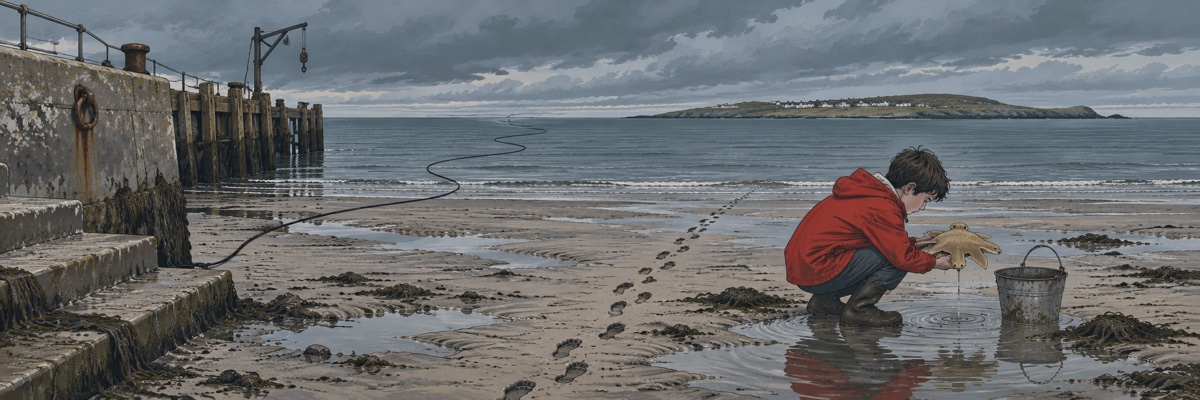
By evening the buyer had towed it away. Celia watched from her brother's kitchen while he counted the cash and laid her share on the table. Beyond the window the tide had gone out, exposing a strip of mud below the harbour wall. A boy in a red jacket was walking along it with a bucket, stopping to dig wherever the wet surface made a little dimple.
The boy lifted something out and held it towards the light. Even at that distance she recognised the flat body and the six fins. He put it into his bucket and carried on digging.
Celia ran outside. By the time she reached the harbour steps the boy had gone. His footprints crossed the mud as far as the water and ended there. She stood on the lowest step and watched the surface. The outgoing tide drew a thin black line past her shoe, straight towards the open sea.

No published comments yet.