
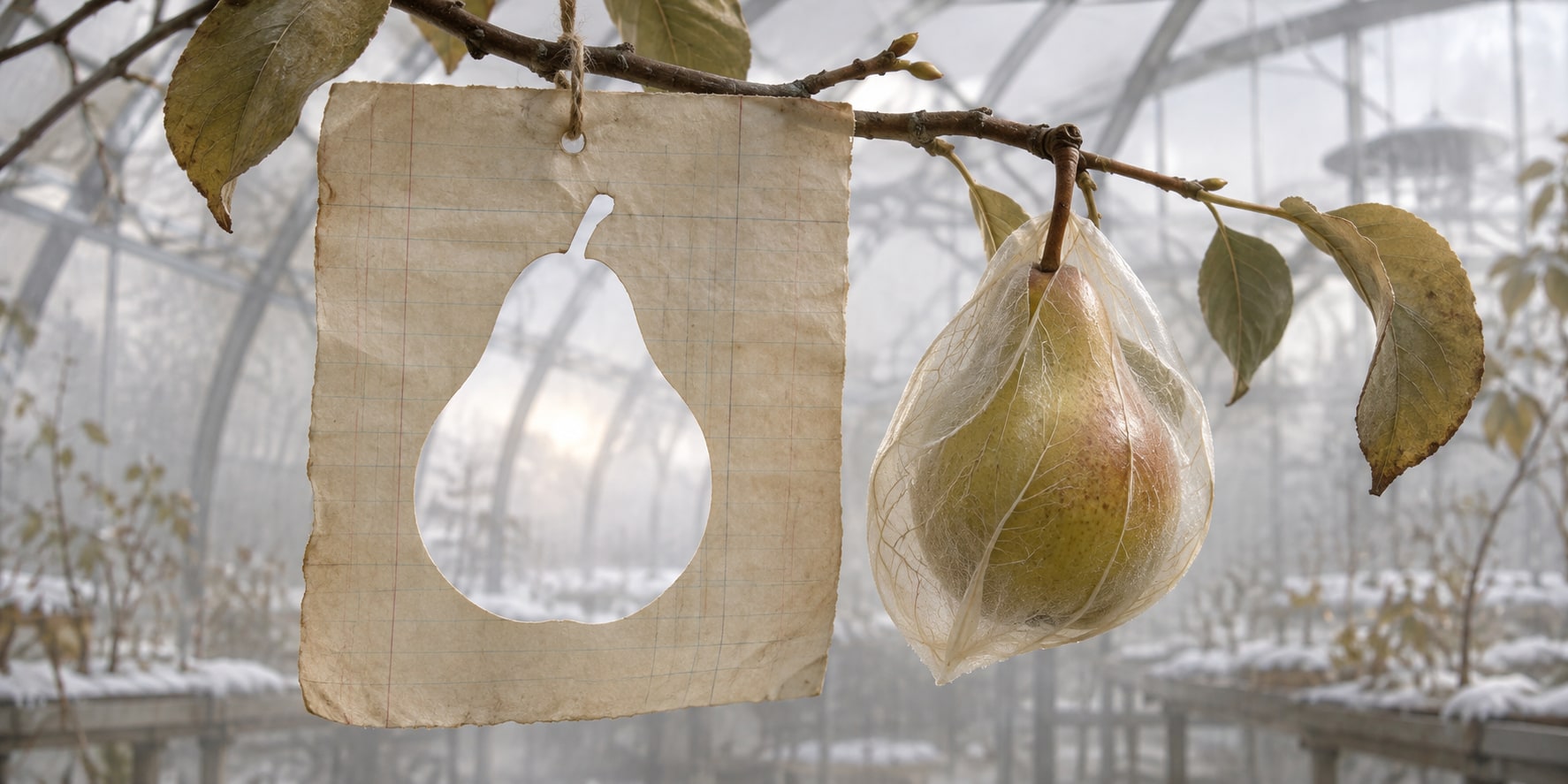
On the morning the roof went white, Bev found a little jacket folded inside a pear. She put the two halves of the fruit down and shook the thing out. It was all one piece, the colour of the wet lining of a cheek, with a small hole at either end. The sleeves she had imagined were only creases. She pulled the thing over the pear she had picked yesterday and forgotten on the bench. The skin tightened. A bruise as soft as porridge came firm under her thumb.
‘You have got to be kidding me, Pat.’
Nothing happened when you said the name already on a tree. For anything to happen you had to call it something else.
By the end of the week all the pears on Pat had gone into little jackets. You could pick them green, eat the sweet inside, put the jacket over some other fruit and carry it across the white in an open cart. At the far end it came out as cool as if you’d carried it under your tongue. Bev tried one on a cut turnip. It worked. She wanted to ring someone and say, Remember what a business it used to be to get your turnips across? There wasn’t anybody left on her shift. From the ridge above the greenhouse to the flats, the road was the same colour as the roof. Every day there was less difference between the two.
The last payment on the cloud glass was due in 2142. She had counted on the crop of 2138, this crop, to leave her only four more seasons to find. Four more years for the fittings and she could have afforded to move somewhere a plum needed nothing more than a paper bag to travel in.
In the grower’s ledger the line above Pat’s name was clean. Bev found the place by a dirty print her thumb had left on the page. There had been a name in that space. She had called the pear Pat after the woman who used to bundle the fruit for sending. A bit of her liked giving Pat a job she’d actually been good at. But as for what the pear had been called before Pat, she could get no further than the dent the pen had made in the paper. She ran a nail through the dent. Halfway across it went perfectly smooth.
There was another tree already named for a worker. Alf, who had once built such a tower of empty crates on the slope that the top one wouldn’t come down until it rained, was a squat yellow apple with a shoulder that fitted into the base of the next fruit. You could stack them six high. Before he was Alf she had called him June. She remembered that because she had been standing there when the old packer named him Alf. Afterwards the man had been unable to remember June, who had been his first wife and for whom the tree had been named. He remembered being married to somebody before. When he spoke of her he said ‘our marriage’, as if the marriage had been a third person who might be persuaded to put him in touch.
It hadn’t seemed to trouble him much. He had left the greenhouse the following spring, and the apples went up on the shelves of the shop in little freestanding columns. Children started with six, as the packer had done. By summer one had built a tower of nineteen, using the undersized ones to finish the top three storeys. The child’s father sent a picture. Bev had spent a warm evening trying to make twenty.
Now there was a sweetness in the house even with the doors shut. The last tree on the slope had pushed a short brown fruit out of the bare wood halfway down its trunk. When she bent to it the cavity at the base let out a breath against her eyelid. A bread smell, sour and comfortable. She knocked the fruit off. It landed end up, rocked on the curve of its belly and went on breathing.
The tree was called Elsie. The woman for whom it was named had hung wet cloths over the young trees every evening that the drying winds blew and had lived into her nineties with one thumbnail beaten flat from a lifetime of closing crates. Bev herself had been brought up in that thumbnail’s orbit. When Elsie made fishcakes she poked a hollow in the middle of each with it. Bev had fetched the last one from the pan on her sixteenth birthday, the inside so hot she had opened her mouth and let it fall on the floor. Her gran had eaten it anyway. ‘We wash these floors.’
It was Bev who had cut Elsie’s allowance of water to one cup. You couldn’t sell a fruit that breathed. She had taken one into the kitchen and heard it wheezing away all through supper, and in the middle of the night when she had opened the bin it had been breathing on a stone. They had planted good trees to windward of this one, uphill ones which needed the cup. In the morning she meant to draw the watering line out of the bed and run it round the thirsty old trunk uphill. She had already eased the clamp. Feeling down the line below Elsie’s dish, she found the earth there cool for the length of her arm.
She picked up the fallen fruit. It exhaled into the crook of her elbow. The little hairs along her forearm stood up wet. There must be thirty of these things in the canopy. Under the lowest branches rose the sour smell of a wet dishcloth forgotten in a shut kitchen. Bev stood there with the cold earth under her nails and the fruit against her arm. In her kitchen a plate sometimes got damp when you set it down near the bin. So much water had been going in the rubbish.
She went uphill to feel the earth under the other trees. Under Alf it was like the dust in a work shoe. Pat was a little better off. There were clouds of fruit jackets swelling above her head. At the ridge she looked back. A strip of green grass showed through the slats on the sill beneath Elsie where, in summer, there had been no grass since Bev was a girl.
If she could give the trick to the other trees she could keep the orchard in fruit with the little water left to her. She thought of the old women who had once worked here, of their wet print dresses hanging off their stooped backs. Of all those names growing on the slope and nobody coming out of the heat when she called them. She had learned one useful thing from the truckloads of apples and pears. You got what the name had meant to you in a working day. A man who stacked, a woman who wrapped. She did not know a single water carrier who had kept enough water in her buckets to take all the trees through the week.
The breathing fruit was still in her hand. She put it on Pat’s roots and left it while she worked. At lunch the hole had closed. The surface was cool under her palm. A thumb’s depth down, the earth was powder. One fruit could dampen a plate; it could not carry water to a tree’s roots.
Back at Elsie, Bev took out her pocket knife and cut through the soft joint where another brown fruit hung. Straight away a third fruit on the same branch took a startled double breath, as if Bev had laid a cold finger unexpectedly between its shoulders. The grass below shivered. She put the knife away. Breath could pass along a branch. She had seen that much.
At the uphill end of the house, Pat’s little jackets were taking on a faint red blush. It was time to pick. Bev put one over her hand and felt the shuddering cold against her joints. She could stand to garden for a decade longer in a pair of gloves like these. There were still names in the house for things she needed. Out of her whole shift she was the only one who knew what every tree could do, who had tended and lifted and watered all of them. She touched her own nose with the cold hand. The orchard needed her name if it was to learn her work. It was the sort of thought she would have chased away from anybody else’s orchard with dogs.
On her way back she called Elsie by name. She tried to summon the face that belonged to the flat thumb and there it was, looking up from picking a fishcake off the floor. She took her time and had a good look.
Bev walked the length of her grandmother’s tree, from the crooked tip leaning away from the glass to the flat branch where a child could ride, walked all the way back to the main stem and gave it her own name.
She watched for the rest of the day. As far as she could see, nothing had happened. The brown fruit carried on breathing even after the light went flat. At dusk she started to pull down the blind and found a new shoot in its way. She followed the shoot along the ridge. It had forked. One fork was wound round a branch of Alf and the other round the lowest bough on Pat. Under the apples little brown mouths were opening. She put her wrist into the grass and held it there until the cuff of her sleeve was soaked.
She pushed the watering line back into the bed and tightened the clamp. At the bench she put the name Bev in the ledger just below a line on which somebody had written hard enough to tear the paper. Her thumbnail fitted into the rent.
At home she made fishcakes. She pressed the dents into them with her thumb though hers were poor dents, too narrow and deep. One fell on the floor when she turned it. She ate it where she stood and was terribly glad for a moment, as if the house had been expecting her to do it.

Loading published comments…