
The promise was to sit bare-arsed in the sun one day in the middle of winter. There would be no husbands, no wet wool against the ribs, no voice calling out how long are you going to be. Nel wanted to know if it would be cold on the top and hot underneath, like sitting on the lid of the bread oven in a draught. Her friend Posy said the heat would be on the top, naturally, but at sixteen they found it hard to talk about their bare arses without laughing, and the substance of the argument was lost in the apricot trees.
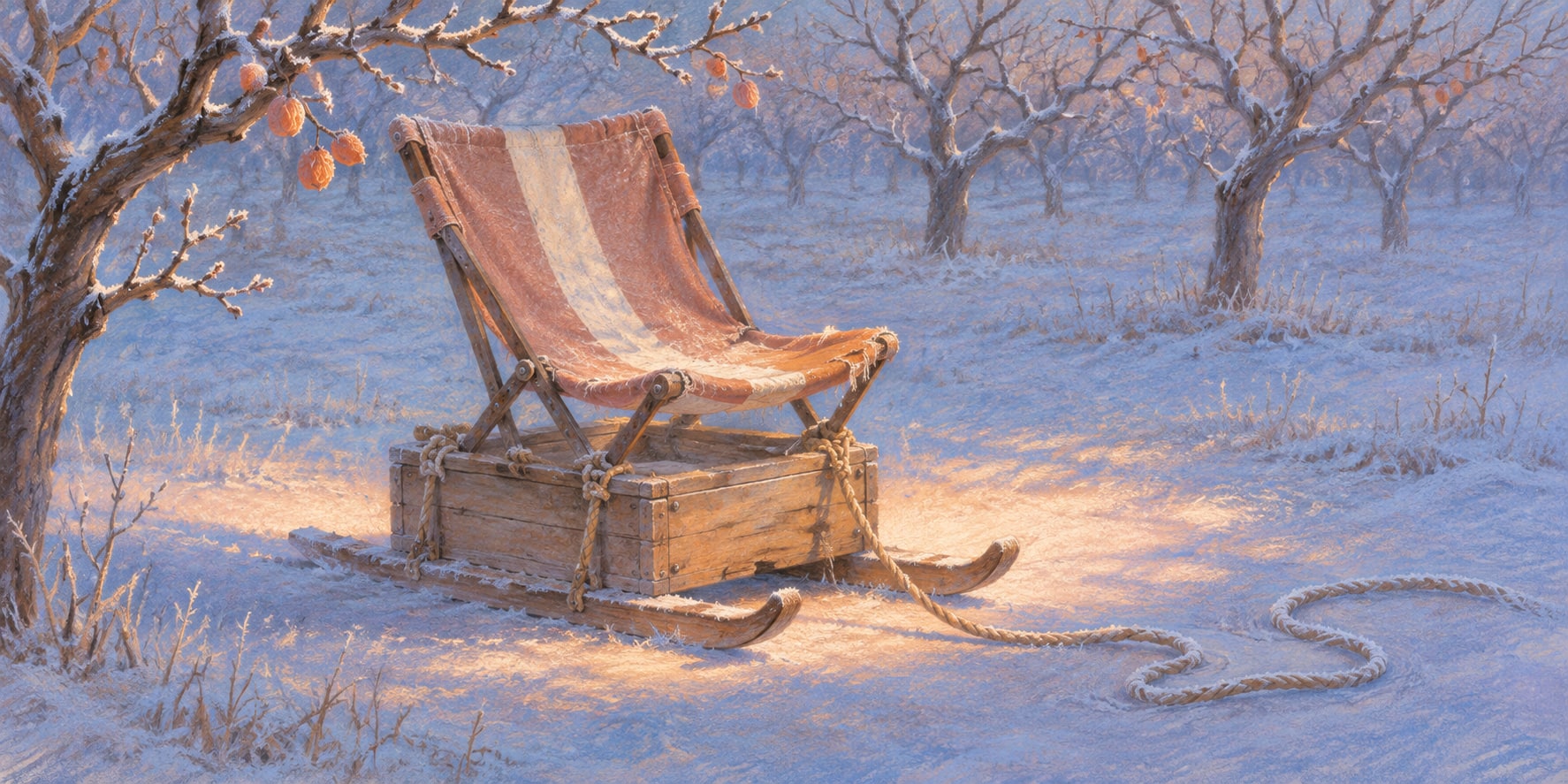
Fifty years later Posy came down the orchard pulling a folding chair on runners. She had been a round girl and she was a round woman. Her chair was a low spidery thing she had won at a dance the year Nel had six teeth out.
‘That time already?’ said Nel.
‘Next year you’ll have another excuse.’
‘I’ve got one this year, as a matter of fact.’
Posy let go of the rope. She had lashed the chair to a low box on runners. The chair folded down flat for luggage or sat up for a passenger. Its canvas had a worn white stripe across the place where Posy’s backside had been polishing it for years.
‘My knees still bend,’ Nel said.
‘For which I give thanks. It’s a rotten business getting your drawers off with straight knees.’
Nel bent to look at a little blade of grass frozen in the mud. The blade was green except for its tip. She snapped the tip off. She had always imagined they would do this as girls. Somehow there had never been a year in which she felt able to take a second look at her body and say, Here it is, then, in the state I intend to keep it.
The first snow came in the night and ran at once out of the gutters. At dawn came the second. Her husband put his cold hands around Nel’s neck where he liked to warm them for sleep, and she let him lie that way until a white patch began to hold on the sill. As his eyes closed she reached across him, dragged a fingertip through the snow and put it in her mouth, asking for her winter awake. You could ask once in a lifetime. The snow tasted of old paint.
His big thumb slid off her collarbone. Nel sat up. Behind the door the black coat she used for funerals hung where she had put it. The cup on the washstand had a hairline crack in the glaze. She had had some idea that at the moment of choosing she would see everything blazing white.
‘There’s the snow,’ she said, just in case. He slept on. Nothing could wake him now before the thaw, not even if she put her finger in his ear, a thing he particularly disliked. She did put her finger in his ear. She had been married to him forty-one years. The ear went faintly pink under her nail.
Posy, with a smudge from the soot on her own sill still at the corner of her mouth, was piling split logs on the sledge, along with the apricots she had dried that summer and a great wheel of cheese furred like the knee of an old black stocking. They had chosen the south field above the dam for their experiment. From autumn till the equinox, in the narrow bottom of the valley where they lived, you received at best a glimpse of the sun as it went by up on the cliff. In the south field they were reasonably certain it shone straight down on the grass. In that field their grandfathers had made hay three weeks before the hay in the village was fit to bring in.
It took them four days to get to the field. They slept in the empty huts where men hammered hoops on barrels in summer. Posy snored and screamed in her sleep and once in the deep hours began to laugh. Nel had forgotten this. She lay in the dark turning over husbands’ names and dates of birth, trying to establish how long it had been since she had slept a whole night next to Posy. When they were children there had been a stage at which all you had to do to procure an entire night with your friend was to throw a pillow through an open window and go after it.
On the fourth day they ate lunch sitting on their sledge in the south field. Overhead the sky was a blue thinner than either woman had seen it. Sun lay on the opposite cliff as usual. The whole of their soft white field was in the shade.
‘Perhaps Tuesday,’ said Nel.
‘The sun takes Wednesday off, as I recall.’
They stayed three weeks. The light travelled steadily down one face of stone each afternoon and settled on the sloping roof of an abandoned goat shed on the far bank. The river was only ten paces across. Everything around it froze, but the water itself shot out of a gorge thick as a muscle and it carried in its folds scraps of brush and sheets of brittle ice which struck the stones with a flat clattering noise that went on in your head long after you came indoors.
At home Nel was a good person to have if the wick fell down the neck of a lamp or a splinter went in too deep to see. She could set something badly made between her knees and improve it by the hour. What she could not ordinarily do was sit still to consider how a badly made thing had got to look that way. In the south field she had quantities of time. The old goat shed had been put up facing the wrong way for winter light. It had a good sloping roof of zinc on which the sun shone for nearly an hour. If only it faced them, she said, the sun would strike the roof and come back across the water and the two of them could sit in its light without getting wet feet.
‘Shall I pop across and turn it for you?’ Posy said.
‘It’s the roof that wants turning.’
‘Oh well, that’s all right then.’
There were mornings Nel let the fire go to save wood. There were mornings Posy ate a second helping of cheese and said she was saving it the trouble of going bad. Sometimes in the afternoon when it seemed impossible to get warm, the idea of a house full of sleepers impressed itself on Nel so forcibly she had to go and put her head under Posy’s three-ply shawl and smell that familiar mixture of scalp and woodsmoke. The sleepers were living too. It was their unreasonable perfection she disliked. At the thaw her husband would roll on to his side, reach for her as usual and find his hand closing on a cold sheet. He would open his eyes in the spring and the cup would still have its crack and she, Nel, would have lived a quarter of a year without him.
‘A penny for an inside thought,’ Posy said.
‘I should have brought a mirror.’
‘My God. Is your hair that important?’
Nel began to laugh. With the shawl over their heads it sounded exactly as if somebody else had laughed too.
On the shortest day they got up before dawn. They had cheese fried on an iron plate and counted out seven dried apricots each. Posy wore two pairs of knickers under her skirt. ‘That’s what I call a sporting chance,’ Nel said. They put on their boots and hauled the sledge down to the bank directly opposite the goat shed.
There was a hole in the roof where a stove chimney used to go. A tongue of metal stuck up at its edge. The day before, Nel had seen a yellow patch glide over the bank at her feet. She had followed it on her knees with an apricot on her palm. When the fruit lit up a soft translucent orange she looked back across the water. The lip of metal shone so fiercely it hurt her eyes.
They waited quite a long time. Posy took the apricots out of her mouth and counted them a second time.
‘You’ll put them back in the wrong order,’ Nel said.
‘I’m warming up the ones I’ll swallow first.’
‘You don’t have to take your things off if you don’t feel like it.’
Posy considered this. ‘I’ve brought a perfectly good bottom all this way.’
At last the roof gave a wink and light fell on the bank. No bigger than a bread plate. Nel unfolded the chair. She dropped her skirt and her drawers and tried to keep the patch of light in view while she lowered the necessary part of herself into it. The light went out.
‘It’s up your back,’ Posy said.
‘Well, since it’s my back I’m not in a position to discover that.’
‘Get down. Give me your coat.’
Posy laid both their coats on the dry grass where the bank overhung its own foot. Nel sat on her heels while Posy guided her by the hip and thigh into the sun. This time she felt it. Such a small, mild laying on of warmth. The top of a loaf would give more heat when you put your hand on it in the morning, even a loaf baked the afternoon before. The rest of her was mostly too cold to care. She sat quite still and let her friend look.
‘It’s not going to last all day,’ she said at last.
‘Then move up. You’ve got my share.’
They hauled at each other’s elbows until they could sit cheek to cheek, the near half warm, the far half cold. At some point in all the shouting required for this operation the sun had dropped below the shed. Neither of them could make out exactly when.
Posy began to cry. Nel got her skirt down over her knees and thought she must have done some damage getting up off the bank. ‘Where is it?’
‘Oh, leave me be. I wanted another minute.’
‘There’s always tomorrow.’
‘I was still taking my knickers off for most of this one.’
Nel wanted to take her by the shoulders and shake her. Thirty seconds of winter sun and already the woman had found the thing wrong with it. What Nel wanted now, with a force that seemed to fill even her coldest extremities, was a fried egg. She left her friend lying under the bank and went back to the hoopers’ hut to melt fat in the pan. There was a jar of eggs buried in limewater under the bunk, enough for their return journey if they could give up eating cake. She fried one for herself and one for Posy and ate both while they were hot.
They had no quarrel to speak of the next morning. They stayed in the field till the apricots ran out, then began eating the stores the hoopers had put by for them against a late thaw. Most days Posy went down to see where the sun had got to. Most days Nel found herself something better to do. She made a hook for the sledge rope, to save a person having to hold on to it all the time, and baked a pretty good cake with no eggs in it. On the way home the snow began to pull apart in long furrows. By the time they came within sight of the orchard they could hear somebody beating a rug in the village. Then a child began to bawl. They stopped to listen. The thaw had come while they were out walking.
The first summer after that, when somebody asked, Nel would tell the story while somebody else passed the potatoes. She did the bare part with two bent knuckles, a brown one and a white one, on the scrubbed wood of the supper table. People laughed and forgot and went on with their suppers.
Posy didn’t tell it. In her garden, though, she began leaving the bottom end of the washing line empty on fine afternoons. Nel’s kitchen overlooked the spot. Once, in October, Nel brought a bowl of eggs out of her pantry into the good light to see which of them was cracked. There was Posy below her with the chair open in the sun, lifting the back of her skirt. Nel kept as still as she could till her friend had settled, then rapped a cracked egg smartly against the side of the bowl.


Loading published comments…