
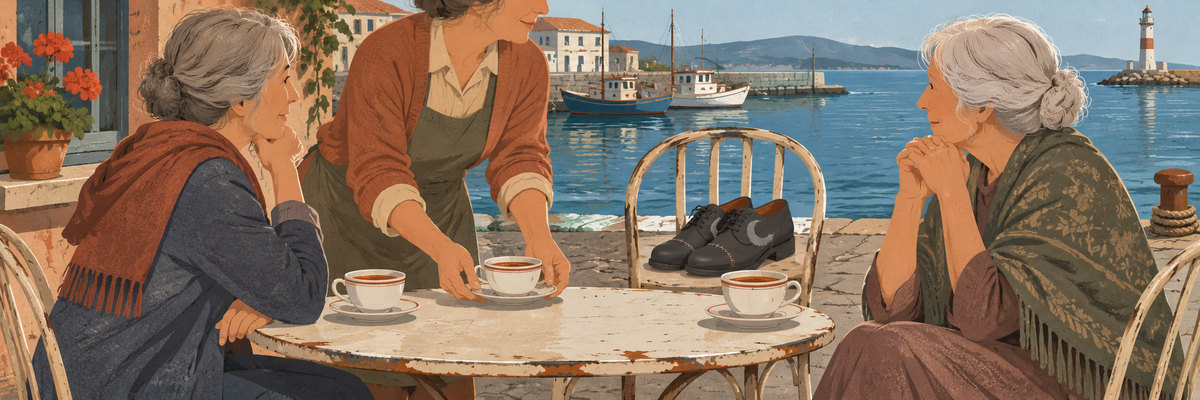
The woman in the photograph had been wearing my mother's shoes.
I recognised the repair first: a grey crescent of upholstery thread above the left heel. My mother used thread too strong for the leather because she expected shoes to fail through disloyalty. The woman wore them outside a café I had never seen. On the reverse someone had written, in my handwriting, WHO PAID FOR THIS?
I took the photograph to my mother. She held it close to her nose and said she wished people would stop asking her about strangers.
Then she took her feet off the table.
Both shoes were there.
The photograph had come through the maintenance chute of the Mercy House, where I worked repairing chairs, locks and the machines that prevented things. I was trained for the first two. For the machines we had coloured instructions and Doctor Venn, who could make an explanation feel like a blanket being laid over your knees.
He had found my mother after the harbour evacuation. He had found beds for nearly everyone. The council had wanted a statue. He asked for a wheelchair ramp instead, and the papers printed that for months.
On Monday I showed him the photograph.
He studied the café, the shoes, the face above them.
“Sometimes a prevention leaves a loose end,” he said. “A possibility which hasn't realised it was prevented.”
“Can it hurt her?”
“Not if we don't give it somewhere to live.”
He fed the photograph into the shredder beside his desk. It made a soft crunch, like a small animal eating lettuce.
That afternoon the maintenance chute delivered a brass box.
It was the size of a lunch tin. There was no hinge, keyhole or maker's mark, only a rectangular window in its lid. Through the window I saw the photograph, unshredded.
My apprentice, Sipho, saw a folded blue scarf.
We carried the box between two workbenches, changing the light. He kept seeing the scarf. I kept seeing my mother outside the café.
“My brother's,” he said eventually. “I thought I'd forgotten the colour.”
His brother had drowned before Sipho was born. That was what Sipho had always told me.
We put a sheet over the box and finished adjusting the waiting-room chairs. Their arms had to be exactly seventy centimetres apart. People waiting for a prevention were entitled to be comfortable, but not together.
Mercy House stood where the old fish market had been. Its public screens showed yesterday's prevented events: tram collision, seven saved; domestic fire, three saved; retaining wall failure, twelve saved. You registered a fear and the engines tested the futures around it. If the danger could be removed without shifting greater harm elsewhere, you sat in the white room while the machine narrowed the world.
The miracle had limits. It could not cure a disease. It could prevent you from boarding the bus on which you caught it. It could not return a dead person. It could choose a world in which you had never met them, making the grief unnecessary. The screens called this bereavement relief.
My mother had never applied for relief. I had checked.
I checked again that night, using the maintenance terminal. Her name appeared once, on the harbour evacuation register. Beside it was a small grey square where most records had a green tick.
When I clicked, the terminal asked who had authorised my enquiry.
I closed it.
At home my mother was sorting buttons into an egg tray. She said the television had been showing the same programme for three days, though the screen was off.
“Do you remember the evacuation?” I asked.
“Rain.”
“Anything else?”
She put a white button into a compartment of brown ones.
“A woman wanted my shoes. They were wet. I said she could have them when she had somewhere to go.”
I waited.
“There's no point looking like that,” she said. “I don't know if I gave them to her.”
The following morning Sipho had covered the brass box with a welding hood. He had stayed late and borrowed the workshop camera. Every image showed an empty window.
“It's not light,” he said. “Or it doesn't travel with light.”
We tried our phones, a mirror and the inspection scope. Empty. Only a living person looking directly through the glass saw an object. No one saw the same one. The cleaner saw a parcel of meat wrapped in newspaper and refused to explain. A security guard saw a baby's hospital bracelet. Venn's secretary saw a train ticket and began to cry.
We stopped asking people.
At lunch I looked through the window again. The photograph had changed. The woman stood at the café door, looking over her shoulder. Beneath her face, pressed against the inside of the glass, was one fingertip.
I brought a ruler and measured the box. Its length was nineteen centimetres, its width eleven. When Sipho measured it, he got the same results. When we weighed it separately, the balance read different masses. Together, with both our hands on the scale, it rocked between them.
Sipho fetched the electrical safety manual. An appendix described a test instrument withdrawn from use six years earlier: an observer-dependent witness chamber.
The accompanying drawing was our box.
Under intended use, somebody had stamped ENIGMA in red. Under disposal instructions, the page had been cut away.
“It holds what a narrowing couldn't digest,” Sipho read. “Contradictory evidence. Personal anchors.”
“Why would that be a test?”
“To see if the machine's telling the truth.”
There were fourteen chambers in the old inventory. Thirteen had been destroyed by Doctor Venn, according to an attached certificate. Beside the final number he had written retained for compassion research.
I wanted Sipho to leave then. That is the part I still dislike telling. I did not want him safe as much as I wanted the decision to belong to somebody else.
Instead he said, “We should look at my brother.”
His family record contained no brother. His birth certificate called him the first child. He remembered being told the drowning story by his father, but could no longer remember his father's voice telling it.
The grey square beside my mother's name was not an application. It marked a witness.
We found hundreds.
The harbour register was the oldest. There had been no storm surge. The original warning came from a pressure sensor the maintenance log said was disconnected. All the evacuation photographs showed the same six people near the barriers. In later images, there were five. Then four.
My mother had appeared beside a girl wearing a blue scarf. Behind them stood the woman from my photograph, wearing my mother's shoes.
Sipho leaned towards the terminal.
“That's not my brother,” he said.
I enlarged the image. The girl was looking straight at the camera.
“No,” he said. “That's me.”
His voice remained perfectly level. His right hand began opening and closing on the workbench.
The uncorrected register listed her brother too: twenty-one, evacuated safely. At sixteen, before the narrowing, Sipho had been a girl with a brother still alive. The machine had rebuilt the years after her disappearance from the harbour. Sipho's present life was not false; it was the life the engine had selected. He had friends, a difficult father, an excellent instinct for bearings. He remembered none of the girl, and I would not tell him he owed her his body. But someone had taken her choices and called the result a rescue.
The scarf remained.
Venn came into the workshop before we could copy the register.
He wore an apron over his good shirt. He had been helping volunteers make soup in the courtyard.
“I've been hoping you would bring that to me,” he said.
Sipho put his hand over the box.
“I know,” Venn said. “It feels private.”
He did not lock the door. He took the chair with the broken height adjustment because he remembered it hurt my back.
“There were people at the harbour who meant to stop us,” he said. “They'd seen an early prevention. They thought changing a person's past was killing them.”
“You evacuated a whole district to catch six people?”
“We moved people out of danger.”
“There wasn't any danger.”
He looked at me with genuine disappointment.
“You work here. You know what happens if we stop. The fires. The children in ambulances. I had a city asking for an answer, and six people insisting the question was sacred.”
He reached towards the brass box, then let his hand rest between us.
“Your mother saw an opportunity to help someone. I have preserved that about her in every revision. Please give me credit for it.”
The workshop seemed suddenly arranged around him: chair, clear doorway, the two of us waiting to hear what he would allow us to be.
“How many revisions?” I said.
He did not answer.
“What do you see in the box?”
For the first time he looked away.
I lifted it towards him. He stood so quickly the chair struck the bench.
“That is not a humane question.”
In the corridor he told the guard we had suffered a maintenance exposure. We would be taken to the white room after the last public appointment. He offered to ring my mother himself.
Sipho's hand was still opening and closing.
“Do you want the other life back?” I asked.
“I want him to stop choosing.”
The guard waited outside, embarrassed. There was no alarm on the maintenance chute. We could have fitted the box into it and sent it down to waste. Venn would have wanted that. Perhaps he would even have thanked us.
Instead I opened the underside panel of the waiting-room camera.
The engines required observations, millions of them. The camera was one of thousands of little mouths through which the city entered the machine. Each morning it checked the chairs against the room's approved dimensions. Each afternoon it checked how many people were sitting alone.
An ordinary camera could not see the contents of the chamber. But we could.
Sipho held the lens while I disconnected its image feed and exposed the analogue comparison socket. It was old equipment. Beneath the software, the engine still accepted a human measurement when optical calibration failed. I had signed those readings every week for four years.
I entered the box's dimensions. Sipho entered its weight.
Then I entered its weight.
The terminal asked us to resolve the discrepancy.
We signed both.
Above us the waiting-room lights dimmed. The machine asked whether both observations were current. We signed again.
It was meant to happen during a test, with one witness safely sedated before the second reading. Two living observers, awake and disagreeing, gave the engine a contradiction it was forbidden to discard. It could narrow us until we agreed, or expand its account of the room.
Venn had not taught us that part. The manual had a warning about it in type larger than the title.
He came running as the first chair acquired a second shadow.
“You'll undo work you can't imagine,” he said.
I believed him. That was the worst thing. I could hear ambulances already, somewhere beyond the courtyard, though perhaps they had always been there.
“Then tell them what you did.”
“It won't matter. They'll shut everything down.”
“Tell them.”
He pressed his thumb against the emergency narrowing switch.
The switch required a second authorised witness. He looked at me. Even then, he seemed certain that the years of ramps and blankets and soup had earned him my hand.
I put it on the box instead.
The window cracked. A damp train ticket slid onto the bench. Then a hospital bracelet. The cleaner's parcel landed with a heavy slap. In the waiting room someone called a name I had never heard, and somebody else answered.
Venn began saying the city's prevention totals aloud. He was still saying them when the guards took him outside.
The engines stopped. We did not know how to restart them safely. For eleven days people queued in the courtyard for information nobody had. Some wanted their old lives. Some feared losing the lives they had now. There was no single change that could satisfy them, and no machine left which was allowed to pretend otherwise.
My mother went missing on the second afternoon.
I found her at a café on the far side of the harbour. Its lease was dated that morning, but the enamel tables had weathered for years. Across from her sat the woman from the photograph, barefoot, with her shoes on a chair between them.
Neither looked surprised to see me.
“This is Mara,” my mother said. “I'm trying to work out how long I've known her.”
Mara moved the shoes so I could sit down.
I wanted to ask which of them had been outside the café. I wanted to know what I had written on the photograph, and whether there was a version of me who understood it all.
But my mother was touching the grey stitching above the heel. She was asking Mara whether the repair had held.
I ordered tea for three.
No published comments yet.