
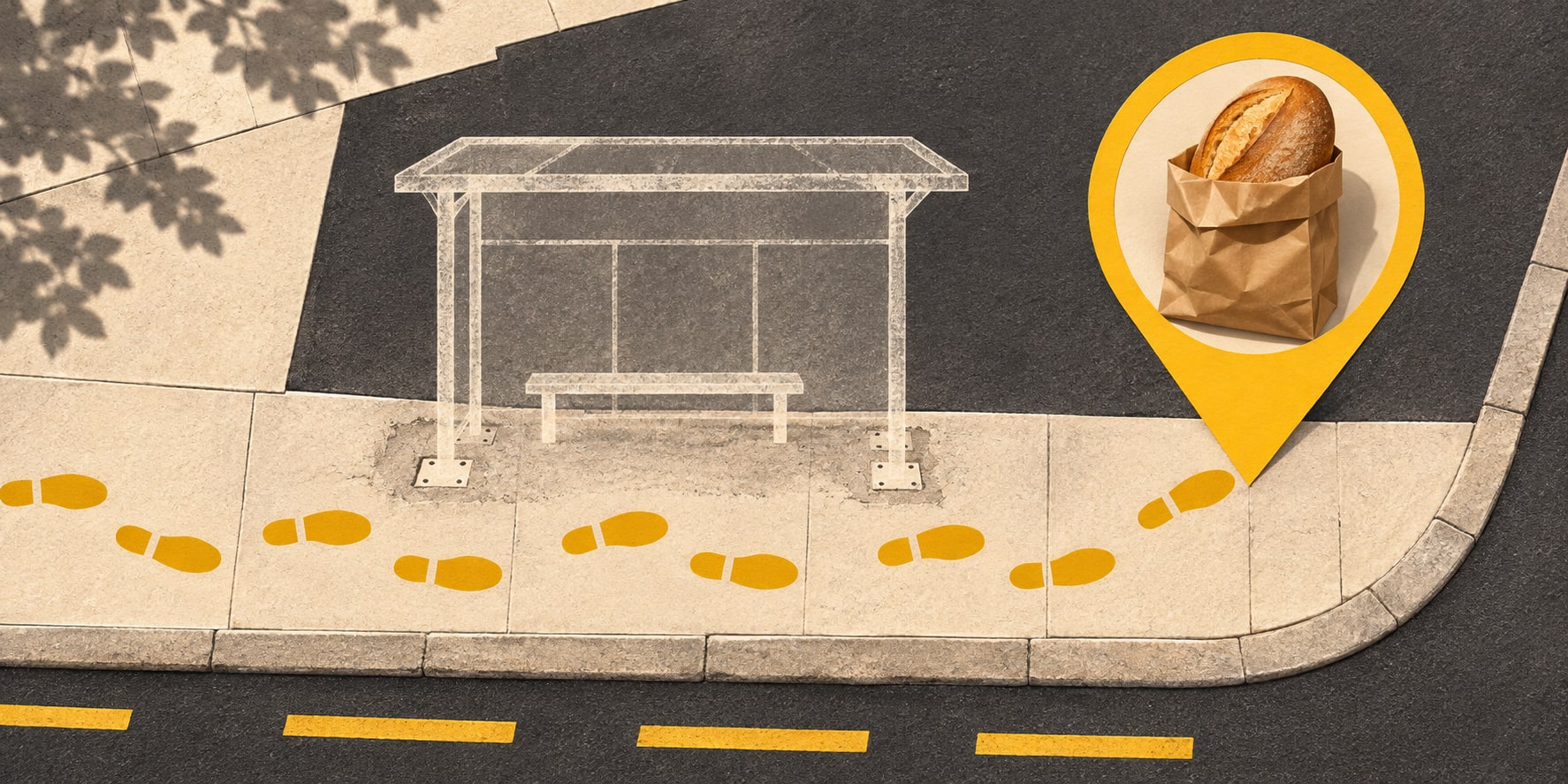
At 19:10 on Thursday, Ayo stood where Wren Street’s old bus stop had been, waiting for its pin to return.
There was no bus stop there. The shelter had been removed years ago, leaving two screw holes in the wall and a clean rectangle in the paint. The city archive showed that the Seven had stopped serving this stretch in 1998. Every Thursday, at the old departure time, the map restored the pin.
Ayo had a bus pass, a badge that said MAP DATA, and a contract ending on Friday. The pin was the last record on his queue marked MUST CLOSE BEFORE LAUNCH. If he cleared it, his review counter would reset. If it returned again, his supervisor would see Ayo’s name beside it for the third time.
Two Thursdays ago, Ayo had moved the pin. It returned at the same time the following week. He deleted it yesterday. Tonight he had come to see whether it would return, punctual as a ghost with a calendar invitation.
An older man came along the road carrying a folded newspaper and a brown paper bag. He set the bag on the wall beside him, then sat on the low concrete lip.
“Does a bus stop here?” Ayo asked.
“It did.”
“Are you waiting for one?”
“I’m waiting for the bread to cool.”
Flour dusted the man’s cuff, and a dark seam of crust showed through the paper where the loaf pressed against it.
Warm, yeasty air escaped from the folded top.
“My daughter closes the shoe shop at half past seven,” the man said. “We walk home on the old Seven.”
“The Seven?”
The man looked at him. “You know it, then.”
“I’ve read the route history.”
“That’s another way of missing it.”
At 19:12, the grey record turned blue. His phone shivered in his hand. The map refreshed without a tap. BUS STOP appeared below the pin. An ETA began counting down from four minutes.
The man glanced down the road. Ayo did too. A woman in pale-blue scrubs came around the corner, following her phone’s map, a yellow folder tucked beneath her arm.
“The Seven stops here?”
Ayo turned his badge around. “It isn’t on the timetable.”
“But it’s on the map. Four minutes.”
The man lifted the paper bag. “We’re waiting for the bread.”
The woman showed them her screen. “I got on the Seven at Wren Street on Monday. I was going to the clinic. I got off near the entrance and walked the last block.”
“The Seven hasn’t stopped on this stretch since ninety-eight,” Ayo said.
“Then I took a bus you don’t have in your archive.”
“Maybe you boarded it somewhere else.”
“Maybe. I had a fever. I know I was on a bus.”
“Is that why you’re here?” she asked.
“I deleted this stop yesterday,” Ayo said. “I came to see why it returns.”
“And you watched it tell me four minutes.”
He had. “Yes.”
At 19:16, the ETA changed to ARRIVING.
No bus came. The woman called the clinic and said she would be late. She listened, looked down at the yellow folder, then ended the call.
“I’m on the evening rota. If I miss handover, I lose the shift.”
The old man unfolded his newspaper and laid it over the bread to keep the top warm. “The Seven still goes,” he said. “The bus stopped.”
The woman gave him a look. “I don’t get paid to walk to work.”
“No,” he said. “You don’t.”
Ayo had come to watch an error. He could file it as a false stop, close the record, and let the counter return to zero. But the error was sending a worker to a blank piece of wall, and the wall had acquired the shape of a queue because he was standing beside it with a badge.
He opened the edit panel. BUS STOP, PLACE OF INTEREST, MEETING POINT, OTHER. He could delete the pin again. That would not stop it returning next Thursday.
The woman took a screenshot of the blue pin. “Will you tell me what this does?”
“I don’t know why it returns. I know the bus isn’t scheduled.”
“Put both in the record. And that the map sent me here.” She held out the yellow folder. The first page was a shift rota, folded at the corners.
The man moved the bag to make room. The woman sat beside him for a moment, not waiting for a bus now, but catching her breath. With her map still open, Ayo selected MEETING POINT and detached the pin from route Seven. He added her report and the empty timetable to the note. The form warned him the record would stay unresolved. His counter would not reset before his contract ended; Friday’s review would show the open item under his name. He submitted it. On her phone, ARRIVING disappeared. The pin stayed.
The woman booked a ride to the clinic. It cost more than the fare. She left when the car arrived and waved once from the window.
At 19:30, the daughter came along Wren Street from the shoe shop. “You’ve brought the wrong paper,” she said.
“It keeps the bread warm.”
“It keeps the crust soft.”
She took the bag anyway. From her pocket she pulled a pat of butter wrapped in paper. Her father tore the loaf in half; she took the smaller piece and set the butter on the warm crumb.
“You remembered it this time,” he said.
“I remember everything you forget.”
“That’s what daughters are for.”
“Then you owe me wages.”
They walked towards the bridge together, eating as they went. Ayo followed a few paces behind. At the next place where a shelter had stood, the daughter stopped. A woman in a white pharmacy coat came from the lane, locked the grille and joined them. Her father waited. Ayo went on a few paces before turning back to wait too. They set off together.
Ayo took the Seven to the station, on foot.



Loading published comments…