
The envelope was already on the mat when Tom came back from the garden. Padded, the cheap kind with paper that tears like pastry, his name written in a slanted hand he didn’t know. The postmark said Tuesday, though today was Sunday. He’d stopped arguing with the postmarks. It was only the rest of the world that was late.
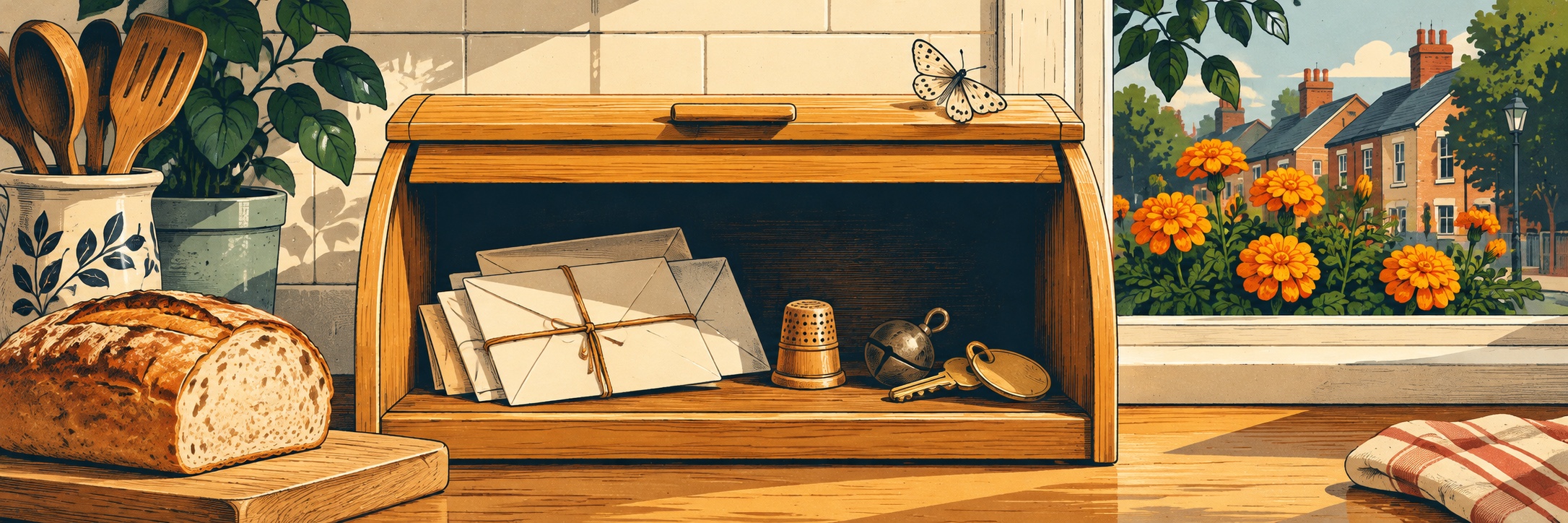
He carried it to the kitchen, set it beside the kettle, and watched a moth worry the lampshade with soft thudding wings. The bread bin—beechwood, a retirement gift from the staff—sat under the window. Inside were eight other envelopes, each with a clipping and a small thing that belonged to someone who had died. Mrs Osei’s hairpin. Patel’s loyalty card from the corner shop, stamped to within one coffee of a free one. A church programme with the date wrong by a day and, in the margin, a shopping list that read pears, good torch, string.
This new envelope felt heavier. He didn’t open them straight away any more. He’d learnt there was a rhythm, and he disliked the way the world bent to it. The kettle began to mutter. The moth clung to the lampshade seam like a brooch. Across the street, Mrs Dwyer watered her marigolds in slippers and a cardigan that had lost two buttons. She had a way of waving with the hose still on so that water arced and fell in polite applause.
When the kettle clicked off, he opened the envelope. Inside: a folded rectangle of newsprint, tomorrow’s date at the top, and a thimble. The thimble was wooden, stained dark, with a notch in its rim where a needle must have worried it for years. The clipping was short.
OBITUARY Dwyer, Maureen (née Blake). Peacefully at home. Beloved neighbour, tireless baker of scones nobody could refuse. Funeral arrangements to follow.
Tom put the thimble on the windowsill. The moth settled next to it as if they were a pair. He stared at the clipping until the print blared. When he looked up, Mrs Dwyer had finished the marigolds and was coiling the hose with both hands.
He went across, empty-handed because hands full look like goodbyes.
‘How are you keeping, Maureen?’ he asked, and hadn’t meant to say her first name. It fell out because the clipping had said it.
‘Oh, on I go,’ she said, cheerful, pink-faced from the watering. ‘And you, Mr Turner?’
‘Tom,’ he said. ‘Please.’
She made tea and cut scones that had perhaps been waiting for a caller, and he nearly told her in three different ways. Be careful tonight. Have you felt unwell? Could I sit in your front room until morning? In the end he asked for her recipe and she laughed and said there wasn’t one, not for something as simple as scones. ‘It’s in the hands,’ she said, holding hers up, flour-soft. ‘In the hands or not at all.’
He walked home with the taste of jam in his mouth and the thimble staring at him through his own window. That night the ambulance came without its siren. The moth battered the lampshade till almost dawn. He put Maureen’s clipping in the bread bin with the others and left her thimble on the windowsill.
Afterwards, he discovered there was no return address to ring, no post office to complain to, only a nonsense printed on the corner of each envelope: Flat 14, The New Mews. The New Mews was a building site two streets down, metal fencing and a banner with a rendering of shining balconies and lifestyle plants. Flat 14 didn’t exist. Not yet.
The next envelope came on a Tuesday that was really Monday, for Mr Rahman from the corner shop, who had been joking with Tom about magazines only that morning.
OBITUARY Rahman, Abdul (Abu). Suddenly. Loved husband, father, uncrowned king of the penny sweets. Family request privacy.
The thing inside was a strip of till paper with the last items he had sold—milk, bread, a lemon ice—totalled neatly and signed at the bottom in a loop Tom had seen on banknotes. It felt like the stub of a life you couldn’t fault for neatness. Tom put the clipping and till paper in the bread bin with the others.
After Mr Rahman died, Tom kept going to the shop. He wanted to stand in front of whatever had taken him, to throw the weight of a retired schoolteacher against it. Rashida was behind the counter, not her father. She moved as if walking inside someone else’s coat. Tom bought milk he didn’t need and couldn’t stop glancing at the door.
‘Have you seen…?’ he said, and then didn’t know how to finish.
‘Seen what, Mr Turner?’
He wanted to say the future. He said, ‘The new flats. The Mews.’
‘They’re very expensive,’ she said, looking at the card reader as if it had become an untrustworthy friend.
When he got home there was a second item in the envelope he’d missed. A small card, typed.
For testimonies, not interventions. Keep the pieces. Keep your notes.
He turned it over. Blank.
He put the card in the bread bin with the others and tried to stop counting Tuesdays. In the afternoons he pruned the rose at the back fence, the one that threw out a red so dark it was almost brown. When he cut a branch wrong and it fell into the soil, he felt he was tidying a stage between acts.
He began to keep notes, as the card had ordered. In a school exercise book with wide blue lines, he wrote names and objects and a sentence, if he could bear it, about each person’s best ordinary thing. Mrs Osei’s habit of tapping the loaf of bread at the market as if listening for a story. Patel’s laugh at a crossword clue whose answer was lime. Dwyer’s way of overfilling the birdbath on purpose so the pigeons could play.
When the envelope came with his name on it, he knew before he turned it over. The hand was the same slanted hand, but it had taken care with his letters, as if to keep them from falling off the paper.
He made the tea, because there had been a kettle on the day this began. He sat at the table and waited for the kettle to click. The moth thumped, then made a small stillness against the shade.
He opened it.
OBITUARY Turner, Thomas William (Tom). Teacher, gardener, note-keeper. Fond of moths, disliked goodbyes. Beloved by people who never said so in time.
The date was next Thursday. Inside the envelope lay two things: the clapper from the old school bell—cold iron, familiar weight—and a key on a label that read Back door (spare) in his own handwriting.
He reached for the phone, and stopped. Who would he tell? What would he say? I’ve been warned by post. He tried to picture Thursday and saw only himself walking the length of the hall with purpose he didn’t yet understand.
The next days became a choreography of caution. He avoided ladders. He refused to climb on chairs to reach the vase above the larder. He treated the garden shears like a pair of small gods. He slept badly and woke exhausted, which is a roundabout way of getting old in one week.
On Wednesday night, wind came up off the river and worried the fences. He sat with the bell clapper beside the kettle and the key in his pocket. He had the peculiar sensation that he was late for something he had already done.
Thursday arrived as plainly as a white plate.
Tom ate toast he could not taste. He put the bell clapper beside the kettle, the spare key in his pocket, and the exercise book under his arm. Then he went out.
At the corner shop, Rashida was stacking tins with both hands, as if stopping them from leaving. Tom bought milk he did not need and a lemon ice he did not want.
‘Can I ask you something about your father?’ he said.
Her face closed first. Then, after a moment, opened by a crack.
‘What sort of something?’
‘An ordinary thing.’
So she told him how Abdul Rahman used to save the bent coins in a mug under the till because he said unlucky money should be kept warm. Tom wrote it down while Rashida watched the pen move. When he had finished, she touched the page with one finger, not quite reading it.
After that he went to Mrs Dwyer’s daughter, who was clearing the house with the curtains half shut, and asked about the scones. There was no recipe, she said. Everyone knew that. Then she cried and told him no one had written down how Maureen knocked the flour from her knuckles against the bowl.
Tom wrote that down too.
By dusk his hand ached. The page for Thomas William Turner remained mostly blank.
He sat at the kitchen table while the moth worried the lampshade seam. The envelope with his obituary lay open beside the bell clapper. Teacher, gardener, note-keeper. Fond of moths, disliked goodbyes. Beloved by people who never said so in time.
For a long while he disliked that last sentence. Then he saw that disliking a thing did not make it untrue.
He took a clean page and wrote:
Thomas Turner drank his tea too strong, grew roses badly, and kept the back door key labelled though no one had asked for it. He knew every child’s handwriting by November. He disliked goodbyes and was often late to hellos.
He paused. The moth tapped the shade once, softly.
Then he added:
He made very good tea when he remembered to pour it.
He used the bell clapper to hold the page flat until the ink dried.
Another envelope lay on the mat. The postmark still said Tuesday. Inside was his own obituary again, with the same Thursday date. OBITUARY had been crossed through; above it, someone had typed TESTIMONY.
Tom sat down before his knees could make a speech of it.
Afterwards he addressed a padded envelope to Flat 14, The New Mews. Into it he emptied the bread bin: the envelopes, clippings, small things and typed card. Mrs Osei’s hairpin, Patel’s loyalty card, the church programme, Rahman’s strip of till paper and the other keepsakes went in with them. He fetched Maureen’s thimble from the windowsill and added it with his exercise book, open to the verbs he had written for her scones. He set the new TESTIMONY clipping on top of the page he had written for himself. Last, he lifted the bell clapper, weighed it for a moment and put it in too.
The spare key remained in his palm.
He sealed the envelope and put it in the bread bin. The moth came down from the lampshade and rested on the lid.
In the morning, the envelope was gone.
Tom stood in the kitchen with both hands on the counter. Outside, Mrs Dwyer’s marigolds leaned over the path, still loud with colour. The corner shop sign buzzed itself awake. Somewhere, a child dragged a stick along railings and made a poor, bright music of it.
He opened the bread bin.
Empty.
For a moment the emptiness frightened him by habit. Then he hung the spare key back on its nail by the door, label facing out. The kettle began its little mutter behind him. Tom took his coat from the peg and went out to buy a loaf. When he came home, he put it in the bread bin.
No published comments yet.