
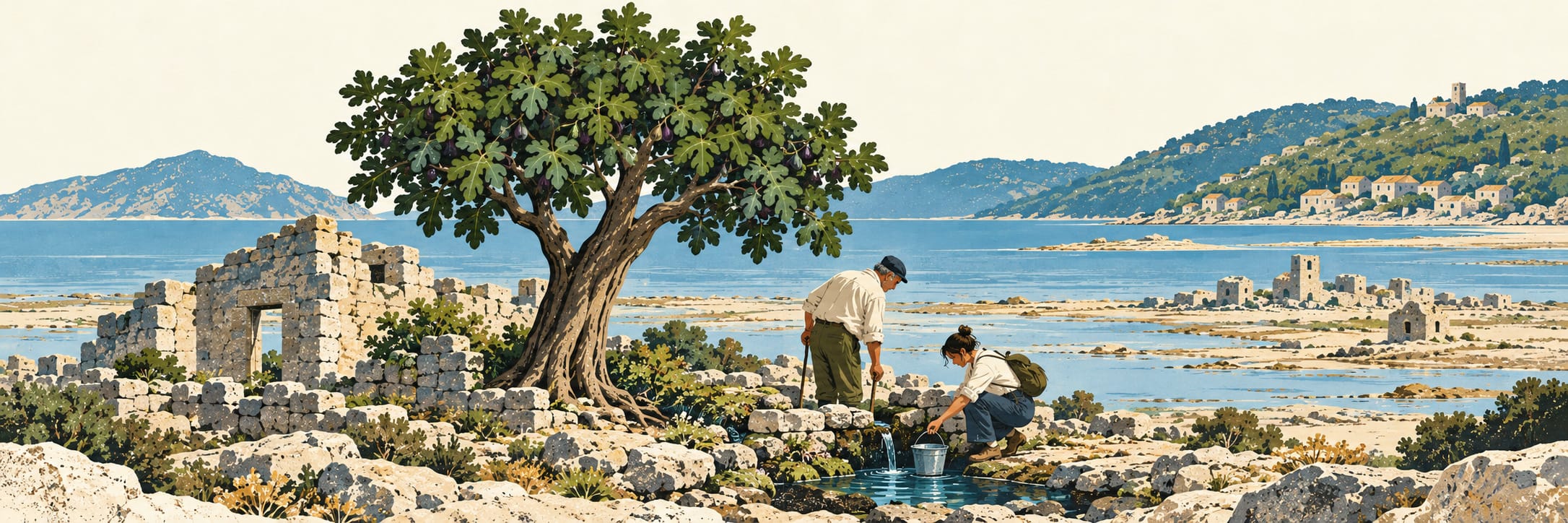
On the morning Gannet Island stopped turning, Olan gave Sela directions to the spring three times and changed them twice.
“Under the fig,” he said first.
“The large one or the bent one?”
“The one by the house.”
“That’s the large one.”
“Then the large one.”
They had been walking for ten minutes. The village had been under the sea for forty years; doors were swollen shut, and salt had drawn pale seams across the stone. Sela’s father had left it at six. He remembered the fig, the house and the spring as if they had all stood close enough to touch.
Gannet did not spin like a wheel. Its long flanks rose and sank, one after the other, over forty years. The ridge along its back stayed above water. Families moved there when their shore went under, then came down again when the island turned. This morning the old village had emerged below the ridge, its lanes and roofs exposed in the low, white light. Sela could see their present home high above it, small against the ridge’s dark spine.
She had brought a bucket, a spade and her salt worker’s sample tin. The cisterns on the ridge would last several days. She wanted to know whether the old spring still ran before anyone carried a bed or cooking pot down the slope. She also wanted to see whether the east pans had kept their walls. If they were sound, she might bring some of her work down from the ridge. She had not told Olan that; he had spoken all morning as if they had come for the house.
“Your grandmother kept the blue cups on the kitchen shelf,” he said. “The light used to reach them at breakfast.”
“Did she keep them there all year?”
“Where else would she keep cups?”
“On the ridge, we keep ours in a box. The gulls have learned the cupboards.”
He smiled at that, then looked down towards the house. “We could carry the bedding first. The roof may have held.”
Sela stopped. “We haven’t decided to move down.”
“We came to find the spring.”
“I came to find out whether it runs.” She set the tin on the wall and wiped a seam of white salt from its lid. “That’s not the same as deciding where we live.”
He studied the village as if it might answer for him. From the ridge it had been a place in his stories: his mother at the shelf, the fig making shade, the short walk for water. Down here its lanes broke around piles of fallen stone. Sela could see the old house’s roofline, but not its door.
“No,” he said. “It isn’t.” Then he pointed towards the fig. “The spring was below that.”
“You said under it.”
“Below it is under it.”
“Unless you’re standing on the other side.”
He had no answer ready. Sela turned towards the tree. The old pans ran up slopes she had never had to read.
The fig stood beyond the house, its trunk split into two grey arms. One leaned over the roof. The other entered the ground beneath the fallen lintel. Salt had roughened the bark, but a strip of green showed where the branches met. Olan went to the door. It had swollen inside its frame. He worked at it with the flat of the spade while Sela crouched by the tree.
The soil looked dark. That did not make it fresh. The village had been under the sea for forty years; water could be held in a crack long after the tide had left. Sela cleared a narrow channel through the grit. Water gathered at the root side, then crept away from the house into the space she had opened. She held the tin beneath the trickle until a few drops collected, then touched one to her tongue. Salt. The taste could have come from water trapped in the old ground; she needed to follow the trickle to its source.
Olan glanced towards the kitchen opening. “My mother never used a tin.”
“Your mother was not checking whether a whole village could move down.”
The sentence came out sharper than she meant it. Olan went quiet. He pressed his shoulder to the door until its swollen edge cracked away from the stone. Sela watched him lift the loose piece and set it gently by the wall, as if the door might still be needed.
Inside, the kitchen had shrunk to a strip of floor between the shelf and the fallen roof. Olan stood beneath the shelf. For a moment he seemed to measure it against the height he remembered.
“It was a big room,” he said.
“You were six.”
“I was six every time I drank from the spring.”
She looked at him. It was the same answer he had given on the ridge; she had laughed then. Under the low roof, she saw how the room had fitted a child: three steps from shelf to door.
Sela traced the damp line beneath the shelf. It passed under a mat of grit towards the fig, but the stones had shifted. At a narrow gap, it disappeared beneath a slab.
“There,” Olan said. “Under the fig.”
She followed the wet trace outside, where it spread under the split root. The little channel she had cleared was filling again from the house side. She set a dry grass stem in the thread of water and watched it move away from the house.
“It’s running out from the roots,” she said. “Not just sitting here.”
“The spring.”
“A source, at least. I can’t promise how much.”
Olan gave the fig a careful look. “The water came out by the roots. I carried a cup from here to the shelf.”
“You sent me to where it came out.”
“Where else should I send you?”
“Where it starts. You’ve sent me in circles.”
“I’ve been sending you in a direction.”
She followed the wet seam back indoors. It narrowed at the shelf and vanished beneath a flat stone set into the floor. The floor around it had sunk, leaving the cover flush with the packed earth. The spade could not get under its edge.
Olan knelt. “Here, then. My mother lifted this when the spring slowed. With a spoon. She fitted it into a nick on the room side.”
“You remember that?”
“I watched her do it.” He tapped the stone once, moved his hand, and tapped again. The second sound was lower.
“There,” he said. “That’s how it sounded.”
Sela ran a finger beneath the salt. A shallow nick caught her nail. She could not see its shape, but she could feel where the spoon had lifted the stone over and over. Her father had found the place with his hands, not his directions.
“Hold the shelf side,” she said. “I’ll take the notch.”
They braced the spade and leaned together. The stone shifted a fraction. Olan started to push harder.
“Wait,” Sela said. The floor beside the shelf was softening. “If it drops, we’ll lose the edge.”
“Then what?”
“We lift it evenly.”
She moved around the stone and gave him the handle. Together they raised it. Water welled into the gap, cloudy at first, then clear. It tapped once against the shelf.
Olan did not drink. He watched it run across the stone and pool in the shallow place where a cup might have stood. Sela filled the tin and waited. A faint mineral taste touched her tongue, no salt. She filled the bucket only halfway.
“That’s enough to test,” she said. “It may run low by morning.”
“The cisterns will hold.”
“For several days. I want to check it again before we carry anything down.”
He nodded, and the house’s low roof seemed to press closer around them. “I thought finding the spring would settle it.”
“It settles whether there’s water.”
“And the house?”
Sela set the tin beside the bucket. “I don’t know yet. My work is on the ridge. The east pans might still be usable down here, but I haven’t seen them. And this room—” She looked at the shelf, the broken door propped by the wall, the part of the floor where water had risen. “I need to see the place as it is.”
He rubbed the salt from his palm. “I remember my mother’s cups.”
“I know.”
“Not the room, then.”
“The room too. But it can’t be only the room you remember.”
He turned back towards the shelf. “No.”
The water kept tapping. Sela lowered the flat stone into place, leaving the lid seated but not wedged shut. Olan reached for the bucket. She took the other side.
At the first fork, the path divided around a row of fallen walls. Olan stopped and studied the lanes. Sela waited, the bucket between them.
“Which way reaches the east pans?” he asked.
She pointed to the lower path. “That way. We can look tomorrow, if the water holds.”
He took the handle beside hers. They carried the water up the ridge. It moved against the bucket’s side with each step.


No published comments yet.