

Predicting the next prime sounds like a natural place for a clever mathematical score. Give each candidate a measure of how promising it looks, rank the candidates, and see whether the winner is the prime you wanted.
But a score can be mathematically interesting and still be aimed at the wrong part of the problem. In two separate tests, I compared prime-ranking ideas with rules drawn from a small divisibility sieve. In one, the wheel-order baseline returned the first five integers coprime to 210 from an eight-candidate pool. In the other, a BFT first-event proposal matched the sieve’s first survivor at every origin. The sieve filters multiples of 2, 3, 5 and 7; its survivors can still be composite.
That is not a verdict on prime prediction in general. It is a reminder to make a method beat the simplest rule that already answers the same question.
A score built for pairs was asked to find the next prime
The first test asked whether a variable factor from the two-prime Hardy–Littlewood singular series could rank a shortlist of possible next primes. The test used the first eight integers greater than each prime origin that were coprime to 210, then returned five candidates. The comparison methods used the same candidate pool and the same five-output budget.
Across one fixed block of 10,000 consecutive prime origins, singular-series ranking included the immediate successor in 5,579 shortlists, or 55.79%. Taking the five candidates in ascending wheel order succeeded 8,400 times, or 84.00%. A fixed rounded-log-density ranking landed between them at 79.73%.
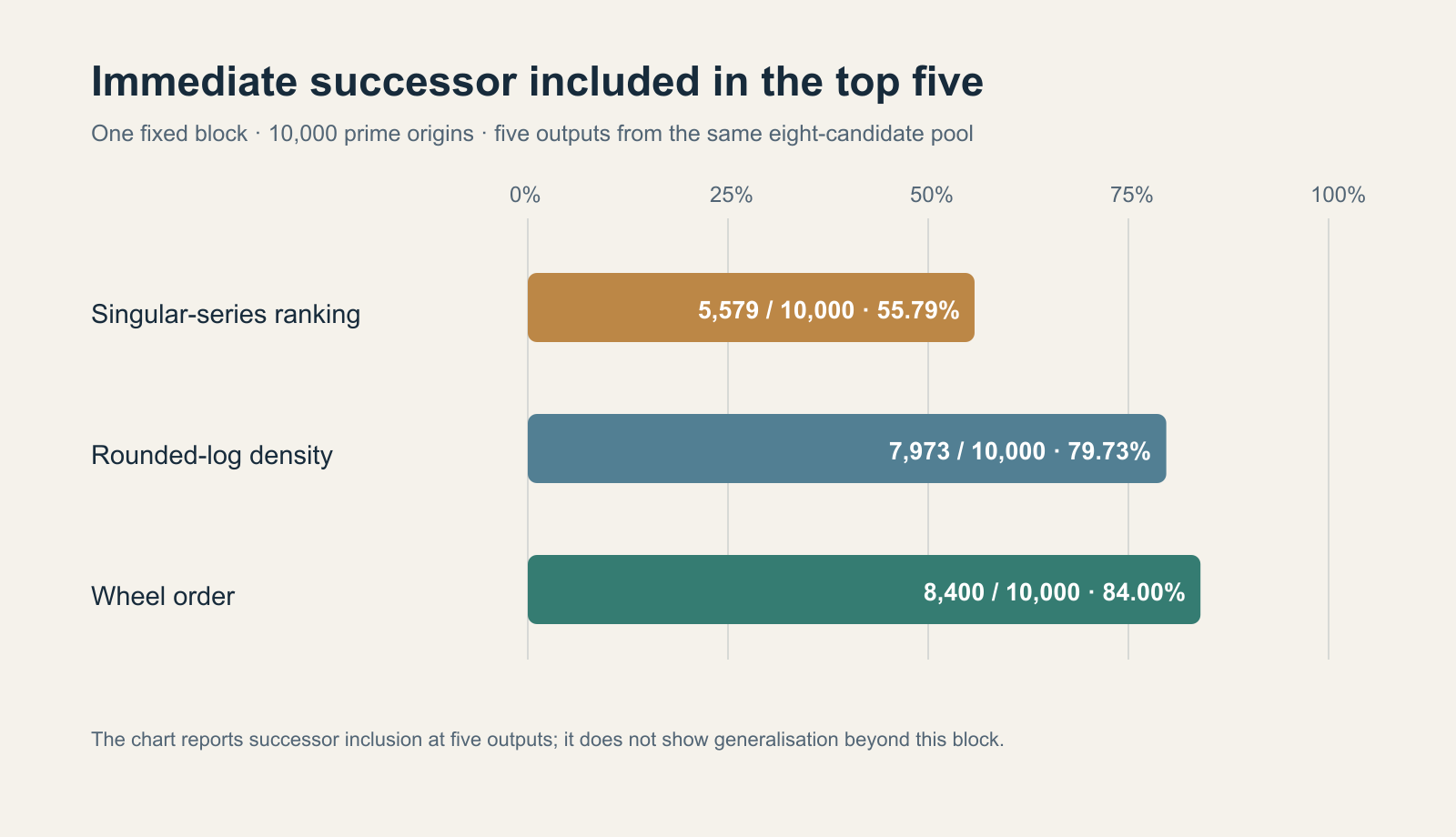
The result is not subtle: for this block, this candidate pool and this output budget, the singular-series rule was a worse way to retrieve the immediate next prime than simply starting at the front of the list.
The question is easier to see once it is stated precisely. The pair singular series describes average translated prime-pair structure. The immediate-successor task asks for the first prime after an origin, which also depends on the absence of any earlier prime in the gap. A statistic relevant to pairs does not automatically rank first successors well. That distinction identifies something the score does not encode directly; this experiment did not isolate it as the cause of the lower hit rate. The test covered one fixed translation from one mathematical quantity to one retrieval task, not every singular-series method or every prime interval.
There was also a built-in limit to the shortlist. In 495 of the 10,000 cases, the actual successor fell outside the eight-number candidate pool. Those remained misses for every method. That is useful context: the test compared rankings within a deliberately bounded pool, not unrestricted predictions over all integers.
A second proposal turned out to be the sieve rule
The other experiment began from a proposal derived from the Banks–Ford–Tao model for large prime gaps. On a separate fixed frame of 3,111 prime origins, the BFT first-event proposal selected exactly the same integer as the first survivor of the modulus-210 sieve at every origin.
Both rules hit the exact next prime 807 times, or 25.94%. The BFT proposal did not beat the simple sieve on this frame; it reproduced it. Two median-gap comparators had fewer exact hits than the sieve, but lower mean absolute distance to the next prime. Even within one frame, the answer changes with the measure: exact retrieval and distance are different goals.
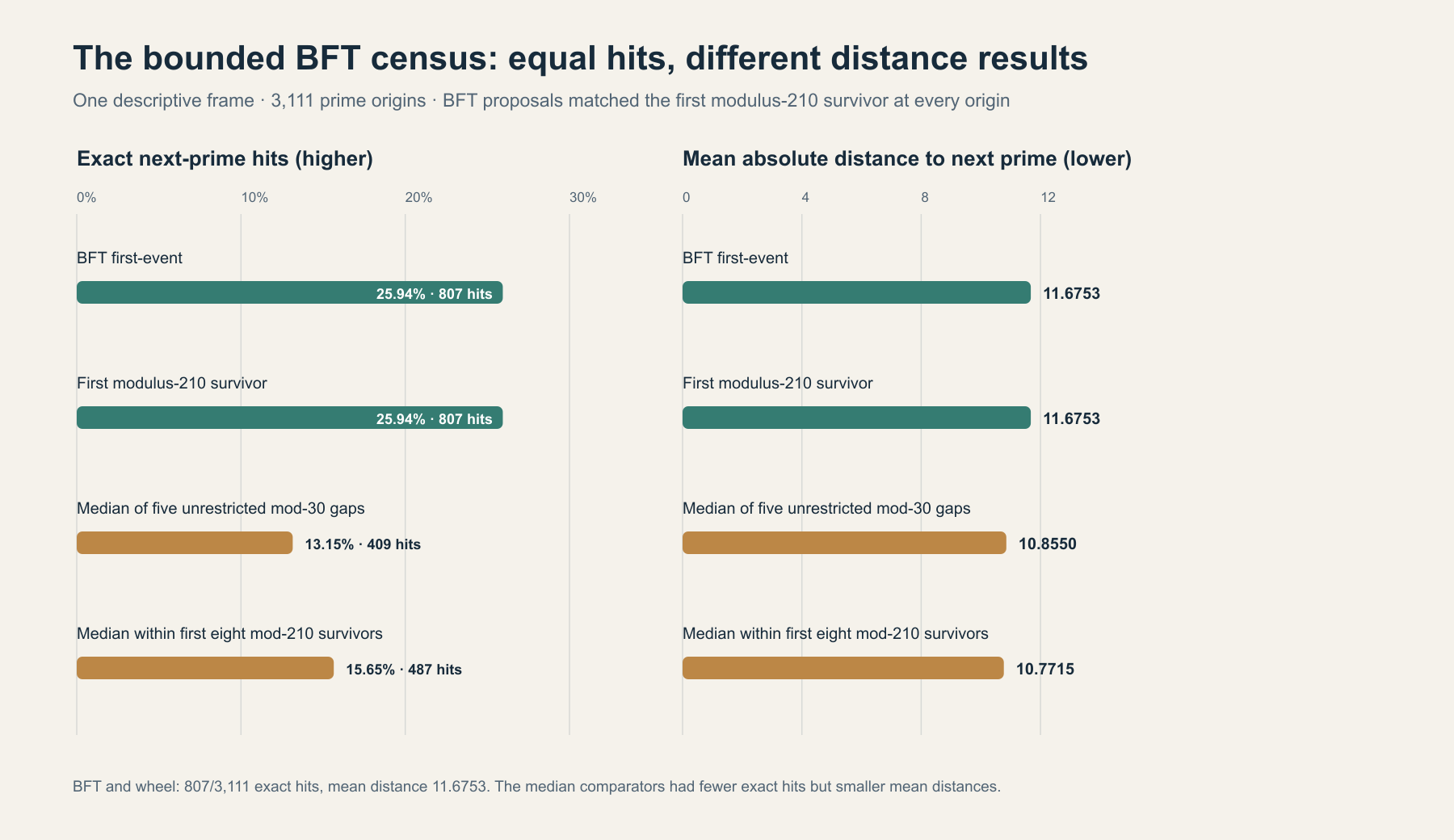
This run was descriptive rather than untouched prospective validation. Some origin-prime labels became visible before the run ended. The report says they were not used to tune or stop it, but that exposure still limits what the result can establish. The verifier also did not independently reconstruct the complete BFT probability law at every origin.
These figures come from a different experiment, range and proposal than the singular-series screen. They should not be pooled or presented as one head-to-head benchmark. Their connection is methodological: both tests asked whether a more involved rule added something over a straightforward baseline.
The baseline is part of the question
A baseline is sometimes treated as an administrative detail: include a simple comparison, then move on to the interesting method. Here it was the most revealing part. In the first test, it showed that the pair-oriented score retrieved fewer immediate successors than either reference ranking on this block. The experiment did not isolate why. In the second, it showed that a proposed model-based rule selected the first sieve survivor on every origin tested.
That still leaves interesting mathematics to do. A failed shortlist does not show that the underlying conjecture is false. Equality with a simple rule in one finite frame does not show that the two procedures will always agree. And no single block settles how well either method generalises elsewhere.
What the tests do establish is narrower and more useful than a grand claim: on the declared finite frames, with the stated rules and measures, the simple baseline matched or outperformed the proposed rankings. The next question is not whether a sophisticated idea sounds promising. It is what distinct result it produces, against a comparator that would make that difference visible.
The Ledger records the methods, outputs and limits for both experiments: the singular-series shortlist and the BFT first-event census.
A useful question for any new score is simple: what does the simplest credible rule already do, and does the new score change the answer in a way that matters?
AI-use note: AI assisted with drafting and editorial development from the Research Artifact Ledger records cited above. The cover is an AI-generated conceptual illustration, not a depiction of experimental data. The inline figures were rendered from the aggregate values in the cited Ledger artifacts.



No published comments yet.