
The storm had tugged the timetables loose like teeth. Niamh went shelter to shelter with laminates and tape that wouldn’t hold on wet glass. Leaves plastered to adverts; the council’s smiling cyclist wore a mulched moustache.
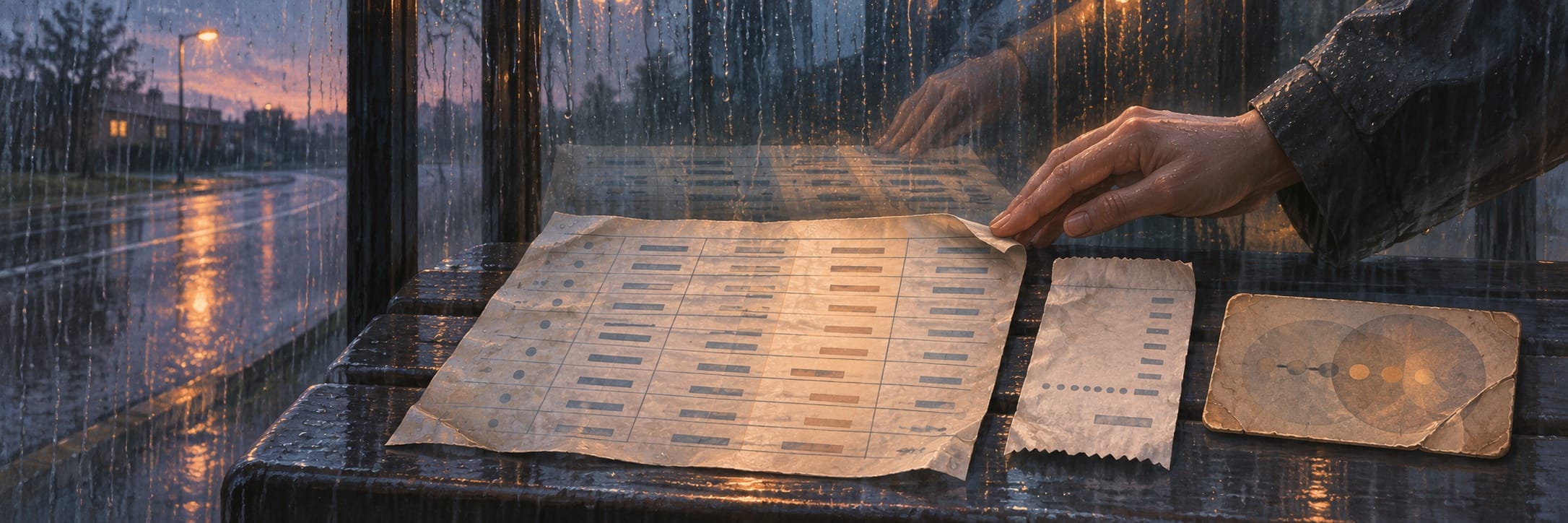
K7 was the last. The plastic case hung open, screws pooled in the tray like buttons. Inside: a page she hadn’t printed. The header was right—Route 34 via Moorbank—but the column read Thursday in small grey type. Today was Wednesday. She rubbed a finger over 17:45. It didn’t smear.
The office printer had declared everything CURRENT that morning. She should have binned the page. She slid it into her jacket instead and taped a plain replacement. Tape squealed. A bus nosed past; the shelter rattled; her reflection trembled.
At home, the key bowl held receipts and hair ties. A slip lay on the doormat—co-op font, total 0.00, timestamp 17:45. No name; she didn’t remember popping in. She set the K7 sheet beside it. The numbers touched, as if attracted: 17:45 against 17:45. She laughed. It didn’t fit the hall. The receipt’s last digit looked paler where the ink had kissed the timetable—barely a scuff, a nothing she wouldn’t notice until later.
She brewed tea and let it stew. Tomorrow, 17:45. The clinic had shoved her mum’s appointment twice; the transport taxi only held a slot if they confirmed by noon; the pharmacy shut for lunch at twelve sharp. If—ridiculous—if the page was true, it might tell her what else could be changed.
Service Notice — Temporary Diversions (K District) Due to continuing works, services may be redirected at short notice. For updates call ext. 2281 (service discontinued). — Transport Team
She pinched the notice from the depot corkboard next morning and pocketed it, superstition thin as paper. K7 smelled of damp paper and chip-shop vinegar.
At 17:39 on Thursday, a man with a shaved head and the scuffed smart shoes of an office ghost stood a metre from the shelter’s lip, like a starting block. He turned a cracked payphone card in his thumb.
‘You waiting for the thirty-four?’ Niamh asked.
He nodded.
At 17:44 the bus came. Right number, wrong driver—a kid with a fixed smile. The route display flickered, catching on the second digit. The air from the doors had that dry, canned smell of a hall corridor. Her stomach tilted. A woman took two quick steps and boarded. The man reached after her, but the doors hissed shut. His payphone card skated from his pocket. Niamh reached for it; in that reach, she didn’t board. The bus sighed away. The plastic was warm in her palm.
Back at the depot, she fed the card into the old audit reader. The machine snorted and printed a dot-matrix stub. It looked like a number until the spacing turned into street IDs—her patch, K district. She laid the stub beside the K7 sheet and the zero-total receipt. Running a finger down the columns, she felt the tug of pattern.
At lunch the following day, she asked Kal at the co-op for a dummy purchase. He rang it in training mode; she said nothing. At K7 she taped the fresh zero-total inside the case, next to the grid. When she stepped back, a minute hopped in the column. 17:45 became 17:46, then settled. Heat rose in her cheeks. She nudged it back; it obeyed. Adjacency: no grand edits, only shoves. At 17:45, the printed time, the bus came again. A woman climbed aboard; the man stayed by the post. Niamh watched the bus pull away.
Her phone buzzed that evening. ‘Mum’s clinic moved again,’ her sister said. ‘They need a confirmation by noon or the transport slot goes. Can you swing by tomorrow? And we have to pick up the new meds before they shut at twelve.’
‘Yes,’ she said, fingers tacky with tape. ‘I’ll make it work.’
After they hung up, Niamh went back to K7. She pushed 10:38 towards 10:47 from the High Road so she could get Mum and the pharmacy done before noon.
The storm returned meaner. Paper went limp; the depot printer jammed into a tiny accordion. Chambers, her supervisor, eyed the K7 reprints. ‘Why the strike-outs?’
‘Bad batch.’ Tin on her tongue.
By Saturday, the grid at K7 showed handling wear. A new blank sat where 14:05 had been; the row stuttered and then went empty, like the route had bitten itself. A pale scuff ghosted the corner digits. Cost, then. She’d felt it already and not wanted to know.
The shaved-head man was there, damp to the bone, eyes on his still phone. He held out a fan of zero-total receipts: all 17:45. ‘She got on yesterday,’ he said. ‘Said she’d be early for once. Then nothing. I thought maybe I’d broken it.’
‘I did,’ Niamh said. ‘For me. I’ll put it back.’
‘But your—’
‘It can wait.’
She peeled off her edits. The paper fought. Rain stitched the gap with fine threads. She laid the old timetable, co-op slips, and the printed stub on the bench like a ledger and matched edges to numbers, careful as a child. One by one she untaped, smoothed, retaped. The blank held. In the plexi, her face doubled, rain striping both.
The man’s phone buzzed. He startled; the receipts went everywhere. He answered with both hands. Relief folded him. ‘She’s at her mum’s. Battery died. She’s—she’s fine.’
Niamh looked back at the grid. 14:05 had returned—no fanfare, just there—as if a shelf she’d misremembered empty had always been in place. She let out a breath she’d been hoarding.
She took the clipped Service Notice and wrote on the back, biro snagging.
For anyone trying to be early If you need it, wait. If you don’t, let it go. Text when you arrive. — N.
She tucked it behind the laminate where you’d see it if you were looking for more than a number. She set the payphone card on the sill; the plexi held a small, human warmth where it touched, then let it go.
She cut across the estate towards her sister’s, rain in her collar, late for a thing she could explain. Gulls shouted over the precinct roofs. A receipt, wet and glistening, stuck to her boot for five steps, then slid to the kerb and went with the water into the drain, turning until the digits blurred to a pale ribbon and slipped out of sight.


Loading published comments…