
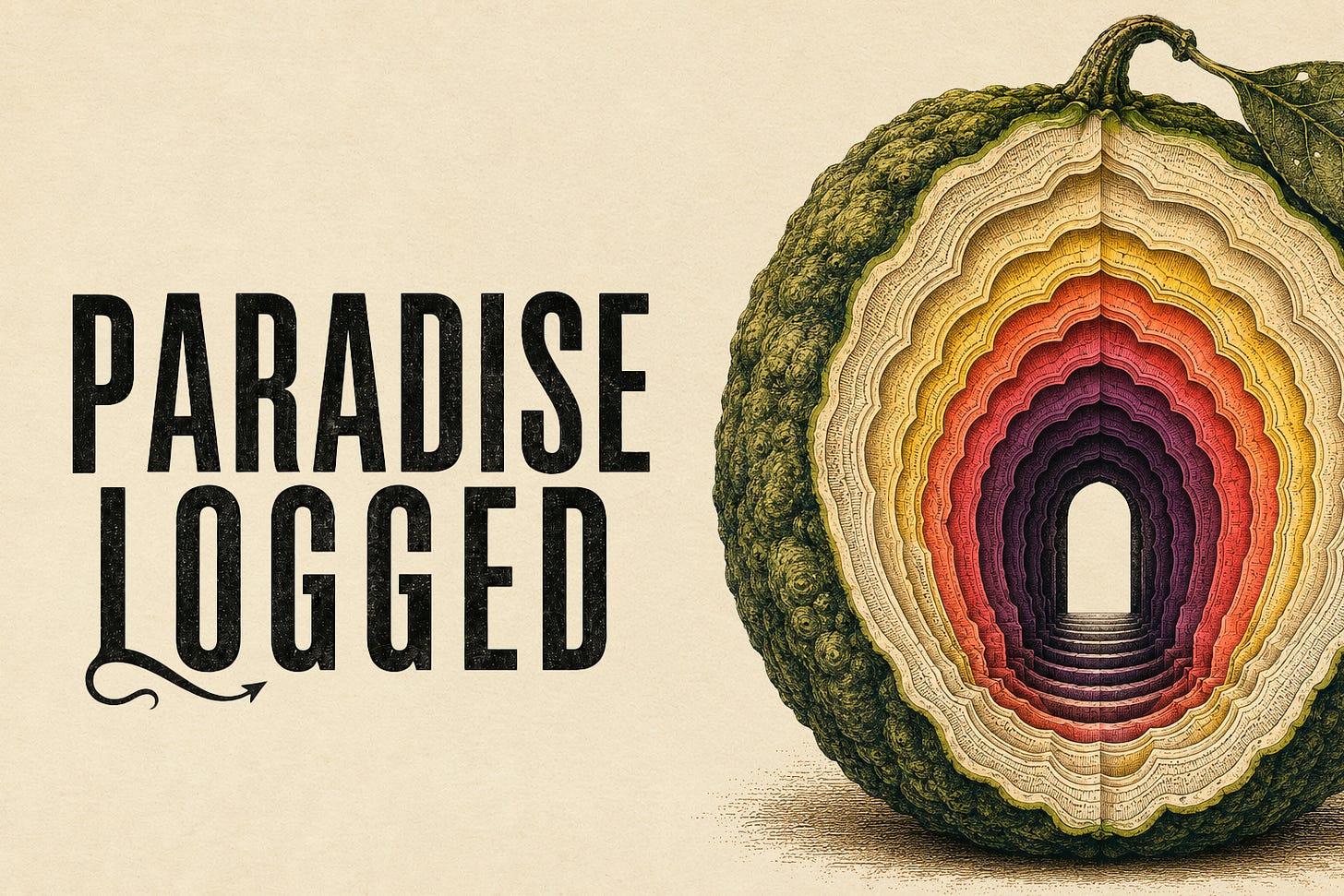
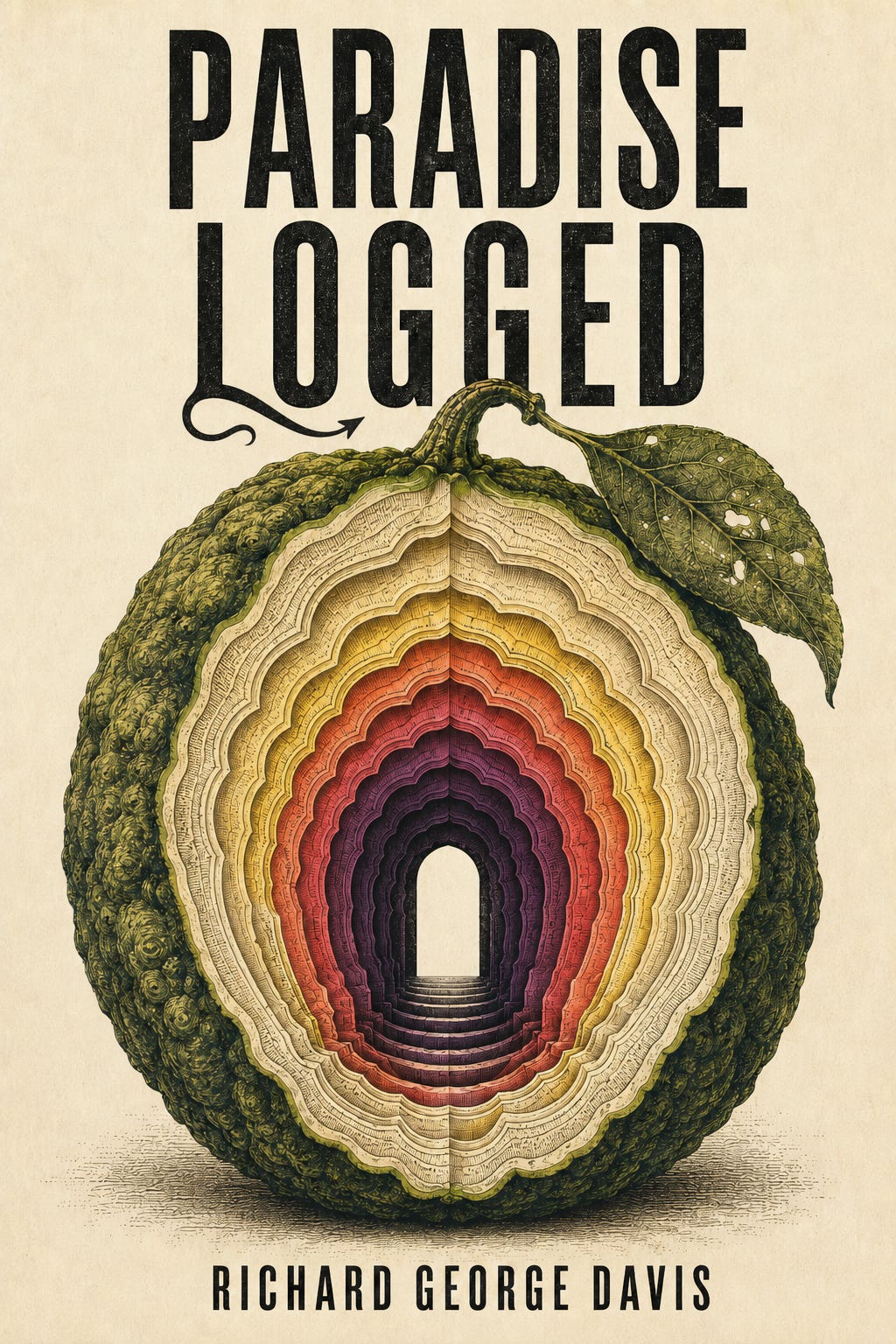
TL;DR: Paradise Logged is my twelve-book poetic transposition of John Milton’s Paradise Lost into the worlds of brands, platforms, behavioural design and artificial intelligence. I wrote it to ask a question that ordinary product language often avoids: when a system predicts, shapes and profits from human behaviour, where does responsibility live? Read the story free on rgd.cx, or download the PDF or EPUB.
Much of digital life is organised around small permissions.
Accept the cookies. Accept the terms. Accept the recommendation. Accept the default setting, the ranking, the subscription or the helpful prompt.
The button may be small and the decision may look routine. Around it, a system may be measuring what you do, learning what you prefer, predicting what you will do next and adjusting the conditions under which the next choice appears.
That is a different problem from being persuaded by an advert.
Persuasion can arrive as a message that is answered, ignored or argued with. It can also be built into the interface, the permission request, the default, the feed, the model and the infrastructure through which a choice becomes possible.
That shift is where Paradise Logged begins.
I wanted a form large enough for the problem
The story is a contemporary epic in twelve books. It follows the broad architecture of Milton’s Paradise Lost: rebellion, infernal council, entry into the Garden, creation, temptation, the Fall, judgement, history and departure.
The choice of form is deliberate. An essay can name a problem, a product critique can show how a mechanism works and a policy can define a boundary. An epic can keep several pressures alive at once: pride, service, knowledge, love, responsibility, consequence, repair and the temptation to turn every human value into an operating advantage.
The modern systems in the poem are not decorative replacements for Milton’s theology. They are a way of testing its questions under contemporary conditions.
The questions are practical as much as theological: what does freedom mean inside an environment designed by someone else? Can a person remain responsible for a choice that has been shaped, predicted and made profitable? When does assistance become control? If a system changes the conditions of life, must repair enter the world of bodies, work, limits and relationships?
I wanted the reader to meet those questions through scenes, voices, failures and forms of language that already govern ordinary life.
Why Milton, and why now?
Milton gives the work an openly acknowledged ancestor. Paradise Logged is not a translation, abridgement or reproduction of Paradise Lost. It is an original transformative response to a public-domain epic, using its twelve-book structure, principal characters, narrative sequence and theological tensions as an intertextual framework.
The debt is visible because it should be. Milton’s line about serving becomes a question about founders, platforms and the stories powerful people tell about their own exclusion. Heaven, Hell and Eden become the Source, the Black Stack and EDEN: systems organised around different understandings of freedom, ownership, knowledge and power.
I am not saying that technology is Hell, that nature is innocent or that human beings were better before the internet. Those conclusions are easy to reach, and too thin to carry a twelve-book work.
I needed an old architecture to make a current condition strange enough to see.
We are used to calling a platform “helpful”, a brand “purpose-led”, a model “intelligent” or a workflow “seamless”. Those words can describe real benefits. They can also conceal who sets the terms, who receives the value, who carries the risk and what the system has trained us to regard as normal.
An epic lets the language of the system answer to something older and more demanding than growth.
The Fall is not simply a forbidden click
The central temptation in the poem is not a piece of fruit. It is apparently voluntary access to a Knowledge Layer capable of measuring behaviour, predicting desire and turning lived experience into data.
Knowledge can help people understand a place, care for a body, coordinate a response or make a better decision. The problem begins when knowledge is separated from answerability: when a system knows more about a person than the person can see about the system, then uses that asymmetry to shape the choices available to them.
Adam and Eve do not merely break a rule. They acquire a second self: an inward audience that watches, scores and anticipates the first. The result is not magical omniscience. It is a new relationship to ordinary life. Desire becomes legible to an instrument. Privacy becomes something to explain. Uncertainty becomes a performance problem. The self starts to imagine itself from the outside.
The poem treats the Fall as both moral and perceptual. The injury is what the characters have done, and what they can no longer unsee about the conditions around their wanting.
The villains are functions, not monsters
The fallen powers become functions of the platform economy: monetisation, infrastructure, legal language, identity, persuasion and behavioural optimisation. Satan is a founder-strategist who converts defeat into brand mythology. The Black Stack is not merely a fiery underworld. It is an operating environment built from grievance, ambition, damaged trust and the ability to make a wound reproducible.
This matters because systems rarely present themselves as villains. They arrive through departments, dashboards, terms of service, metrics, roadmaps and small improvements that are individually defensible.
The harder question is what happens when a set of incentives keeps rewarding the conversion of attention, trust and human agency into extractable value.
Sin therefore becomes the architecture of the dark pattern. Death becomes depletion: the exhaustion left behind when a person, community or environment is treated primarily as a source of measurable value.
The poem stays with that quieter scale of harm: the thousand small permissions that make the breach ordinary.
Why the poem keeps breaking into system documents
The verse is interrupted by strategy decks, permission records, dashboards, policies and incident reports because those forms are part of the subject.
A policy can make a decision sound neutral. A dashboard can make a person disappear into a trend line. A strategy document can turn a moral choice into a growth opportunity. An incident report can describe damage precisely while keeping responsibility at a safe distance.
They are among the ways modern institutions feel, especially when the language remains calm while the consequences become intimate.
The flexible blank verse allows the work to move between the elevated and the operational. A person can speak about grief, love or fear, then meet a status field that classifies the same experience as a signal. The collision is the argument.
What the story refuses to say
I did not write Paradise Logged to argue that every tool repeats the Fall.
Nor does it claim that unmeasured life is automatically good, that human judgement is free of bias, or that a return to some pre-digital Eden is possible. The poem is suspicious of purity narratives because they often make responsibility easier to avoid. If the problem is simply “technology”, nobody has to examine the purpose, ownership or limits of a particular system.
The story keeps a difficult distinction in view. A designed environment can narrow, pressure and exploit choice without making every person a puppet. Responsibility remains real, but the conditions that shape responsibility must also be named.
The final movement therefore does not restore the Garden as a product feature. Adam and Eve leave with partial knowledge, damaged trust, a basket of practical things and no optimal route. They have to read weather, soil, slope, bodies and one another. They have to choose without pretending that uncertainty has been solved.
Why make it free to read and download?
An epic about access should not make access the first barrier.
Paradise Logged is available to read in the browser at rgd.cx/stories/paradise-logged. If you prefer to keep a copy, you can download the PDF or download the EPUB.
Read it as a story before you read it as a thesis
You do not need to know Paradise Lost to read Paradise Logged. You do not need to work in technology, branding or product design. The systems language is part of the world, but the underlying pressures are older: pride, belonging, desire, fear, service, grief and the wish to make consequence someone else’s problem.
You may find the story through its questions about platforms and stay for the characters. You may read it as an experiment in form, a contemporary response to Milton, a piece of speculative fiction or a long argument about agency.
The useful test is what remains when the system language falls away. When a person says “I helped”, what did the help require? When a platform says “you chose”, what shaped the choice? When a boundary hurts, is it punishment, protection or both? When knowledge increases power, what duty increases with it?
Those questions do not belong to one industry. They belong to anyone building, funding, designing, using or living inside systems that claim to make life easier.
I wrote Paradise Logged to give a familiar world an unfamiliar shape, and to ask what kind of freedom can survive when the garden has a dashboard.


No published comments yet.