

TL;DR: Follower count still looks impressive in a report, but it is no longer a reliable proxy for trust, reach quality, or commercial momentum. In 2026, the stronger strategy is to measure relevance through signals like saves, shares, replies, qualified clicks, repeat attention, and what people actually do next.
The metric that stopped meaning what you think
A big follower count used to mean something simple: more people followed you, so more people saw you, so more people cared. That logic is broken now. The number still looks good in a screenshot, and it still flatters the ego in a report, but it tells less and less of the truth. Too many teams are still building strategy around a ghost.
The scene
You are in a reporting meeting.
Someone shares the social dashboard. The top-line number looks decent. Followers are up. Reach is acceptable. One or two posts performed well enough to keep the room relaxed.
Then the mood shifts.
The saves are thin. Shares are weak. Replies are polite but shallow. Clicks are there, but they are not leading to much. The content is visible, yet strangely weightless.
Nobody says it immediately, because it is awkward.
But eventually the real question creeps in: if the audience is growing, why does the work feel less effective?
That is the trap. Teams are still using an old measurement model inside a platform environment that has already changed its rules.
The thing people get wrong
The mistake is not caring about growth.
The mistake is treating follower growth as the clearest sign of relevance.
That made sense when platforms behaved more like networks you consciously built. You followed people. Their posts appeared. Audience growth more or less improved distribution.
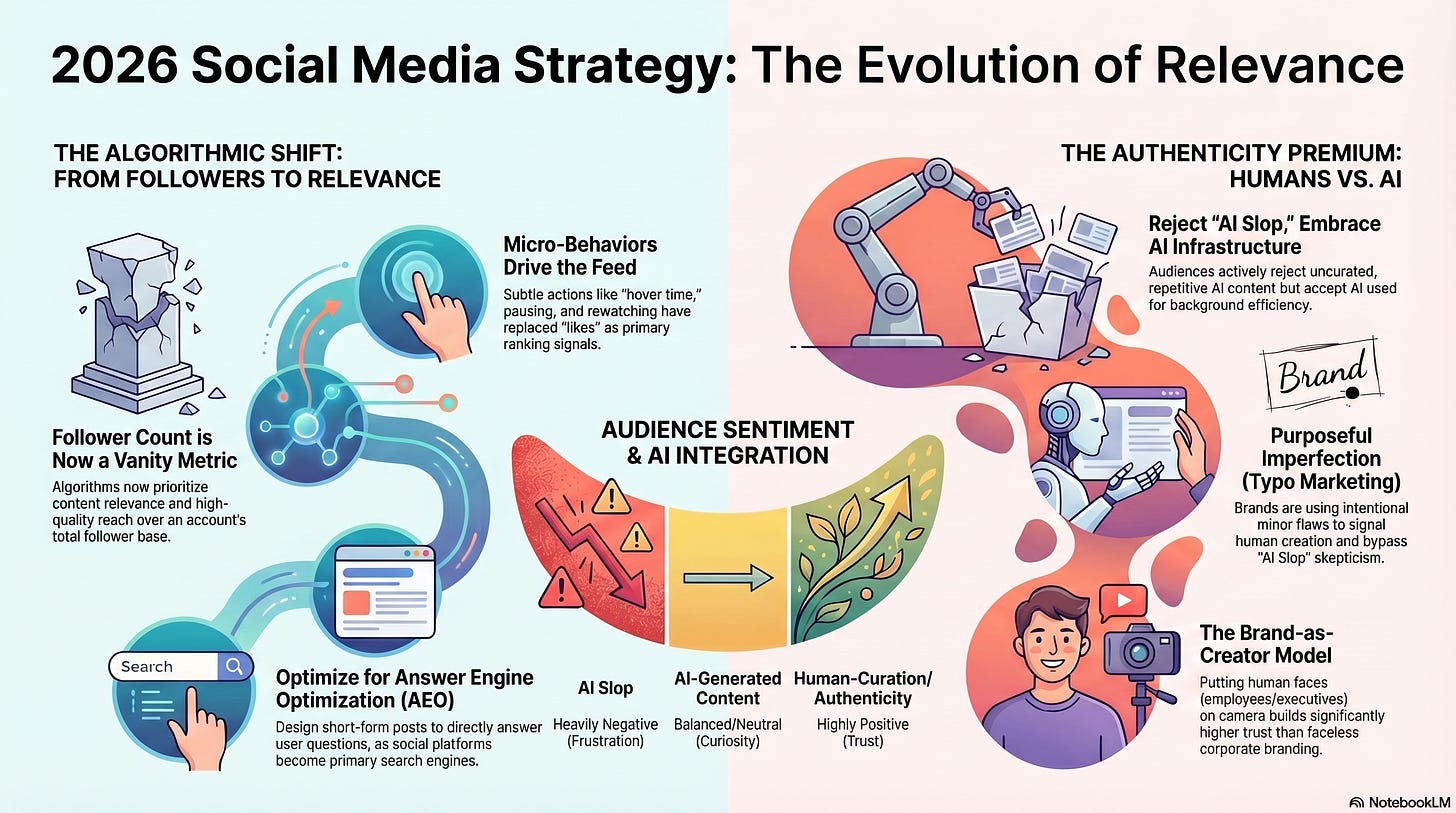
But the source material behind this article points to a deeper shift: the system has moved from connection to relevance. In plain English, platforms care less about who somebody formally follows and more about what that person appears interested in right now.
That does not make follower count meaningless.
It makes it a weak headline metric.
What’s actually going on
The feed is paying closer attention to behaviour than declared preference.
Not the neat, visible behaviours only. The quieter ones.
Micro-behaviours matter more than public applause. A pause, a rewatch, time spent hovering, slower scrolling, lingering in comments, or saving a post can tell the system more than a like because those signals are harder to fake.
Reach is no longer confined to your existing audience. A strong piece of content can travel well beyond your followers if it matches the behavioural pattern the platform wants to serve.
Attention quality now beats audience size. A smaller, more relevant audience can outperform a much larger one when it produces stronger intent signals and better downstream action.
That is the deeper point behind the line repeated across the source set: relevance is the new reach.
This short explainer breaks down the new 2026 playbook: why follower-first strategy is fading, what relevance looks like now, and how brands need to adapt.
Your Follower Count Is Officially Dead: Short ExplainerWatch
The trade-off
Follower count still has value.
It can create social proof. It can make a brand look established. It can reassure stakeholders who prefer one clean, public number at the top of a deck.
But it also creates lazy thinking.
Because once a team starts treating follower growth as the main proof of progress, it often begins optimising for what looks successful instead of what actually moves people. More content gets made to attract visibility. Less content gets made to earn memory, trust, or action.
That is the trade-off.
Follower-led reporting is easy to understand.
Signal-led strategy is harder, but far more honest.
The better move
The better move is not to ignore audience growth.
It is to demote it.
Treat follower count as context, not as the verdict.
What deserves more weight now are the signals that suggest somebody actually cared: saves, shares, replies, repeat views, profile visits, qualified clicks, DMs, search discovery, and the actions that happen after exposure.
The source material also pushes a second, less comfortable point: the single, uniform brand voice is weakening as a rule. People do not behave the same way across apps, and brands increasingly cannot either. A platform-native expression is starting to matter more than rigid tonal consistency.
That does not mean becoming fake. It means becoming context-aware.
The same brand may need to be sharper on LinkedIn, more conversational on Instagram, more creator-led on TikTok, and more editorial on Substack.
Not multiple personalities for the sake of theatre.
Multiple expressions in service of relevance.
2026 Social IntelligenceDownload
For the longer strategic framework behind this piece, download the companion report.
Quick test
Run these checks on your last month of content.
Which posts earned the strongest save rate, share rate, or reply quality, not merely the highest reach?
Which pieces led to a meaningful next step such as a qualified click, enquiry, DM, or email sign-up?
Which content held attention because of its hook, pacing, usefulness, or person on camera?
Which posts travelled beyond your existing audience and still performed well?
Which follower gains produced no matching lift in trust, interest, or business movement?
Try this
Here is a simpler reset than “post more and hope”.
Step 1: Audit your last 20 posts against saves, shares, replies, profile visits, qualified clicks, and repeat views.
Step 2: Identify the pattern behind the winners: topic, opening line, format, pacing, visual treatment, and call to action.
Step 3: Separate your content plan into clear jobs: discovery, trust-building, search-answer content, and conversion support.
Step 4: Build platform-specific expressions of the same strategic truth instead of copy-pasting one flattened brand voice everywhere.
A note of caution matters here.
AI is not the problem. The source material is quite clear that AI is already baseline infrastructure for ideation, editing, and speed. The problem is what happens when the machine output becomes the final output. Audiences appear willing to accept AI as a tool. They are far less willing to accept uncurated synthetic sameness.
That is where human judgment becomes premium.
Not human presence as decoration.
Human taste as filtration.
Closing
So yes, the headline is provocative.
It should be.
Because it forces a more useful question than “How many followers do we have?”
The better question is this:
What does our content make the right people do?
Do they pause?
Do they save it?
Do they share it?
Do they come back?
Do they trust us a little more?
Do they move closer to action?
Follower count is not dead because numbers no longer matter.
It is dead because that number is no longer the clearest summary of whether your social strategy is working.
The brands that adapt will not always look the biggest.
They will look the most relevant.
Prefer the spoken version? This companion audio expands the argument and pushes on the edge cases; “You have to divorce your self-worth and your metrics from follower growth.”
If you’re still reading (sharp)
Hit reply with SIGNAL if you want a follow-up on what to track instead of follower count. Or tell me where you think this argument collapses under scrutiny.
That is still one of the better things the internet can do when it behaves itself.


No published comments yet.