

TL;DR: Most people treat niching like a branding decision. It is closer to a research decision. Start with a simple statement of purpose, mine the language already orbiting your work, then validate it through real conversations until the niche stops sounding theoretical and starts sounding obvious.
You do not need a more clever niche; you need a more honest one, not the version that merely sounds strategic in your bio, but the one your audience keeps describing back to you, because that is a very different thing.
The scene
I have seen this play out more than once.
Sometimes in client work.
Sometimes in conversations with creatives trying to tidy up what they do into something the market can understand.
Sometimes in my own thinking too.
You sit in front of a blank page trying to “pick a niche”.
You open a notebook. Write down three industries. Delete two. Overthink the survivor. Open Instagram. Change the bio. Change it back. Decide you are “multi-passionate”. Then quietly hope the market will somehow do the sorting for you.
It usually does.
Just not kindly.
The thing people get wrong
People think a niche is something you invent.
It is usually something you detect.
That mistake matters. Because once you treat your niche like a branding costume, you end up writing for an imaginary audience instead of a real one. You optimise for sounding positioned, not for being understood.
The stronger move is less glamorous: treat your niche as a hypothesis. The statement of purpose is the starting point, not the finish line, and it is meant to be tested rather than worshipped.
What’s actually going on
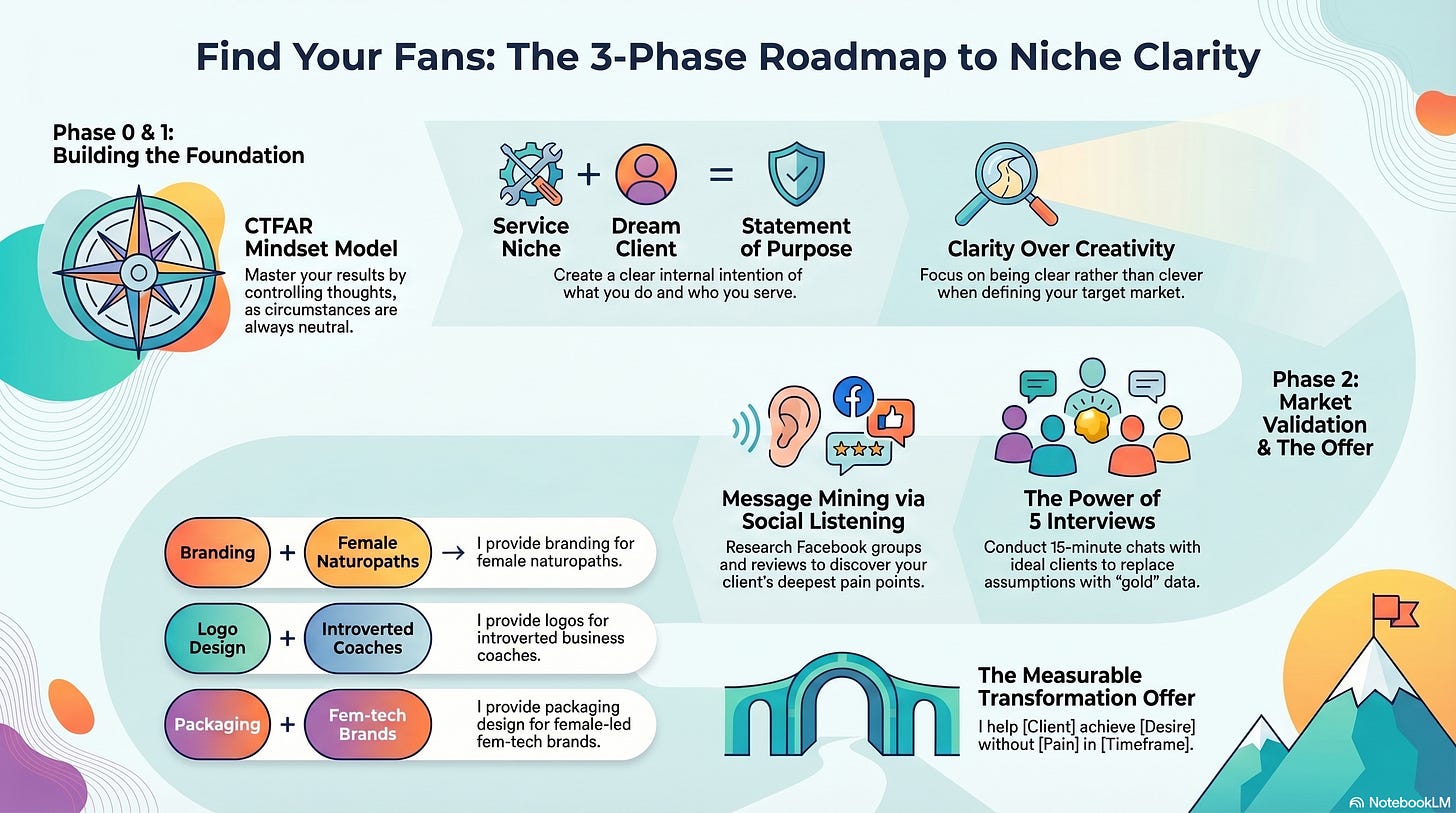
A useful niche tends to emerge in three moves.
Start with intent. Define what you do and who you think you do it for. Keep it simple.
Mine the message. Talk to people. Listen harder than you speak.
Validate through language, not vibes. Pull out exact phrases, recurring frustrations, hidden motivations, and the transformation people actually want.
That is the part many people skip.
They choose a market before they understand the person.
And then they wonder why the messaging sounds clean but doesn’t convert.
The trade-off
Guessing is faster at the start.
Validation is faster in the long run.
If you guess, you get the temporary comfort of a neat label. But you also inherit weak copy, fuzzy offers, and a constant suspicion that you are talking past the people you want to reach.
If you validate, the early stage feels slower and messier. You have to ask awkward questions. You have to hear people describe their world in terms you did not predict. You may even discover that your original niche idea was too broad, too shallow, or just wrong.
That is not failure.
That is the work.
The better move
Stop trying to sound niche.
Start trying to recognise patterns.
A good niche is rarely just “I help coaches” or “I work with founders”. That is demographic sorting. Useful, but thin. The stronger signal sits underneath that: the recurring identity tension, the repeated pain, the desired shift, and the language people use when they describe the version of themselves they want to become.
That is why identity mapping matters.
Once you understand the cause, the feeling, the belief, and the identity sitting beneath the problem, your message stops sounding generic and starts sounding like it belongs to someone specific.
Listen: Find your fans through identity mapping
The 3-phase roadmap
Phase 1: Define the starting hypothesis
Write the rough statement of purpose.
What do you do?
Who do you think you help?
Do not overpolish it. It is a working draft.
Phase 2: Mine the message
Look for existing proof.
Client calls.
Testimonials.
Enquiry emails.
DMs.
Comments.
Past projects.
Notice which problems repeat. Notice which words repeat. Notice where people light up.
Then go deeper with conversations. Ask what they were trying to solve, what made it frustrating, what they had already tried, why it mattered, and what success would actually feel like.
Phase 3: Validate the transformation
Turn the findings into a sharper promise.
Not a slogan.
A practical transformation.
What does this person want to achieve?
What do they want to avoid?
How would they describe success in plain language?
If the offer sounds clearer after ten conversations than it did before them, you are moving in the right direction.
The Validated Niche
If the roadmap gives you the structure, this video should give you the proof.
This is where the idea stops sounding neat and starts sounding real: a niche is not confirmed because you picked one. It is confirmed when the market keeps handing you the same language, the same pain pattern, and the same transformation target from different angles.
The Validated NicheWatchYour niche is strongest when it survives contact with real people.
The Clarity Blueprint
And once that clicks, the PDF becomes the practical companion.
Where the video and podcast help the idea land, the PDF serves as the slower, more structured version: the thing you revisit when you want to turn insight into a repeatable method.
Its job here is to remind you that clarity is not a mood.
It is a process.
And processes beat panic.
Download / Read: The Clarity Blueprint
 The Clarity BlueprintDownload
Quick test
Can you describe your audience without hiding behind job titles?
Do you know the exact words they use for the problem, not just your polished version?
Can you name the belief or identity tension underneath the surface complaint?
Have you spoken to real people recently enough to challenge your assumptions?
Does your current offer describe a measurable shift, or just a nice-sounding service?
Try this
Step 1: Write one rough statement of purpose: “I help ___ with ___. ”
Step 2: Gather ten scraps of real audience language from calls, DMs, emails, comments, or past feedback.
Step 3: Highlight repeated phrases around pain, desire, frustration, and self-image.
Step 4: Book five short conversations and ask open questions until the same patterns show up again.
Step 5: Rewrite your niche and offer using their language, not yours.
Closing
A niche is not a box you trap yourself in.
It is a pattern you learn to see.
The people who build traction fastest are not always the most talented. Often, they are the ones who stop trying to be universally impressive and start becoming specifically relevant.
That starts with purpose.
It sharpens through message mining.
And it gets real through validation.
If you’re still reading
Hit reply with NICHE if you want a follow-up on turning interview notes into a cleaner offer and homepage message.
Or tell me where you think this falls over.
That is usually where the useful conversation starts.


No published comments yet.