
Before you write the article, deck, pitch, post, talk, or campaign, write the story brief first.
Not the format brief.
Not the word-count brief.
Not the “make it sharper” brief.
The movement brief.
Where is the audience now? Where should they be by the end? What is blocking that movement? What makes the claim trustworthy? What should happen next?
If those five lines are unclear, the writing will usually become heavier, cleverer, or more polished before it becomes useful.
This is for people turning messy ideas into decks, pitches, talks, articles, posts, campaigns, or thought leadership.
Most messy ideas do not need more polish. They need a better brief.

The Brief Before the Draft
Most people jump too quickly from idea to outline, from outline to deck, from deck to design, and from design to panic.
The message feels too long, too flat, too clever, or too heavy. So they try to fix it with better language: a sharper hook, a cleaner metaphor, a stronger closing line.
Those things can help. But if the movement is unclear, better writing only makes the confusion sound more confident.
The better move is simpler. Before you write, define five plain lines:
Current state
Desired state
Obstacle
Evidence
Action
That is the story brief.
It is simple on purpose. Simple is where weak thinking has fewer places to hide.
Here is the logic in miniature:
If the audience currently thinks their message needs more polish, but they need to see that it first needs a defined movement, then the story has a job.
The rest of the brief simply makes that movement visible.
Start With the Current State
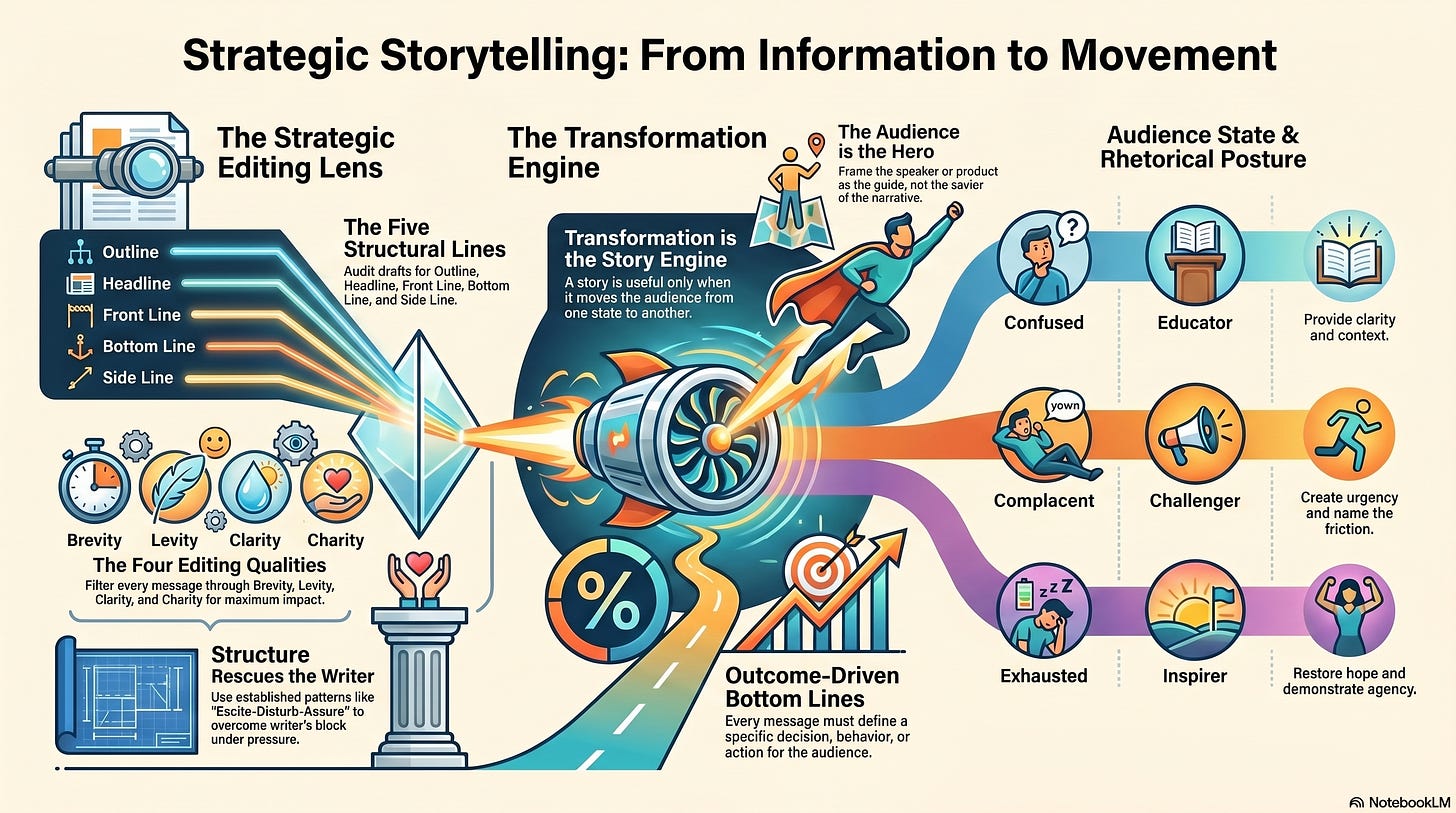
Current state: What does the audience believe, feel, misunderstand, resist, or avoid now?
This is where many messages fail. They begin with what the speaker wants to say, not where the audience actually is.
The speaker starts with the solution while the audience is still trying to name the problem. They start with the big insight while the audience is still asking whether the issue matters. They start with the offer while the audience is still comparing bad alternatives. They start with inspiration while the audience needs evidence.
The current state keeps you honest. It stops you from writing for an imaginary audience that is already convinced, already attentive, already motivated, and already prepared to act.
Most audiences are not there yet.
They are busy, sceptical, distracted, tired, protective, half-informed, overloaded. Sometimes they are interested, but not yet moved.
You cannot move people from where you wish they were. You can only move them from where they are.

Define the Desired State
Desired state: What should be different by the end?
This is not the same as “what should they know?” Knowing is often too weak.
By the end, what should the audience believe more clearly? What should they stop assuming? What should they feel permission to do? What decision should feel easier? What risk should become visible? What possibility should become credible? What should they be able to repeat to someone else?
A useful message changes the audience’s state. Not always dramatically. Sometimes the shift is small:
From “this is interesting” to “this is worth testing.”
From “we need more content” to “we need a clearer argument.”
From “storytelling is polish” to “storytelling is structure.”
From “the deck needs work” to “the decision is not yet clear.”
From “this is a creative problem” to “this is an audience movement problem.”
That is enough.
The desired state does not need to be grand. It needs to be clear.
If you cannot say what should be different by the end, you are probably not writing a story yet. You are collecting material.

Name the Obstacle
Obstacle: What stops that movement?
The obstacle is not always a villain. It may be a misunderstanding, a bad habit, a missing piece of evidence, a fear, a default process, a category cliché, a political risk, a trust gap, or a decision nobody wants to own.
This matters because movement needs friction. Without friction, the message becomes a list:
Here is what happened.
Here is what we made.
Here is what we think.
Here is what we offer.
Here is what we recommend.
All of that may be accurate. But accuracy alone does not create movement.
The audience needs to understand what is in the way. The obstacle gives shape to the story. It shows why the current state persists, why the desired state has not already happened, and what the audience must work through.
But this is where people often overcorrect. They add false drama. They turn contrast into conflict. They turn hesitation into stupidity. They turn a normal trade-off into a crisis.
That can make the story louder. It does not make it more trustworthy.
A useful obstacle is truthful, relevant, and proportionate. It gives the audience enough friction to care without making the message feel manipulative.

Choose the Evidence
Evidence: What makes the claim trustworthy?
This is the line that protects the story from becoming theatre.
Evidence does not always mean a statistic. It can be a pattern you have observed, a customer quote, a repeated objection, a before-and-after example, a technical mechanism, a demonstration, a lived experience, a clear process, a credible comparison, or a caveat that shows you are not hiding the hard part.
The point is not to bury the audience in proof. The point is to give them enough reason to trust the movement you are asking them to make.
Too little evidence, and the story becomes a mood. Too much evidence, and the story becomes a filing cabinet.
The brief should force a choice:
What is the smallest amount of proof that earns the next step?
Not every proof point belongs in the main story. Some belong in an appendix. Some belong in the follow-up email. Some belong in the FAQ. Some belong nowhere because they are impressive but irrelevant.
That last category is painful.
It is also where clarity gets made.

Decide the Action
Action: What should happen next?
This is the line most weak communication avoids.
The audience should not have to guess what the message wants from them. Should they approve the proposal? Reply to the email? Change the positioning? Book the workshop? Test the idea? Stop doing something? Choose between options? Share the article? Ask a sharper question? Remember one line?
If the action is vague, the story will become vague.
This does not mean every message needs a hard sell. Sometimes the action is a decision. Sometimes it is a behaviour. Sometimes it is a belief shift. Sometimes it is a conversation. Sometimes it is simply a better question.
But there must be a bottom line.
A message without a bottom line may still be elegant, intelligent, and beautifully written. But it leaves the audience holding the work instead of using it.

The Template
Use this before writing the next thing.
Current state
What does the audience believe, feel, misunderstand, resist, or avoid now?
Desired state
What should be different by the end?
Obstacle
What stops that movement?
Evidence
What proof, example, mechanism, or caveat makes the claim trustworthy?
Action
What should the audience do, decide, support, stop, change, remember, or ask next?
That is the compact version.
For more complex work, add four supporting lines:
Audience
Who is this specifically for?
Emotional posture
Do they need clarity, urgency, hope, challenge, reassurance, or confidence?
Risk / caveat
What could be overstated, misunderstood, or unsupported?
First line / last line
How will you earn attention, and what should the audience leave with?
The brief should fit on a page. If it needs ten pages, it is not a brief yet. It is source material.
Here Is the Brief Doing Its Job
Start with a messy idea:
“We should write something about storytelling, communication, decks, and why people need better structure because lots of ideas are good but people do not act on them.”
That is not bad. It is just not ready.
Now run the five lines.
Current state
People think their message needs more polish.
Desired state
They see that the message first needs a defined audience movement.
Obstacle
They are hiding inside information because information feels safer than choosing a clear action.
Evidence
Accurate decks, posts, and proposals often still fail when the audience does not know what changed, why it matters, or what to do next.
Action
Before writing, define current state, desired state, obstacle, evidence, and action.
Now the article has shape.
Not because the words are polished.
Because the movement is visible.
Why the Brief Makes Writing Easier
The five-line brief works because it turns a vague writing problem into a set of choices.
It makes you choose the audience, the shift, the friction, the proof, and the next step.
Most weak communication avoids those choices. It keeps adding material instead: another paragraph, another slide, another example, another caveat, another metaphor, another clever opening.
The work gets heavier, but not clearer.
The five-line brief does the opposite. It removes the places where vagueness can hide. It tells you what belongs, what does not, and whether you are writing a story, a report, a pitch, a memo, a post, or a pile of organised anxiety.
That is why the writing gets easier.
Not because the brief gives you better words.
Because it gives the words a job.
The Test
Before you publish, present, pitch, or send, check the five lines.
Can you state the audience movement in one sentence?
Can you name what is blocking that movement?
Can you show why the claim should be trusted?
Can you say what should happen next?
Can you cut one impressive section without weakening the action?
If the answer is yes, cut it.
That section may be good. It may even be the section you like most. But if it does not help the audience move, it does not belong in the main story.
Save it for later.
Or let it go.
The Useful Question
The next time an idea feels messy, do not start by asking:
How do I make this sound better?
Start with:
Where is the audience now, and where do they need to be by the end?
Then write the five lines.
Current state
Desired state
Obstacle
Evidence
Action
That will not write the whole article for you.
Good.
It will do something more useful.
It will tell you what the article is for.
In Conclusion
A messy idea is not always a weak idea.
Often, it is an idea without a defined movement.
The audience is somewhere now. They need to be somewhere different by the end. Something is blocking that shift. Some evidence must earn their trust. Some action, decision, or question must become clear.
That is the work of the five-line story brief.
It does not make the writing cleverer.
It makes the writing useful.
Before you polish the message, define the movement.
Once that movement is clear, the article, deck, pitch, post, or campaign has a job.
And when the message has a job, the audience has a way to move.
Reply MOVE and I’ll send the five-line story brief worksheet.
Or send me a messy idea, and I’ll show you where the movement is hiding.


No published comments yet.