
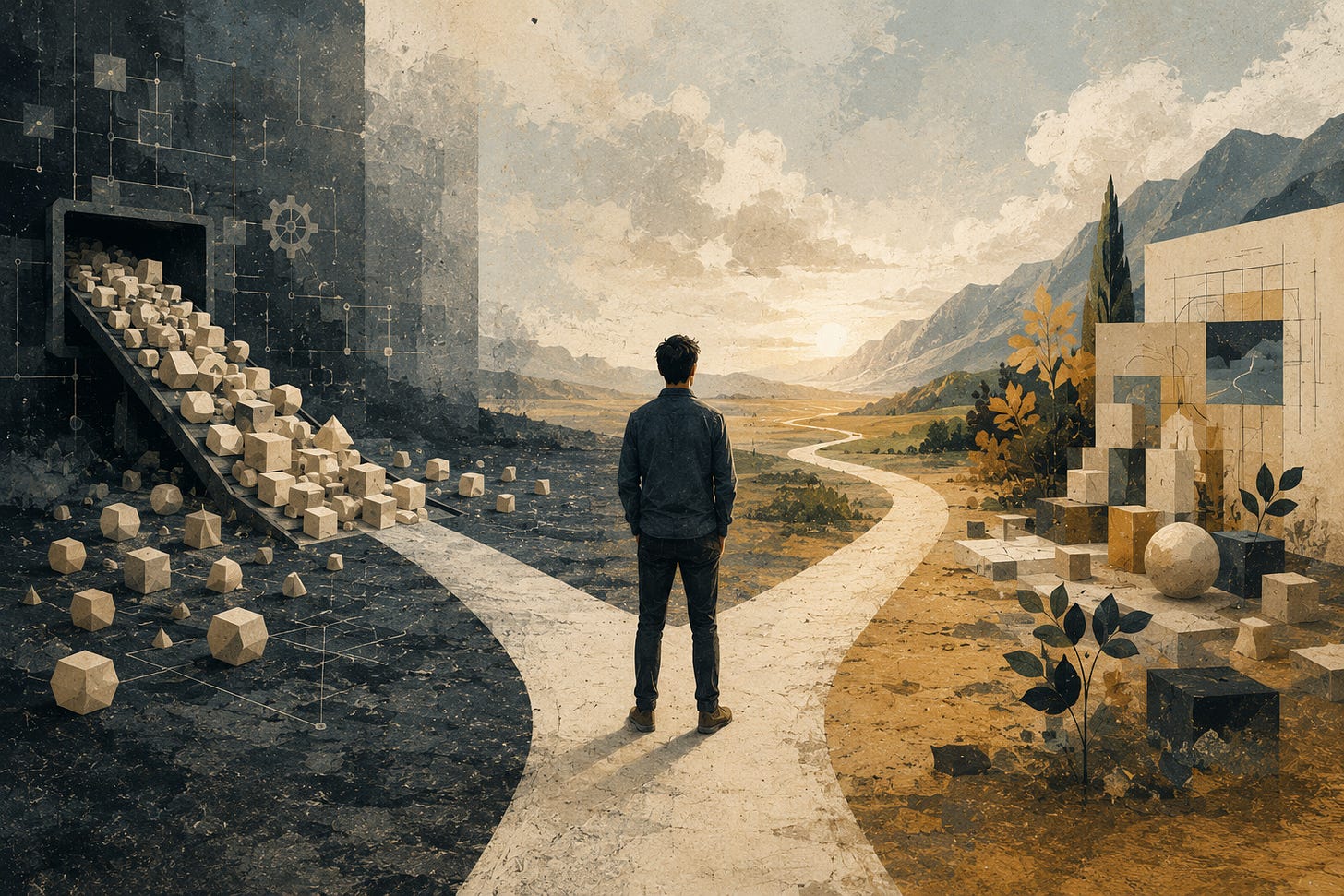
A client can now generate something that looks like a website before I have finished explaining why the website needs to exist.
By the time I send a proposal, they may already have a logo, a page layout, several blocks of copy and a rough idea of what the work should cost. None of it needs to be particularly good. It only needs to look finished enough to change their expectations.
That is the market I now work in.
I did not start using AI because I had resolved the debate about whether it was good for creativity. I started using it because refusing would have made me slower while the people buying the work were becoming accustomed to faster production.
Technically, using AI was a choice. Commercially, the alternative was to compete in a market whose new expectations I had decided to ignore.
So I adapted.
The harder question was what I was adapting into.
The argument for or against AI is too simple
Most conversations about AI and creative work fall into two familiar positions.
One says AI is replacing human skill and filling the world with work that imitates creativity without understanding it. The other says AI is simply another tool, resistance is nostalgia, and anyone who does not adopt it will be left behind.
Both contain something true. Neither helps much when I am deciding how to scope a website, price a brand project or explain why a client should involve me instead of using the first plausible answer a model produces.
AI is already part of how I research, write, design and build. It helps me organise complex information, test ideas, explore directions, create working drafts, accelerate routine code and identify inconsistencies.
My question is no longer whether to use it.
It is what AI should accelerate, what it should leave intact and where I still need to remain responsible.

The same tool does not create the same capability
Clients can access many of the same systems that I use. The machinery is no longer reserved for specialists.
That does not mean we will produce the same result.
Two people can use the same camera without making the same photograph. They can use the same software without making the same design decision. They can give similar instructions to the same model without having the same ability to recognise what is generic, misleading, technically fragile or strategically wrong.
The difference is not simply prompting skill.
The tool is shared. The judgement, context and experience behind the result are not.
It is knowing what to ask because you understand the problem. It is noticing when the brief points towards the wrong deliverable. It is identifying the assumption hidden inside a confident answer. It is understanding how one decision will affect everything connected to it.
It is also knowing when not to use what the machine produced.
AI can generate options. Experience changes which options you take seriously.
My work was never only the finished object
My practice moves across strategy, messaging, design, development, content and ongoing technical care.
That can look like a long list of services. The value is really in the continuity between them.
A brand rarely fails in only one place. The proposition, language, identity, website, customer journey and technical implementation need to agree.
A decision made during discovery affects the message hierarchy. The message hierarchy affects the site structure. The structure affects design and development. The build affects accessibility, performance, analytics, maintenance and what the organisation can realistically manage after launch.
That is why I think about the work as:
Discover → Design → Deliver → Drive.
AI can assist in every phase. It can organise discovery material, expose contradictions, suggest possible structures, accelerate routine production and help test or document what has been built.
The danger is not that AI enters the process.
The danger is that the process becomes:
Prompt → Generate → Polish → Ship.
That sequence can produce an artefact before anyone has established whether it solves the right problem.

The thing AI makes cheaper is not always the thing I sell
AI can reduce the time and cost required to produce an artefact.
It does not automatically reduce the work needed to understand what should be produced, why it should exist or what consequences the decision may create.
A client may ask for a website when the real problem is an offer nobody can explain. They may request a new identity when the product, service and story contradict one another. They may ask for more content when nobody has decided what the organisation believes strongly enough to repeat.
AI can help expose these tensions. It can generate possible answers and arguments for different directions.
It does not carry responsibility for choosing between them.
Faster generation can therefore make judgement more important rather than less. When fifty plausible directions can appear in an afternoon, producing another direction is no longer the scarce capability.
The scarce capability is recognising which one fits, which one merely looks current, which assumption has not been tested and which attractive shortcut will become an expensive problem later.
That is the part of the work most easily hidden by efficiency.

Process is also where judgement develops
AI can feel less like holding a tool and more like ordering a result.
You ask. Something arrives.
A serious AI-assisted process can still involve interrogation, comparison, testing and revision. But it is also possible to receive a polished answer without seeing how the answer was formed.
That matters because process is not only the inefficient route to a finished object. It is also where judgement develops.
AI can produce the appearance of competence before the person using it has learnt how to assess the answer.
My judgement was built through unclear briefs, failed concepts, difficult conversations, technical limitations, launch problems and maintenance realities.
I learnt what tends to break because I saw things break. I learnt which questions matter because I watched projects move in the wrong direction when those questions were not asked. I learnt that a polished visual solution can hide a strategic problem, and that a feature can work at launch while becoming an operational burden later.
Not every part of that journey deserves to survive.
Some of it was repetition. Some was avoidable administration. Some was production work that technology should make faster.
But some of it was feedback.
If every difficult step is removed before someone understands what it teaches, they may gain the ability to produce an answer without developing the ability to assess it.
That is a particular risk for people entering creative and technical work now. The problem is not simply that they may become lazy. It is that they can produce the appearance of competence before they have built the internal models needed to judge the result.
A plausible answer arrives before they know why it is plausible—or why it is wrong.

Balance is not half human and half AI
“Balance” can easily become a way of avoiding the decision.
Use a little AI. Preserve a little humanity. Settle somewhere safely in the middle.
The useful balance is not a percentage. It depends on what a particular step contributes.
Some friction is only waste. It delays the work, repeats known tasks or forces someone to do manually what can be automated safely.
Other friction is productive. It exposes assumptions, forces trade-offs into the open, develops understanding or prevents an expensive mistake.
AI should remove as much bad friction as it responsibly can. It should not automatically remove the places where the client and I discover what the problem actually is.
A discovery session may look like another meeting, but its value may be uncovering that the project is built around an unresolved contradiction.
A review round may look inefficient, but it may be where the client finally understands the trade-off they are making.
Ongoing support may look like an additional expense, but it preserves continuity between what was intended, what was built and what happens when the system meets reality.
That does not make every meeting useful or every human interaction worth preserving.
It means we should understand the job a step is doing before removing it.

The human signal remains valuable
There is a contradiction in the way AI is being adopted.
We remove the human process while trying to preserve the appearance of human involvement.
We want emails that sound personal without requiring someone to write personally. We want support that feels attentive while reducing the cost of attention. We want brands that feel considered while minimising the process of consideration. We want writing that appears to contain lived insight even when the experience behind it has been removed.
The human signal remains desirable.
The human source becomes negotiable.
Cost is a legitimate concern. Some clients genuinely need a faster and more affordable option. A defined landing page does not always require a strategic excavation. A temporary campaign asset may not need weeks of exploration.
Faster and cheaper are not goals on their own. The question is what the process is actually improving.
Those clients are not failing to value design. They are buying a narrower service.
The problem begins when production and judgement are treated as the same thing.
I need to show where the value entered
When I describe my work as strategy, design, development, writing and AI-assisted production, I am providing information.
A list of deliverables is information. The number of pages, concepts, revisions and integrations is information. Even the finished artefact only proves that something was produced.
It does not explain why the decisions mattered.
The more useful story is what changed.
What was unclear before the work began? What contradiction did we uncover? What did the client initially ask for that turned out not to be the real problem? What was removed? What became coherent? Which risk was avoided?
This does not require exaggerated case studies or invented commercial results. It means showing the consequence of judgement rather than documenting the presence of labour.
The human contribution becomes visible when the client can see how the thinking changed the direction.
My services need to reflect the difference
Using AI responsibly is only half of the adaptation. I also need to change how I structure and sell the work.
A client who needs defined production should be able to buy defined production. That service can be faster, narrower and more affordable because the problem is already understood and the boundaries are clear.
A client with an ambiguous, identity-bearing or interconnected problem needs a different engagement. That work includes discovery, interpretation, integration and accountability.
If I package both as a vague promise to “design a website” or “develop a brand”, the production service looks expensive and the strategic service looks unnecessarily slow.
The distinction needs to be clear before the work begins.
I also need to show more of the decisions without performing busyness. What did we rule out? What changed the direction? Where did AI help? Where did judgement override the generated answer? Which steps were accelerated because they were repetitive, and which were protected because removing them would weaken the result?
That is not a defence of old working methods. It is a clearer account of where value entered the work.
The balance still is
I will keep using AI.
It allows me to research, think, test, design, write and build more efficiently. Refusing it would not automatically make my work more human. It would often only make me slower.
But adapting to AI does not require handing every decision to the logic of speed.
AI can shorten the route between a brief and an artefact. It cannot decide whether the brief describes the right problem. It cannot choose which trade-off the organisation should make. It cannot remain responsible after launch.
That part is still mine.


No published comments yet.