
It took me twenty-seven years to get the third door in the Christmas pageant. The committee said you had to live at the house to do it. In March I paid forty thousand over the asking price for a place with damp up to the windowsills. At the first door the innkeeper sounded sorry. The man at the second wore a nightcap and wanted to know where exactly he was supposed to put a donkey. I had the brass knocker and the line that sent them to the stable. No room. Two words. They gave me a lantern to make my face look mean.
My brother had been Joseph once, in a dressing gown with rockets on the cuffs. I was the donkey’s front end. He kept putting a boiled sweet between my cardboard teeth to see whether he could feed it to me. At the third house an old woman missed her line. ‘Well, come in, love,’ she said. My brother stepped over the sill. We waited. Someone played a little of the next carol to cover for him. We went round the side of the house and looked in the kitchen. The old woman was there putting milk into a cup. She couldn’t tell us where my brother had gone.
By Boxing Day the police had taken the old woman’s chimney apart. For years afterwards I thought it mattered that I’d had the donkey head on and hadn’t seen which way he turned.
Now the children coming up my path were wearing our old costumes. A bit of parcel tape held the donkey’s ears together. Joseph had a tea towel over his hair and Mary carried the baby in one bent arm with her phone in that hand, screen up. Through the letter box I could hear her say, ‘It says rain in ten minutes.’
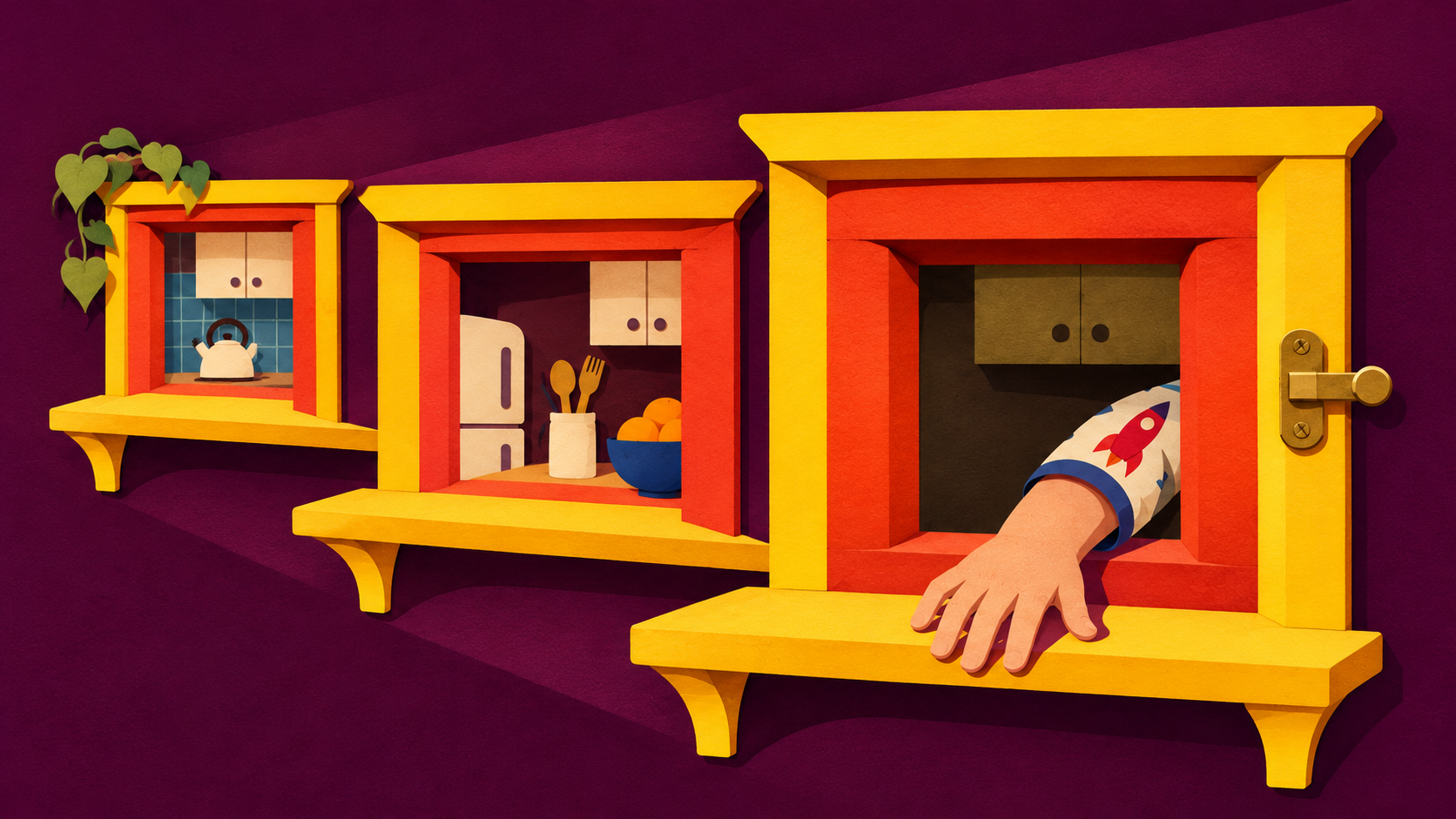
They knocked. I opened up. Behind them somebody was collecting money in a tin, and a coin went round and round the bottom. I lifted the lantern. In the glass of my open front door I could see my own kitchen, and just inside it a boy peeling a satsuma with his teeth. He had orange pith in the gap where a tooth should be. There was a rocket at his wrist.
‘No room,’ I said. The children went on to the stable, where there was cocoa for everybody. I shut the door and ran to the kitchen.
The serving hatch in my kitchen looked into another kitchen. Through a hatch in that one I could see a yellow one with a silver tree. The boy was putting a saucer down on the yellow table. A woman in a Christmas apron held her cheek out. He kissed it and went on through another hatch. I put a knee on my worktop and followed.
It was possible to tell which kitchens had little children in them from the stickiness of the floor. I lost a slipper. In one room somebody’s father had newspaper over his knees to catch the carrot peelings. He looked up and said, ‘Have you grown again?’ My brother stood against the jamb to be measured. The old man made a pencil mark above his head. It joined a thick black bar.
The boy saw me. ‘The donkey’s got your glasses,’ he said.
He used to put my spare glasses on things. A melon. A lampshade. Our dog had to have one ear held out. For a second all I wanted to tell him was that I wore contact lenses now.
‘Come home,’ I said.
‘Can you take his carrots for a minute?’
There was a dish of carrots on the table. I picked it up. The old man wiped his hands on the newspaper, leaving an orange smear across a racehorse. ‘There she is,’ he said, and he kissed my hair. By the time I looked up, all I could see of my brother were the soles of his shoes going through the next hatch.
I climbed up after him with the dish. I meant to ask him to wait. From the kitchen ahead came the soft knock of a familiar cupboard that had never quite shut. I could smell my mother’s cigarettes. When we cleared her flat I took three jumpers out of the sack for the charity shop and slept in them, the cleanest one last. A hot dish had scorched a yellow oval into her tablecloth. Mine fitted over the mark. She took my chin in her fingers to get a proper look at me.
Behind her, through a square of ribbed glass, a donkey came nodding up my front path. The two people inside it walked badly together. The back kept trying to overtake the front. My glasses were slipping down its long brown face.
Mum opened the cupboard. ‘My girl,’ she said, and set down a sack of carrots by my chair. She handed me the peeler.
Halfway down the sack my hands began to hurt. By the bottom I had my mother’s brown spots on them. I heard a sweet rattle against cardboard and went into the hall. My brother was at the door asking if there was room. I could have sent him to the stable without opening up.
I lifted the latch. He was rubbing one eye with his rocket cuff. I took his free hand. Mine was big enough to get the whole of his inside it this time.
‘Well, come in, love,’ I said.
The donkey’s cardboard muzzle bumped against my kitchen window. I kept my back to it and poured milk into a cup.
Loading published comments…