
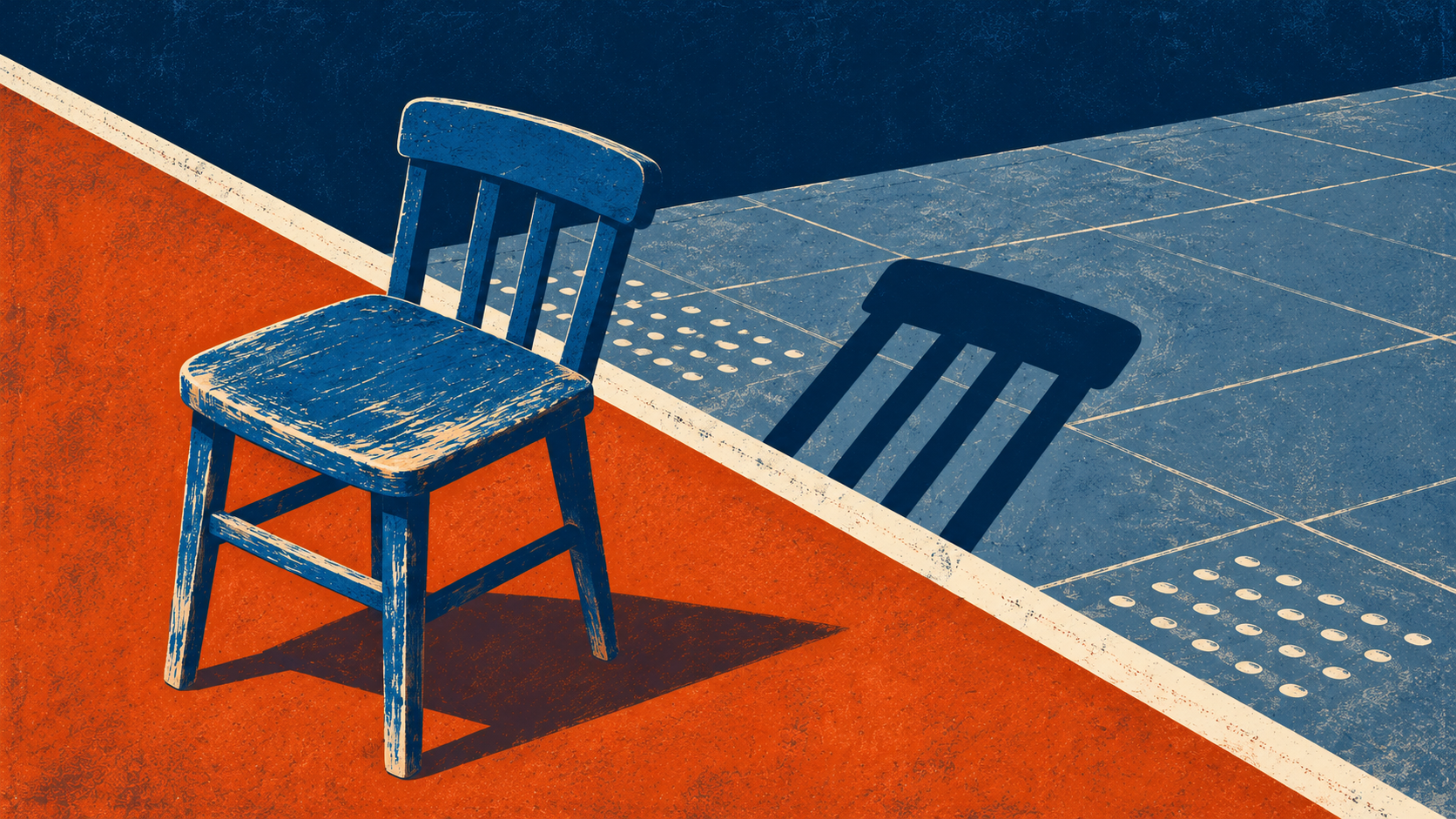
My aunt says the family has always kept one blue chair near the front door. She says this as if the chair has a passport. It began, according to her, in a flat above a pharmacy, moved through three rented houses, crossed a sea in a container, and arrived in the current place with one leg shorter than the others. The chair is not old enough to remember all this. My aunt is.
When our cousins visit from different countries, we put the chair in the middle of the room. Nobody sits on it for long. It wobbles. People use it to hold a handbag, a plate, a phone that needs charging. The chair is less furniture than an excuse to ask where someone has been.
This year my cousin Leila came for four days. She had been born in one city, raised in another and educated in a third. I was born where we live now, but I have spent most of my life explaining that this doesn't make every answer simple. People like the idea of a generation with one global address. We use the same apps, watch the same clips, send the same laughing face when words fail. That is a kind of closeness. It is not the same thing as knowing where someone feels expected.
Leila asked me to take her to the station on her last morning. We had both been awake late, looking at old family photographs on our phones. The same photograph appeared in three different chats, each with a different caption. In one, the blue chair was “the arrival chair”. In another it was “the chair before the move”. My aunt called it “that thing we couldn't throw away”. The image had not changed. The sentence around it had.
At the station, Leila looked at the departure board. A train had been cancelled. We had forty minutes. She suggested coffee, then changed her mind, then asked if I wanted to walk. We walked past the platform shop and down a corridor where the ceiling lights made everyone look as if they had forgotten something.
“Where do you think home is?” I asked.
She looked at me. “When you ask that, do you mean where I sleep or where I can be annoying?”
I laughed. “The second one.”
“Then it keeps moving.”
It was not a grand answer. It did not resolve the difference between us. It made the question less like a form with one correct box.
We spent the remaining minutes discussing a sandwich she had forgotten in her bag. It had become warm and slightly flat. She ate half and gave me the rest. We did not take a photograph. I think that mattered more than I understood at the time. A picture could travel to the chat, be captioned and saved. The sandwich belonged to the awkward interval before the train, to two people with nothing impressive to report and no need to turn the moment into proof that family worked.
When her train was called, she hugged me with one arm and pulled her bag with the other. I watched the doors close. Then I sent our family chat a photograph of the empty platform and wrote, “Platform Nine has no chair.” My aunt replied with a picture of the blue chair at home, a coat hanging over its back.
That evening, I sat on it. The short leg tapped the floor twice. I folded a piece of cardboard and slid it beneath the foot. The tapping stopped, but the chair still rocked under my weight.
My aunt watched me work. She could have told me the chair had always leaned that way. Instead she brought a second piece of cardboard and asked whether the front leg or the back one was shorter. We tested both. It held firm when we moved the shim to the opposite side. It was a tiny repair, but we had to keep talking while we did it. She told me which house the chair came from. I told her which version of the photograph Leila had sent. The chair still leaned a little towards the door.



Loading published comments…