
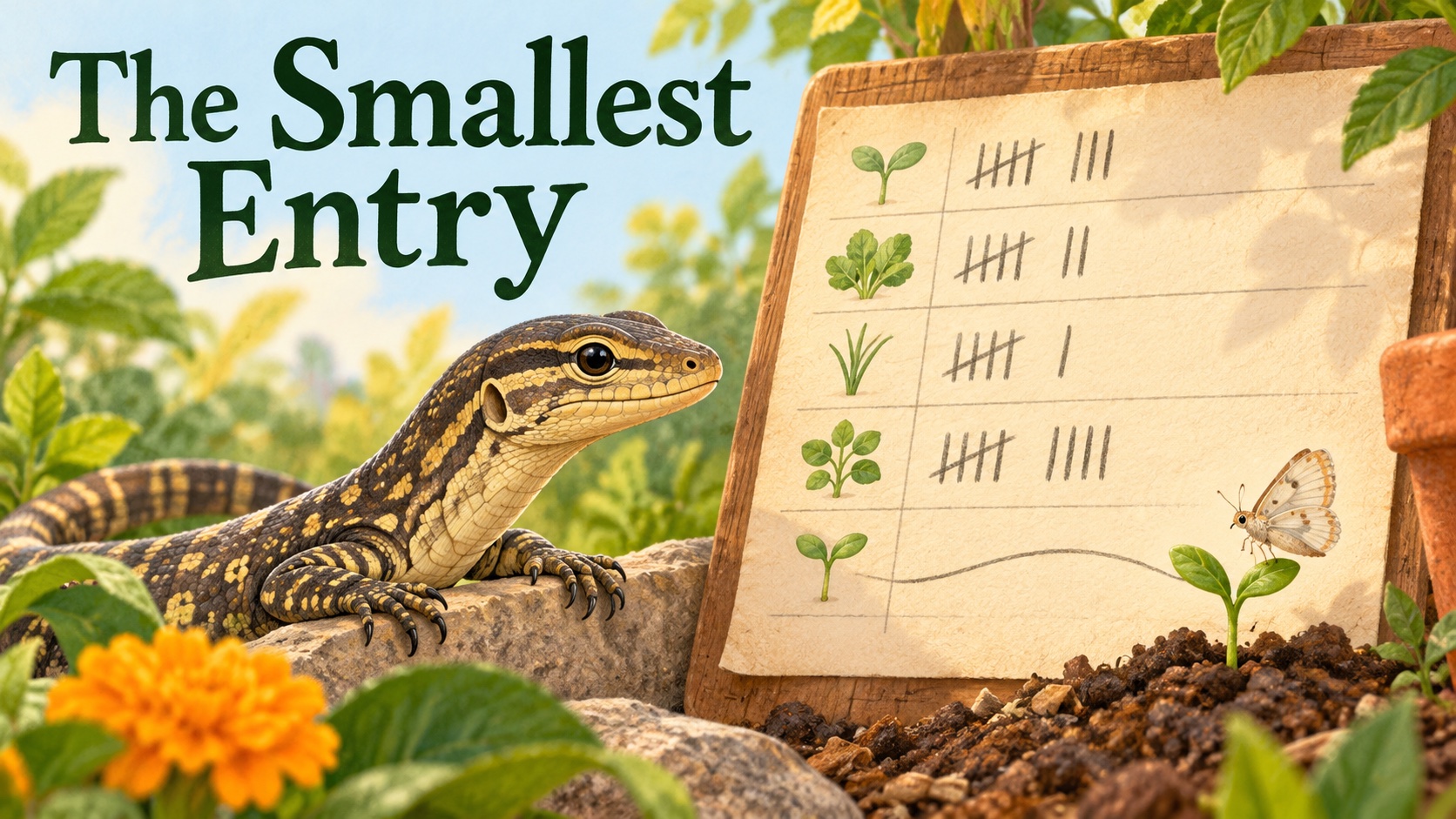
Nandi liked the garden board because it had a box for everything.
Seedlings: 24. Buckets carried: 6. Spades returned: 3.
She counted the seedlings twice, in case one had been hiding behind another. There were twenty-four. She counted the spades once because none of them was small enough to hide.
“All correct,” she told Mr Dlamini.
He was carrying a watering can from the tap. “Good. Put the pencil back where the next person can find it.”
Nandi tucked it into the string loop. The loop was too high for a small child, but not for her. She had tied it there herself.
Then something landed on the newest seedling.
It was a moth, pale as the inside of a shell, with two dark marks on its wings. It opened them, closed them and turned round as if it had reached the wrong bus stop.
“One moth,” said Nandi.
She looked for a box on the board. There was one for seedlings, one for buckets and one for spades. There was no box for moths.
She tried the margin. The moth flew off.
“It was here,” she said, writing a small one beside the seedling total.
The wind lifted the corner of the paper. Nandi held it down with one hand and the pencil with the other. The moth came back and settled on the board itself, just above the word seedlings.
“That is not a plant,” Nandi told it.
The moth walked sideways.
“I don't think it knows the boxes,” said Mr Dlamini.
Nandi made a new column. She drew a little wing at the top and wrote Moths. Then she watched the pale moth fly across the beds and disappear behind the water drum.
At the next visit, Nandi measured the seedling. It was shorter than yesterday, or perhaps the soil had shifted. She checked the ruler against the board. The moth did not come.
The day after that, she found three tiny holes in a leaf. She wrote them in the margin. The next day the leaf had curled. She drew the shape beside the holes, because there still wasn't a box for curled leaves.
“How many times did you see the moth?” asked Mr Dlamini.
“Twice.”
“How long did you watch?”
Nandi thought about the number. “Until it left.”
“That's one way to count.”
He was tying a new cane to a tomato plant and the string kept slipping from his thumb. Nandi held the cane steady while he tried again.
“There,” he said. “Thank you.”
Nandi looked at the board. “If it comes back again, I'll count it too.”
“That's a sensible plan.”
For a while, the garden grew. Nandi kept the first-day totals at the top of the board and used the rows below for new notes. Her moth column remained blank. When she had time, she stood beside the pale plant and watched. The sun moved over the wall. A lorry rattled past. Someone called from the pavement. No moth.
Then the hot days lasted longer than the cool ones. The soil went pale and hard. A row of leaves drooped by lunchtime.
The adults talked beside the tap. They had a limited number of full buckets and a list of which beds needed them most. Mr Dlamini crossed one bed off and added another. Nandi carried a small watering can to the plants he pointed out. She did not get to choose which ones received the big buckets, but she could carry the little one carefully without spilling.
The pale plant kept its curled leaf. One morning, Nandi stood beside it for ten minutes. She counted the minutes with the second hand on her watch. No moth arrived.
On the board, she wrote:
Moths: 0.
It looked wrong beside the number twenty-four. A zero seemed like an empty box, the sort of answer that meant there was nothing to say. Nandi pressed the pencil hard, then rubbed at the mark with her thumb.
The zero grew grey but stayed there.
She stopped rubbing. It was true that she had seen no moth during those ten minutes. It was not true that there had never been one.
Nandi wrote underneath: Looked by the pale plant, ten minutes, before breakfast.
The words needed more space than the number. She turned the board sideways and made a small note below the rows of neat boxes.
The next morning, she asked Mrs Mokoena if she had seen a moth near the back wall.
“A brown one on the washing line,” Mrs Mokoena said. “Yesterday, while I was hanging socks.”
“Was it pale?”
“I don't know. I was busy with the socks.”
Nandi wrote down what she had said and when she had seen it. Later, a boy who came with his grandmother said he had seen something white by the tap. He couldn't remember which day. Nandi wrote that down too, with a question mark.
Mr Dlamini looked at the notes. “They don't all prove the same thing.”
“No,” said Nandi. “They saw different things.”
He read the lines again, then handed her the pencil. “You'll need a bigger board.”
They found a piece of card in the shed. Nandi ruled three columns: what, where, when. She copied the first-day totals across the top: Seedlings: 24. Buckets carried: 6. Spades returned: 3. Then she pinned the new card beneath them, where nobody had to be tall to write on it.
A few days later, clouds gathered behind the flats. Rain made dark freckles on the dry ground and brought out the smell of soil. The pale plant lifted one leaf, then another. Nandi did not write that the rain had saved it. She wrote the date and drew the two leaves as they were.
No moth came that day.
Before leaving, Nandi sharpened the pencil and placed it on the low shelf. Beside the card, she left a blank line.
There was room for the next person to look.


No published comments yet.