
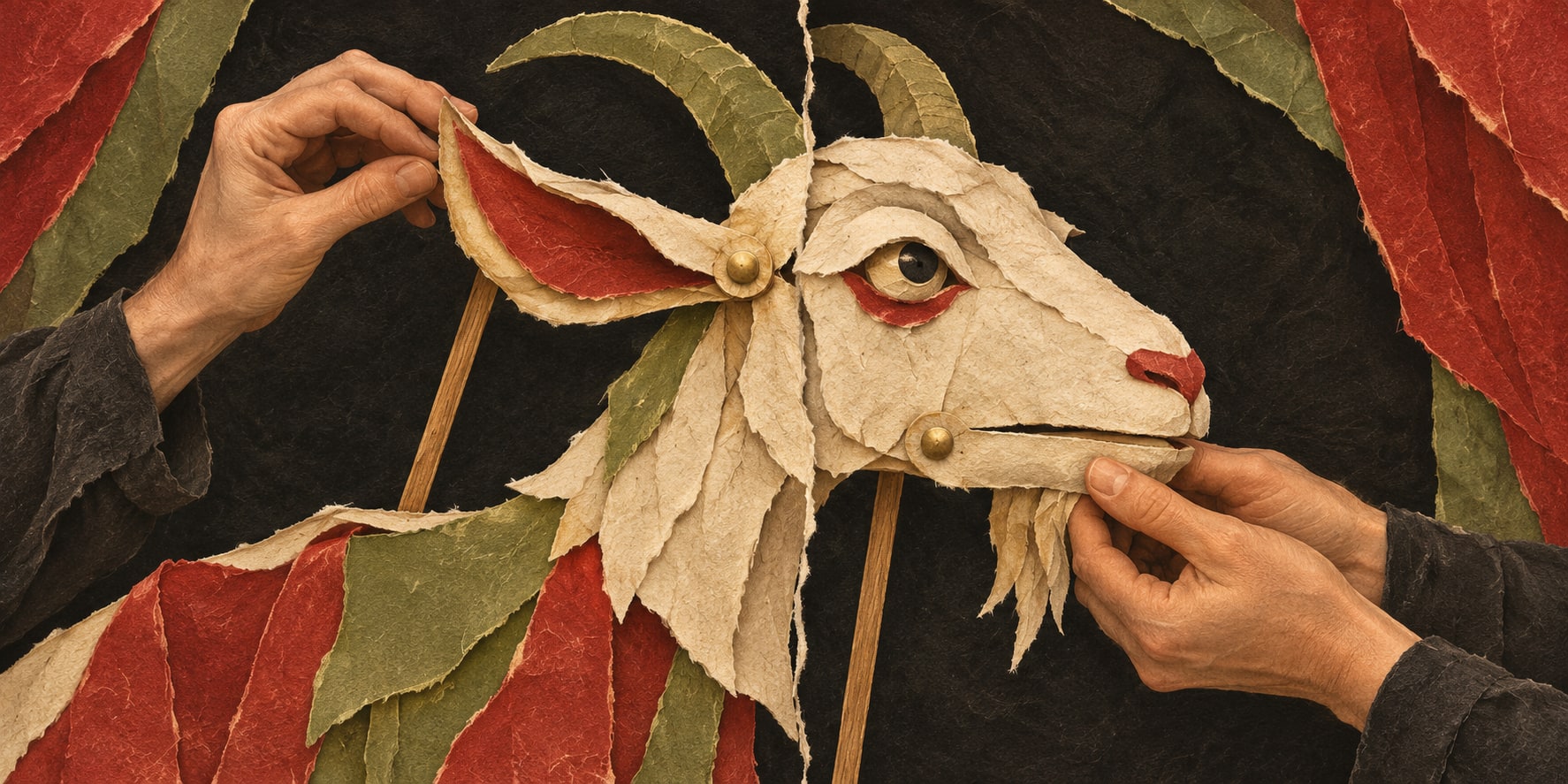
Somebody had put a real cabbage in the barrow. I could smell the cut stalk through the gauze in my goat’s throat. When I picked it up between the wooden lips the head went down like a hammer and Dot, who had the other end of the animal, landed on top of me. The cabbage rolled off the stage and struck the tin foot of the collection box.
From the third row the caretaker said, ‘That would be yours, I think.’
‘Darling,’ Dot said into the small of my back, ‘the little ones come out for lunch in eight minutes.’
‘Get off me then.’
‘You’ve got my plait under your shoe.’
We sorted ourselves out. I lifted the cloth and there stood a boy in a red school jersey, holding up the cabbage. He had come in with the caretaker to set out the chairs. He looked straight past my head into the dark where Dot was.
‘Which of you made it hungry?’
‘Both of us,’ I said.
‘Oh,’ he said, as people do when you have given them some information they already possess and which does them no good.
It was the first stop of our autumn tour. The show had been made in a little theatre with a capacious dock at the back. We had taken it into schools the year before and learnt that a barrow could be hired almost anywhere from a gardener, which saved a ridiculous amount of space in the van. The barrow arrived full of what people thought a goat might fancy. Old flowers, newspaper, silk carnations smelling of somebody’s wedding ten years ago. Dot always took the heavy stuff out and put in the light. Our own cabbage, green silk pleated round a bath sponge, had made a hundred and eighty journeys through the wooden lips.
‘Where is the sponge one?’
‘Where you left it, probably.’
I was going to say I had never in my life had to lay a finger on that cabbage except through the mouth of the goat. It was a sentence I could hear all the way to the end before I said it. I went round the back to look in the crates.
The boy came too. ‘My gran grew that for you.’
‘I’m looking for a different sort.’
‘She says she grew it under a net. You can see the holes where the caterpillars got through anyhow.’
On his palm the cabbage was larger than his head. Green as bottle glass at the tips, with a thumb of yellow showing through where the leaves lay tight. I began to feel ashamed of the bath sponge.
Dot sat on the edge of the stage rubbing her scalp. Two black marks from the goat’s harness ran down her thighs below the hems of her shorts. We had driven through the night because of an afternoon’s business she’d had in town. Afterwards she had talked at such length about an expensive noise in the van that I’d wondered why I couldn’t hear it.
‘Give it here,’ she told the boy. He handed it over. She tucked her chin in and sniffed the broken stalk. ‘Have you ever seen a goat pick up a whole bloody cabbage?’
‘I don’t think they’re meant to swear here,’ the boy said to me.
‘She’s visiting,’ I said.
Dot put the cabbage in her lap. ‘The bit of business in the second half,’ she said. ‘You’ve always done that back to front.’
Six years we had been doing the goat. In that time a child had thrown up on its back, it had appeared on television minus its hind legs because the cameraman had never worked with an animal, and once at a wedding it had been asked to bless the honeymoon bed. In the fullness of all this experience it appeared there was a right way round for a joke which, to my certain knowledge, had never failed to get a laugh.
‘You might have told me.’
‘I’m telling you now. In comes this goat, sees something it wants to eat and picks it up for everybody to look at. When you’re hungry do you hold a sandwich up over your head?’
‘If I was being paid to.’
The boy laughed. Dot handed him the cabbage. ‘Back in the barrow, love.’
She got down from the stage, stood in the centre aisle as if taking a photograph and framed me in her fingers. Big hands. In a costume almost anything she did with those hands looked like a consequence of something I had done with mine. Out of the costume I could never work out where to put my eyes while she was talking.
‘I took that job,’ she said.
‘Which job?’
‘The salt works. The one with the white horse.’
I had thought they wanted us for the spring. It was an old salt warehouse with a floor so beautiful they charged people to photograph brides standing on it. I told her I hadn’t worked out whether the van could get through the yard.
‘They want me for the horse. It’s a solo.’
‘I know it’s a solo. I thought we were building it.’
‘They’ve got somebody building it. I said yes yesterday.’
The boy was stripping off the ragged leaves. One of them clung on by a little white hinge. He smoothed it down with his thumb and went to the bin with the rest. I wanted to ask if they’d seen her do anything except the view from behind me. It was the greatest compliment I knew how to pay the goat that a person could watch it all evening and never once imagine Dot. I put the goat’s head down on the floor.
The doors went. A whole building full of children, released at once, made a noise like a bath being filled at great pressure.
‘You could have told me yesterday,’ I said.
‘I’d have had to spend three hundred kilometres in a van with you knowing.’
We got under. The costume smelt of the two of us in our separate parts, my vinegar at the chinstrap, her eucalyptus pastilles to which she had been addicted since she gave up cigarettes. In through the nose, out through the teeth. With the children stamping that was the one small sound we could still hear of one another. I set my forearms in the head. Dot put the weight of the rump into its band across her pelvis, and for a moment there were only our four hot legs and the cloth rising and falling between us. Then she took one little step towards me till the backs of my knees felt the fronts of hers and there we were, the size we had agreed to be.
A goat is all edges up close. They let you press one sharp slat after another of their bodies when they rub against your side, until you find you’ve been deprived of the paper bag you were holding. Ours had only one good edge, the ridge down its long back. If we stood too far apart the ridge went straight as an ironing board. If we came close together the middle flopped. I had always thought of Dot’s job as keeping that line true. During the first five minutes of the show I began to notice how seldom she did.
The goat listened to a woman sing from inside a postbox. Dot sat the rump down all at once with a bump which sent the ears rocking forward. The laugh came a beat before I opened the mouth. Later we went along sniffing the front row for the child who had polished his shoes with bacon, and I felt Dot easing half her weight away a moment before I bent. I had lifted that enormous head in passages where I might have sworn it weighed no more than a spoon.
It was like hearing an accompaniment on its own for the first time. It was also the most wretched performance I had given in several years. I ran into the postbox and a little girl had to point out a strip of bunting caught on one horn. At the interval I wanted to go outside and tell Dot she had ruined my concentration. Dot went to the lavatory. I sat on the floor with a horn in either hand.
We came to the barrow. The boy’s gran was in the front row, easy to spot from the possessive way she sat up when her vegetable appeared. Somebody had put a ribbon round the handle. My flash of resentment that a family should feel entitled to supply both our props and our audience was succeeded by a more reasonable concern. I still didn’t know what we were going to do.
Dot let the animal almost sit again. I could feel the ribs going slack under my elbow. I waited for her to come back up. She didn’t. For the first time it occurred to me to go on without her. I took a step towards the cabbage and she made the gentlest possible resistance, as if something behind the goat had caught its attention. I tried another step. I felt her hip begin to turn away from the barrow. My two forearms went on wanting the cabbage. I understood the animal to be frightened of the gardener.
There wasn’t any gardener. I turned the head to see what Dot had seen. She moved the rump a little further away and I went with her. Through the gauze I saw a whole row of red jerseys turn towards a perfectly innocent piece of wall. Then Dot gave me her weight back all at once and we both went for the barrow. I got two lips full of the loose outside leaf the boy had begun to strip. It tore with a delicious wet rip. I drew it under the chin and dropped it through the throat, still chewing for the people at the back.
Half a cabbage leaf stuck to my bare chest. We went away backwards with the wild guilty caution of a goat that has eaten something much better than a cabbage. The boy’s gran was laughing so hard the boy had to take her spectacles off for her.
Afterwards he came to collect what was left. I tied the barrow ribbon round the loose leaves to hold them together for the journey home. I could smell the bruised green of it on my own skin even after I had put my shirt back on. The boy gave the cabbage to his gran and ran his finger, just the once, along the ridge of fur between the two halves of the empty animal.
‘Did she see a man?’ he asked.
‘You’ll have to ask her.’
Dot was down beside the barrow, trying to get the handles through the narrow gap between two rows of chairs. He went over. I could hear the two of them disagreeing. He had seen a man with a stick. Dot said she had felt a dog coming into the yard under the gate. They tried being the goat each way. For the man the boy folded both ears flat against his head. When Dot did the dog she left one ear cocked.
I carried the boxes out. There was our sponge cabbage, stuffed between the jack and the bare metal above the back wheel. I pulled it out and gave the jack a shake. There was our expensive noise. In broad daylight its green was a disgrace. I wedged it back in the gap and went in to see the dog.
Loading published comments…