
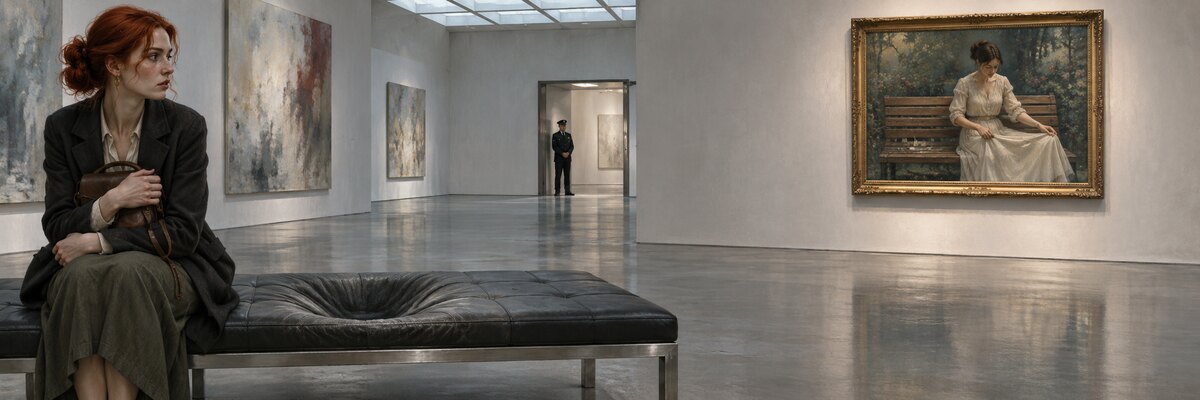
You sit because there is a bench. Nobody else has sat in this room, or so it seems: the padded leather is uncreased, cool enough to feel through your skirt.
The painting opposite contains a woman sitting on a bench. Her bench has wooden legs. Yours has a steel pedestal. It is not that sort of painting, then.
You read the label. The artist is dead. The woman may be his sister. No one is sure, though they have managed to be sure about the price of admission.
When you look up, she is leaning forward.
The guard at the door is occupied with a loose thread on his sleeve. You could ask whether the painting has always been like that. Instead you lean forward too, testing a childish explanation.
She remains still. There is no embarrassment in her stillness, and you begin to dislike her.
An elderly couple enters. They discuss the yellow in the sky and the possible influence of someone whose name you cannot catch. The woman in the painting looks past them at you. You can feel the effort it takes her. The couple moves on.
You stand.
The painted woman lifts a hand to her forehead and peers into the distance. Her face is no bigger than a plum. You had thought it too small to contain an expression so plainly irritated.
You sit. Her hand comes down.
At school you were punished for wriggling when a visiting artist drew the class. He had put you at the edge because of your red hair. Your foot went to sleep. Afterwards the school hung the drawing in the entrance hall, where your head appeared to belong to the girl behind you.
The woman points to the empty place beside her.
You inspect the bench. Still steel. Still yours.
“We're closing in ten minutes,” says the guard.
The woman points again, sharply now. You do not think she is inviting you into the painting. There is nothing welcoming in her face. She is asking you to move along.
You slide to the left.
Her eyes follow. She makes a little chopping gesture. Further.
At the end of the bench you wait. She turns her head towards someone beyond the frame. Her mouth opens. You cannot hear what she says, but the guard looks up from his sleeve.
“Nine minutes,” he says. “Sorry.”
A dark shape crosses the foreground of the painting. For a moment it obscures the woman's knees. It is broad and indistinct, the colour of the guard's uniform, though he has not moved.
The empty seat beside you sinks.
You stay very still. On the painted bench the woman smooths her skirt. She is no longer watching you. She has done what was required and can at last look somewhere else.
The leather creaks. A hand, or the pressure of a hand, settles on your bag.
You pull the bag onto your lap. Whatever else this is, you paid for that yourself.

No published comments yet.