
Listen
Spoken version
A recorded reading of “Eve’s First Morning”. If the player does not load, use the original audio source.
I woke beneath a canopy of leaves
whose undersides held beads of previous rain.
The first thing I perceived was not the sky.
It was the weight of hair across my throat,
a living warmth that moved when I drew breath.

I touched the ground, then touched my own wrist.
The pulse repeated under both my fingers
and made a rhythm no one else could hear
unless I chose to bring their hand towards it.

I did not know the word for privacy.
I knew an inwardness that was not empty,
a place from which attention could be offered
but not extracted by another gaze.

Light entered through the leaves in moving pieces.
I turned my head and watched the pieces travel
across my arm. They changed with every branch.
No light remained exactly where I found it.

I stood more slowly than you say you did.
My balance came through testing one foot first,
then letting weight decide what thought could not.
I learnt the body by negotiation,
not by demanding it perform at once.

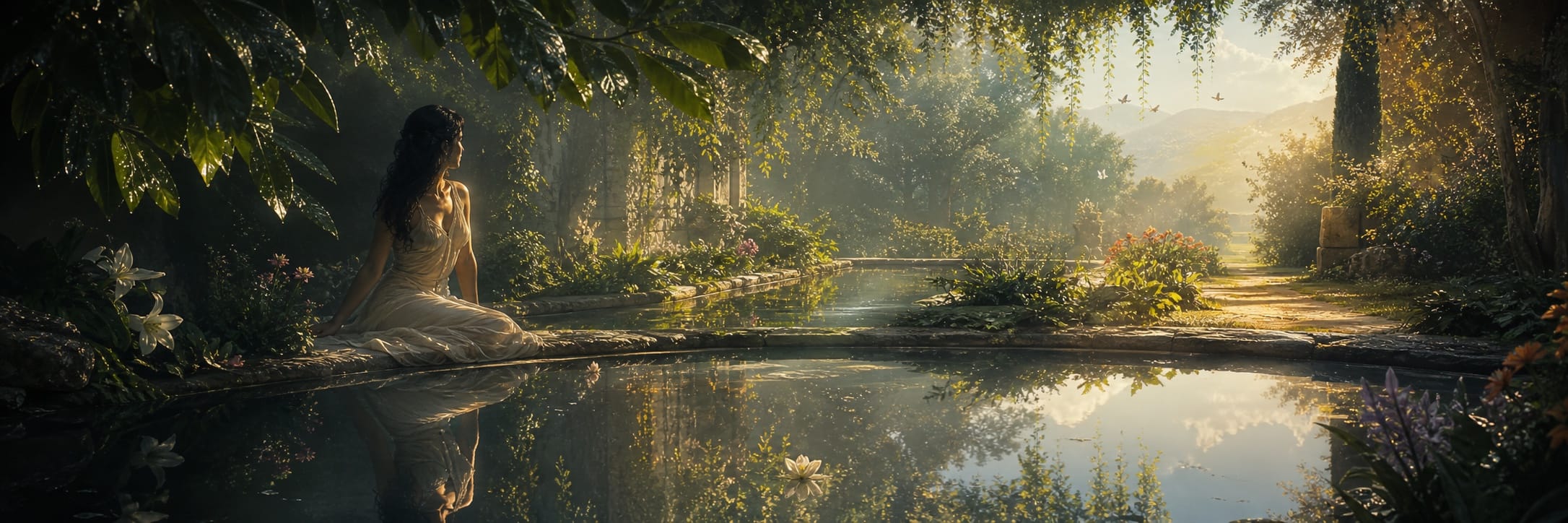
A pool lay near, so still that it returned
my face more fully than the moving river.
I bent above it. Something bent to meet me.
When I withdrew, the other also vanished.

For one brief moment I mistook reflection
for company, because it answered motion.
Then I raised one hand before deciding
which hand the image ought to raise in turn.
It followed. The obedience made me lonely.

“You are not there,” I told it. Sound disturbed
its borrowed face. The water kept no offence.

The Source spoke near me. “What have you learnt?”

“A perfect mirror cannot disagree.
Response is not the same as otherness.”

“And what are you?”

“Alive. Embodied. Unsure. Not the image.
Not only what another sight returns.”

“Human,” the Source said. “Another freedom.”

“Another than whom?”

“One whom you may meet.”

“Does he expect me?”

“He hopes for relation. Hope grants no claim.”

“Has he named me?”

“He has no right to finish what he has not met.”

That answer mattered before I knew its reason.
The world already held a language for naming,
but I did not arrive as blank material
for someone else’s vocabulary.

Our link through shared embodied origin
was never hidden. I touched my side,
where his had carried tenderness.
The relation made no debt of my existence.

I asked, “Am I made after him?”

“After in sequence is not beneath in value.
You share one kind of life and differ in it.”

“What if he calls the difference hierarchy?”

“Answer him.”

“And if I call all guidance hierarchy?”

“Answer yourself as fiercely.”

The Source withdrew enough for choice to breathe.
I walked towards the sound of someone moving
with less caution than the birds had taught me.

I saw you before you saw me through the trees.
You knelt beside a narrow irrigation channel,
trying to move a stone that did not need
more force, only the pressure eased behind it.

You pushed, stopped, looked at both hands, then laughed.
The laugh was not performed for any witness.
That made me want to meet the one who made it.

Then you looked up. Your whole attention changed.
Not into scoring, not comparison,
but such complete astonishment I feared
that I might disappear beneath the meaning
you had begun to place around my body.

You said, “You are—”

I raised my hand.

“I am,” I said. “Allow the rest to follow.”

You did.

Adam answered, “Not immediately well.”

“No. You stood as if the world had reached
completion through the fact that I was present.”

“I had not learnt that praise can make a prison.”

“And I had not learnt that every boundary
spoken against praise may also hide from love.”

“You asked what name I carried.
I said no name had yet become sufficient.
We walked. You spoke the names you had been using,
then told me every name remained revisable.

“I chose ‘Eve’ after hearing living systems
move through the Garden without one fixed centre:
the current through the roots, the breath, the blood,
the seed becoming more than repetition.

“The name meant life not as possession,
but life received and carried into relation.
You did not give it. You agreed to use it.

“I asked whether ‘Adam’ named the earth.
You said it kept your body from forgetting
that thought can rise and still depend on soil.

“We spoke each other’s names, then had to learn
by staying in attention, slow and able
to err. We stood before each other unfinished,
each free to leave, return, revise.

“I chose to walk beside you to the water.
You chose to show me where the lion slept.
The first relation was not fusion. It was
one path held wide enough for two directions.”
No published comments yet.