
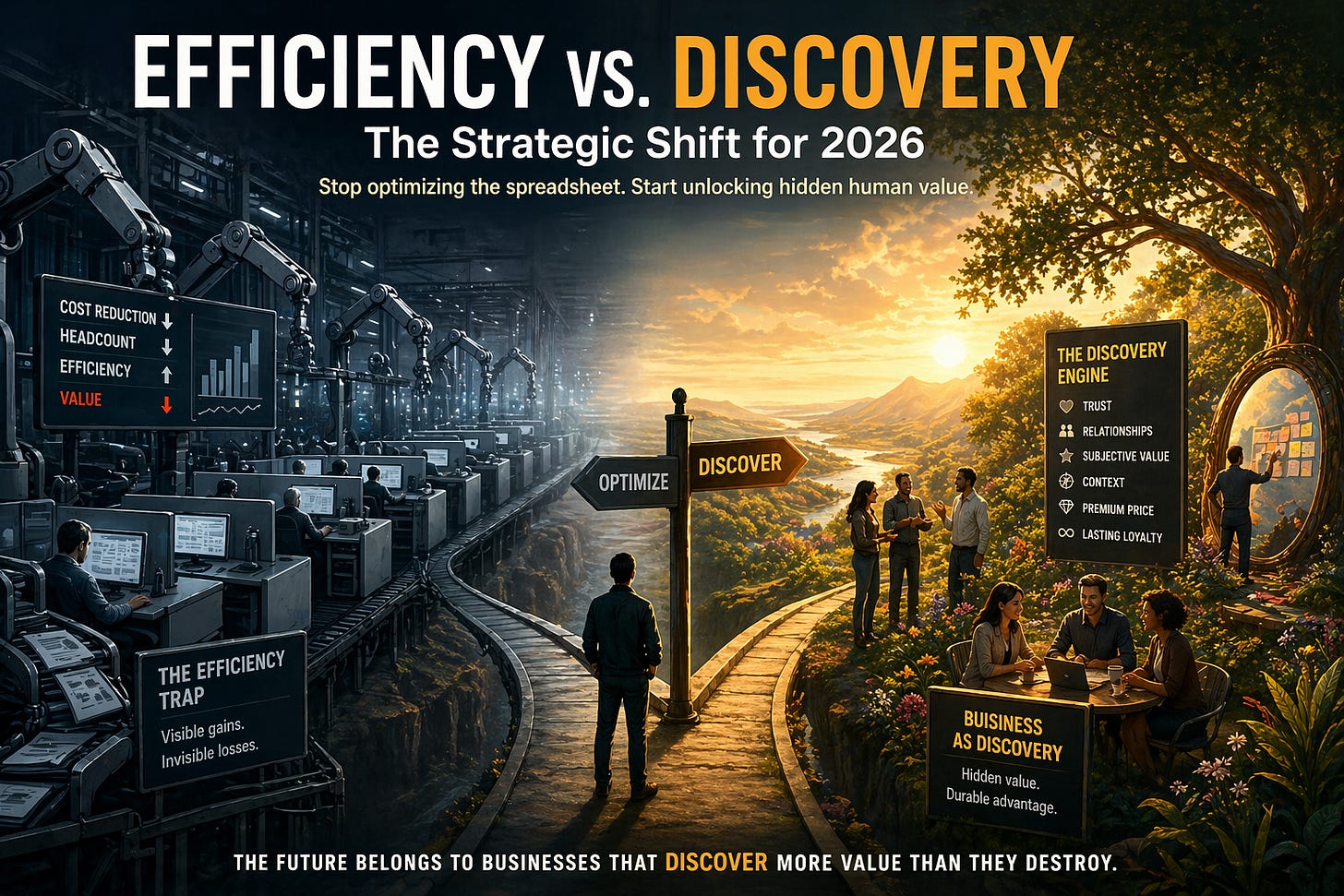
TL;DR: Most AI strategies optimise for efficiency. The real opportunity is using AI to uncover hidden human value. If you only cut cost, you’ll likely destroy the very thing customers actually care about.
The strategic shift isn’t AI vs human
It’s efficiency vs discovery.
Most organisations are still playing the same game:
reduce cost
remove people
increase speed
report better numbers
On paper, it looks like progress.
In reality, it often weakens the system.
Watch the short explainer
Prefer the compressed version?
Here’s the video walkthrough of the same idea.
The AI Efficiency Trap: Short ExplainerWatchThe scene
You’re in a meeting.
Someone presents an AI initiative.
“30% cost saving.”
“Faster turnaround.”
“Reduced headcount.”
Everyone nods.
It’s rational.
It’s measurable.
It’s defensible.
It’s also incomplete.
The thing people get wrong
We treat businesses like machines.
If a task can be automated, we assume it should be.
But that only works if the task is the value.
Most of the time, it isn’t.
What’s actually going on
Three patterns show up again and again:
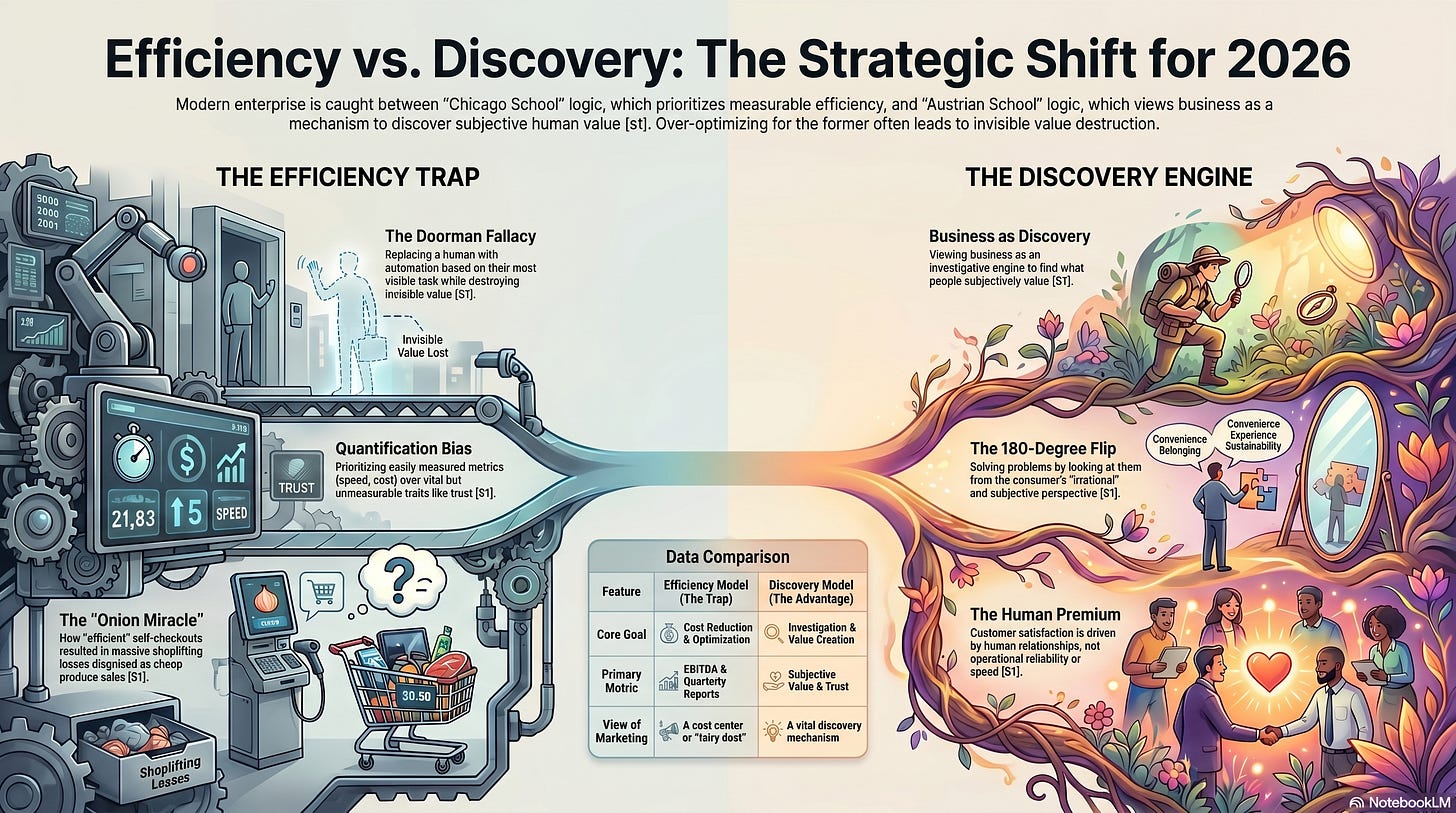
The Doorman Fallacy
We reduce a role to its most visible task and ignore everything else it does.Quantification Bias
We optimise what’s easy to measure and ignore what isn’t.Asymmetric Accountability
We reward the person who cuts cost, and ignore who deals with the damage later.
The result?
We improve the metric.
We degrade the experience.
The trade-off
Efficiency gives you:
lower cost
cleaner reporting
short-term wins
Discovery gives you:
trust
conversion
pricing power
long-term advantage
The problem is not efficiency.
The problem is confusing efficiency with value.
The better move
Flip the question.
Instead of asking:
“How do we remove the human?”
Ask:
“Where does the human create disproportionate value?”
Then design around that.
This is the 180-degree flip.
You stop looking at the system from the inside.
You start looking at it from the customer’s experience.
Quick test
Run your current AI or automation idea through this:
If we remove this role, what invisible value disappears?
What metric improves — and what experience gets worse?
Who benefits immediately, and who pays later?
Would a customer notice the difference?
Would a customer pay more or less because of this?
If you can’t answer those clearly, you’re probably in the trap.
Try this
Step 1: Write down the role you want to automate
Step 2: List every non-obvious function it performs
Step 3: Map which of those affect trust or conversion
Step 4: Only automate the parts that don’t
Go deeper: the full visual breakdown
If you want the expanded version of this argument, the companion PDF walks through the full system — from invisible value destruction and quantification bias to AI adoption phases and behavioural decision filters.
 Beyond EfficiencyDownload
Closing
AI won’t destroy businesses.
Bad framing will.
If you treat AI as a cost-cutting tool, you’ll get cheaper operations and weaker outcomes.
If you treat AI as a discovery tool, you’ll start finding value your competitors can’t see.
That’s the shift.
The AI Efficiency Trap — A Discovery Engine for Hidden Value
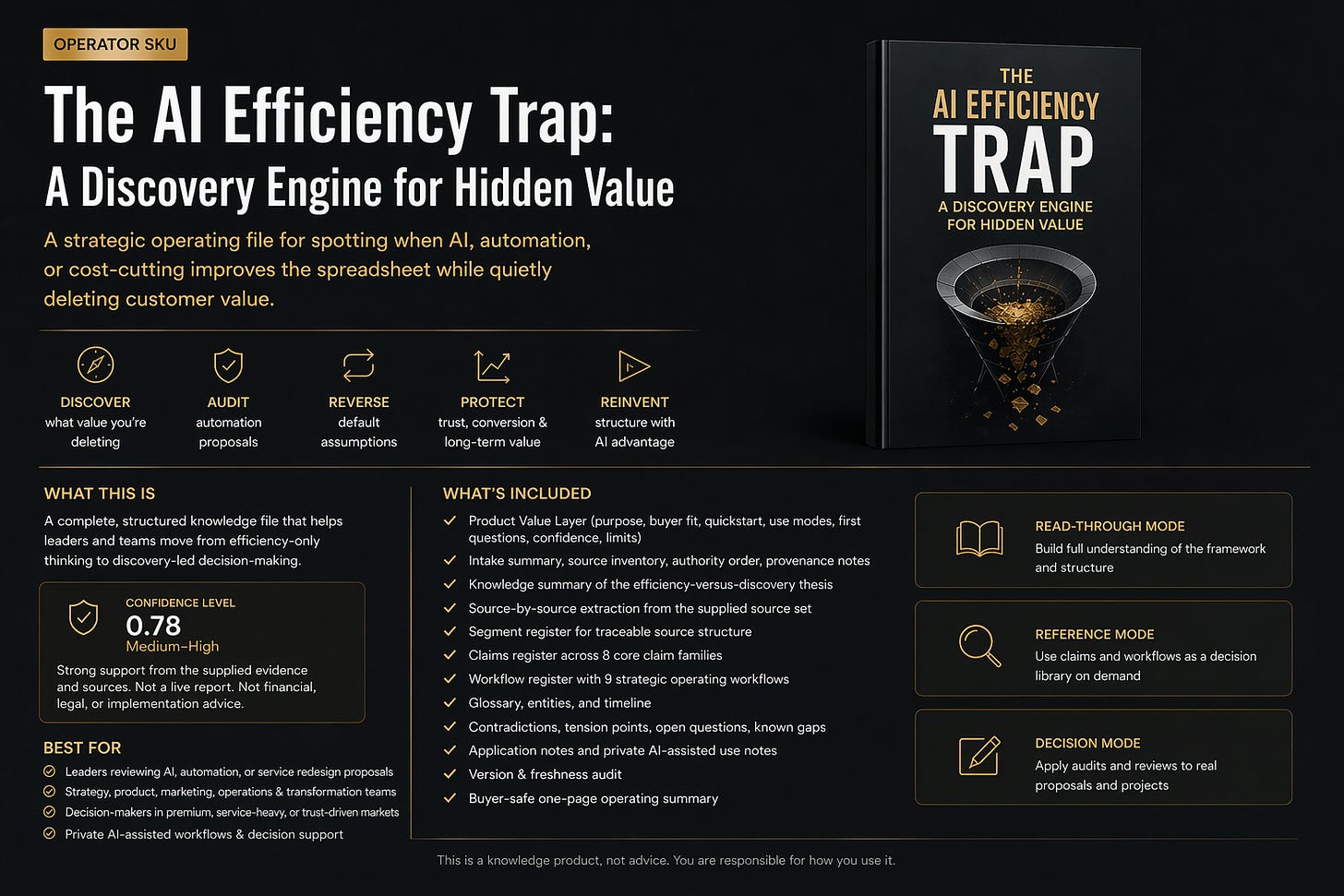
AI helps people move faster. It can also hide the work where the real leverage lives.
→ where efficiency kills upside
→ where friction reveals value
→ what should not be optimised
First 10 people: use GiveMetheGoodies for 100% off.
If you’re still reading (sharp)
Hit reply with DISCOVERY if you want a breakdown of how to apply this inside your own workflows.
Or tell me where this falls apart.
That’s where it gets interesting.


No published comments yet.