
A decimal odometer and a prime wheel both repeat. Put them side by side and a useful question appears: how do their cycles line up, and what happens to the moment when the odometer carries?
For base ten and the familiar wheels modulo 30 and 210, one shared factor answers both questions. It fixes which pairs of states can occur, determines the joint period, and guarantees that every carry endpoint is rejected by either wheel.
The shared state
Track an integer label t in two ways: its last k decimal digits, t mod 10^k, and its residue modulo a wheel modulus M. Here M is either 30 or 210, and k is any positive integer.
The two moduli share exactly a factor of 10. So a proposed pair of residues is reachable precisely when the decimal state and wheel state agree modulo 10. The generalized Chinese remainder theorem then gives one combined state modulo the least common multiple.
That least common multiple is the period of the joint state. For modulus 30, it is 3·10^k; for modulus 210, it is 21·10^k. Each joint period contains 10^(k−1) complete turns of the wheel. Since each full turn retains 8 residues modulo 30 or 48 modulo 210, the survivor totals are 8·10^(k−1) and 48·10^(k−1) respectively.
| Wheel | Survivors in one wheel cycle | Joint period | Survivors in one joint period |
|---|---|---|---|
| Modulo 30 | 8 | 3·10^k | 8·10^(k−1) |
| Modulo 210 | 48 | 21·10^k | 48·10^(k−1) |
Why the carry disappears
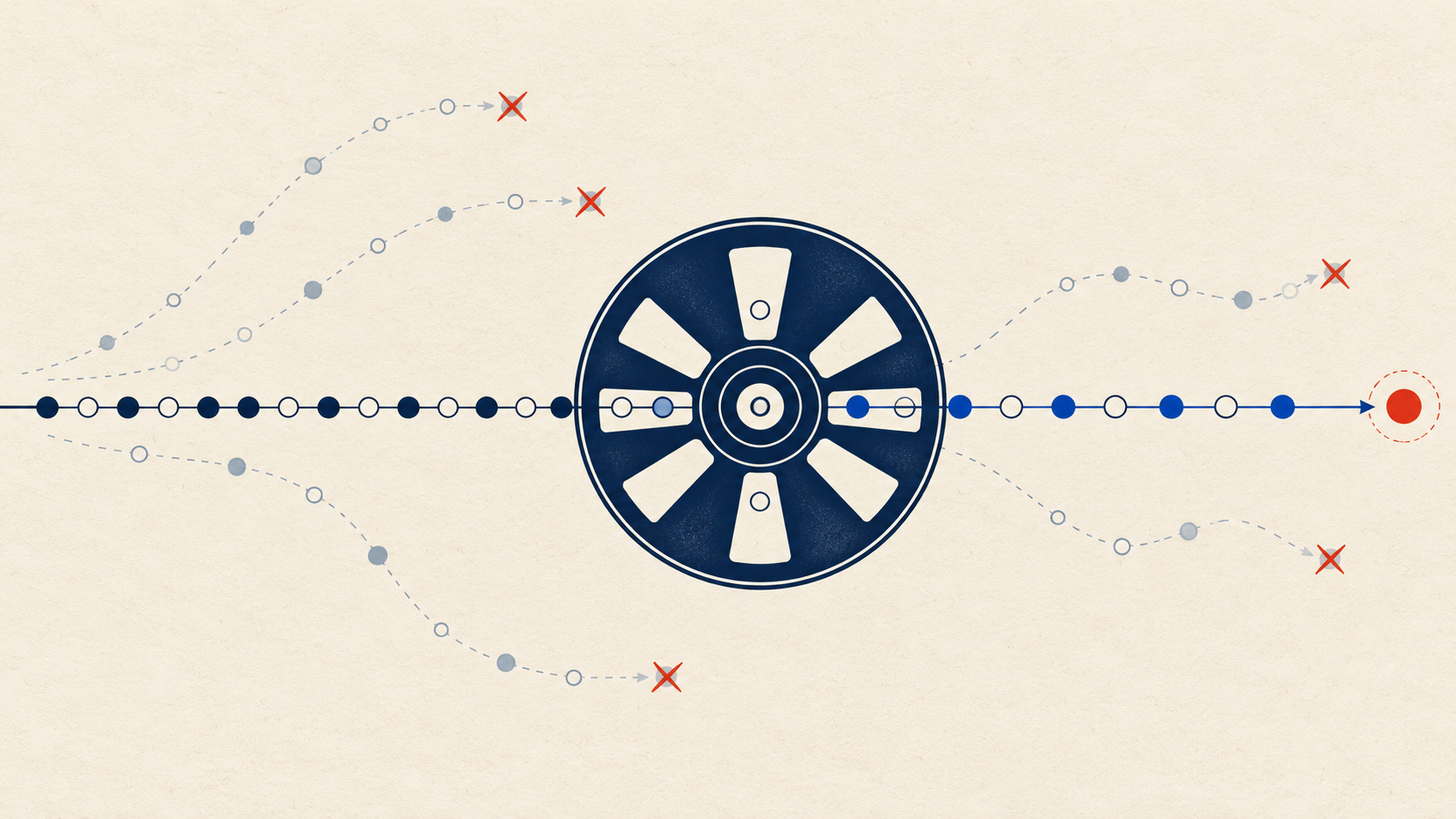
A carry through j decimal places occurs at a label divisible by 10^j. Every such label is divisible by both 2 and 5. Neither wheel can retain it: being coprime to 30 or 210 is a necessary condition for survival.
This is a filtering statement, not a primality test. A wheel survivor can still be composite, and 1 survives a coprimality filter unless it is handled separately.
A two-digit example
Take the mod-30 wheel while the decimal display tracks two digits. The joint period is 300. Decimal state 37 mod 100 is compatible with wheel phases 7, 17 and 27 modulo 30. The corresponding labels 37 and 137 survive; 237 does not, because it is divisible by 3.
The example also shows why the decimal display alone does not determine whether a candidate survives. The final wheel phase matters too.
What was checked
The accompanying standard-library script enumerates complete joint periods for k=1,2,3 and both wheel moduli. It checks reachable state pairs, compatibility modulo 10, survivor totals, per-state counts, final-digit distributions and carry rejection. The algebra gives the formulas for every positive k; the enumeration is a finite cross-check of the first three cases.
The scope is deliberately small: base ten and the mod-30 and mod-210 wheels. The derivation applies standard modular arithmetic and the generalized Chinese remainder theorem to those cycles. It is not a new theorem, prime predictor or sieve method, and it makes no novelty claim.
For the related finite prime-ranking tests, see A Clever Prime Score Can Still Lose to the Wheel. The complete derivation, source map and runnable verifier are in the Research Artifact Ledger artifact, with its source-to-claim map and finite-check script.
AI assistance disclosure
AI assisted with drafting and editorial development.
OpenAI GPT models, accessed through Codex, materially assisted the mathematical analysis, source and reference checks, finite-check review, preparation and revision of this text, and creation of the conceptual cover. The general formulas are supported by the stated algebra; the script checks only k=1,2,3. The model-assisted review and finite enumeration are not independent human mathematical specialist review or formal proof-assistant verification. The author is responsible for the work. The retained research record does not provide a complete model-version history, and no complete history is claimed. The cover is an AI-generated illustration, not a diagram of experimental data.
No published comments yet.