
Listen
Spoken version
A recorded reading of “Salt Road at Midnight”. If the player does not load, use the original audio source.
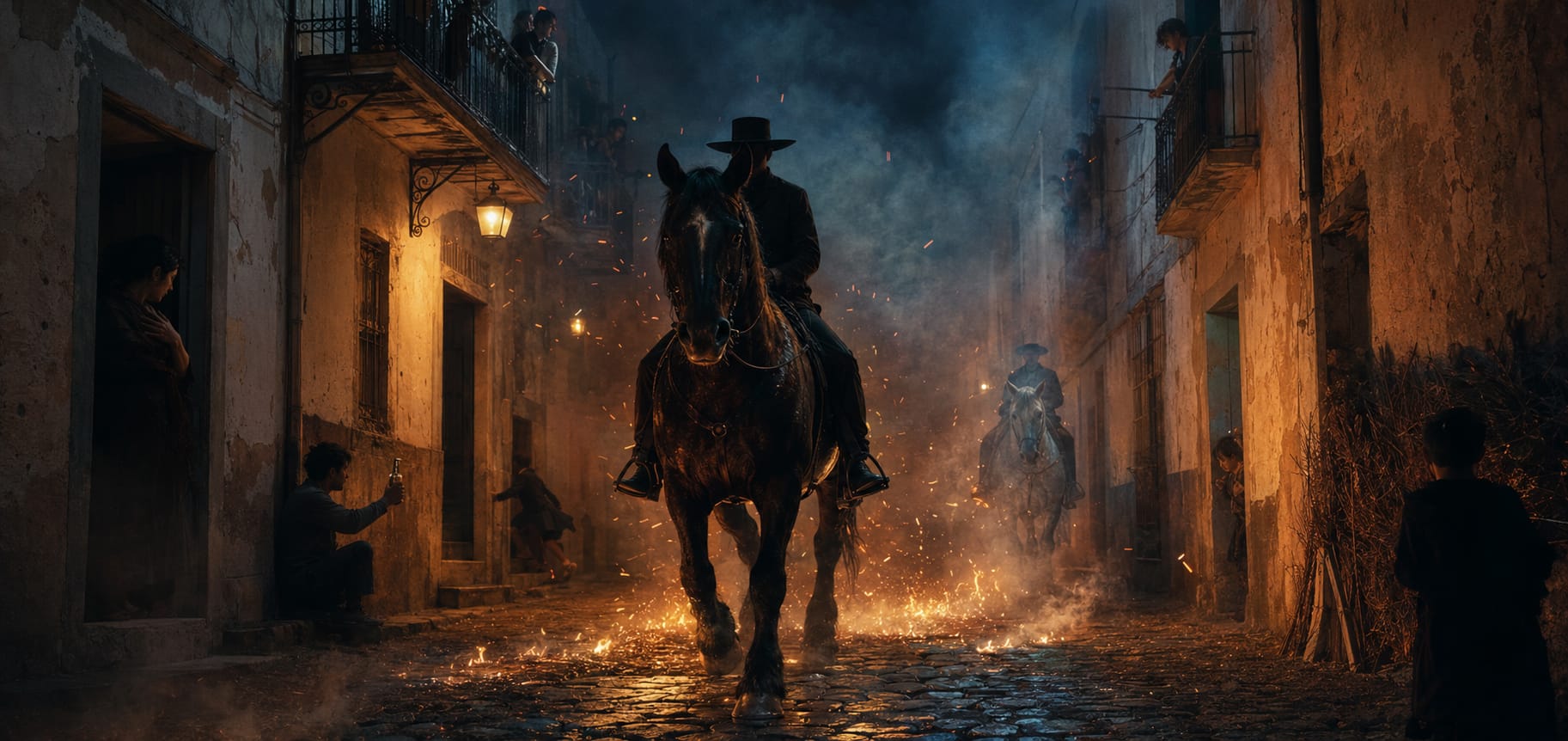
The lane narrows to smoke and bell-metal.
Balconies lean in like witnesses
who have seen this before and will not swear to it.
Under the lamps, the night keeps changing skins—
ash-blue, copper, then the blunt orange
of broom and branch giving up their names.

A horse steps out of the furnace
as if fire were only weather.
Its ears are two dark leaves
feeling for the gap ahead.
The rider sits still as a nail in a beam,
hands quiet on the reins,
while sparks break loose by the thousand
and skitter up the walls.

Around them, the street learns old verbs:
flare, hiss, blacken, endure.
Children vanish into doorways.
A man tips a bottle back for courage.
A woman marks her chest in smoke.
Hooves strike the stones
and each strike is something the body knows
from before writing—
go on,
go through,
go on.

What burns is not only the stacked brush,
not only the dry ribs of broom.
The horse carries a weather older than fear:
hide slicked dark, nostrils wide,
the bit wet at the mouth.
Even the white one, ghosting out of the thick dark,
takes the blaze like a river at night—
not to conquer it,
not to love it,
only to find the far bank there.

By then the crowd is no longer watching fire.
They are watching passage.
How a road made cruel can still be crossed.
How smoke parts for chest and lifted knee.
How sparks, once risen, look almost tender
at a distance.

And when the rider is gone
the lane keeps that shape for a moment—
heat trembling in the air,
hoofbeats folding deeper into stone—
then only singed rosemary,
and one bright ember in the black dust.

No published comments yet.