
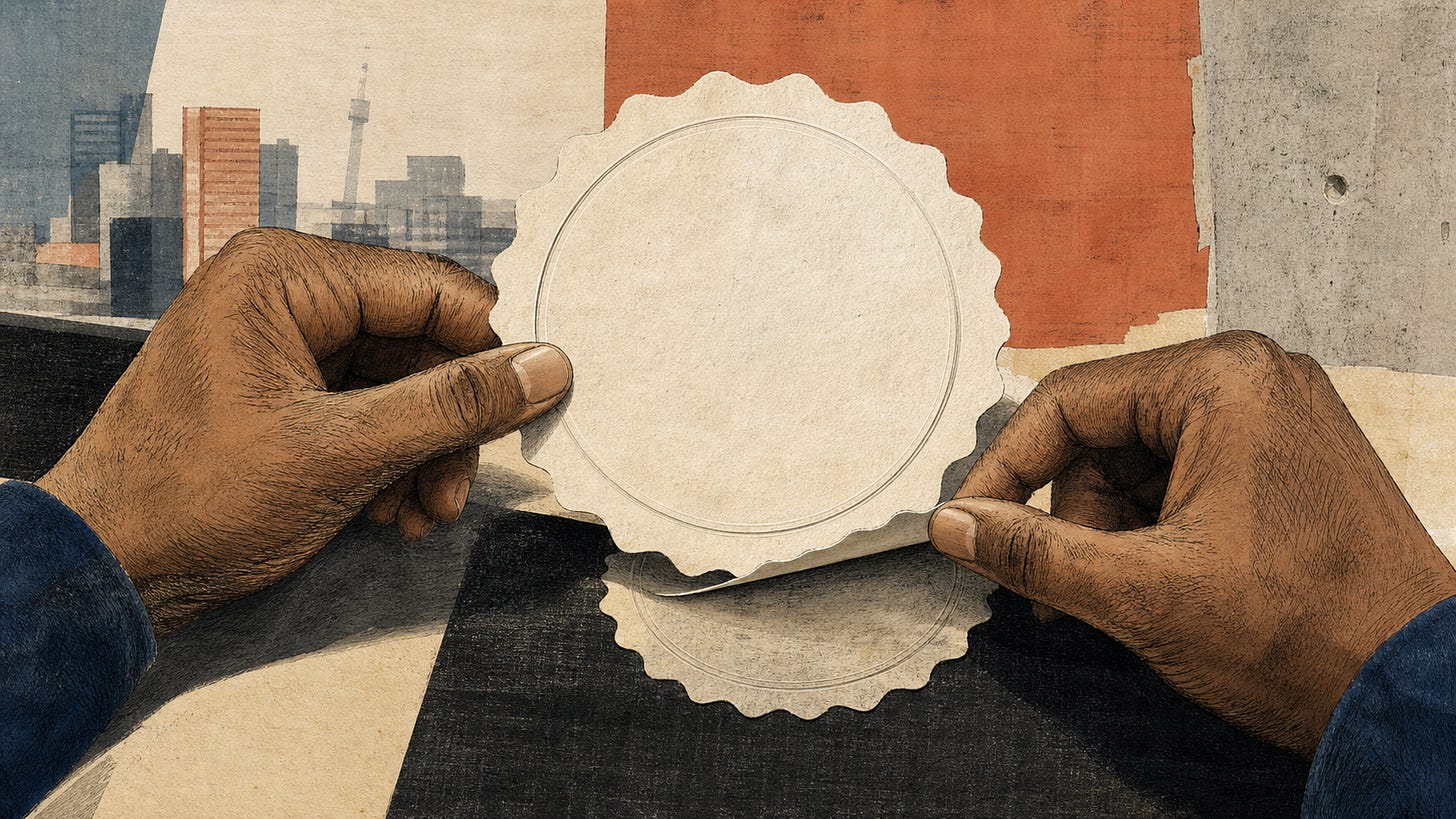
TL;DR: The problem is not that everything is a lie. The problem is that signals we once treated as proof, such as a professional website, a familiar logo or a confident message, are now cheap to manufacture. When digital credibility is easy to counterfeit, we look for trust in things that require presence, accountability and a history of behaviour.
There is a particular kind of exhaustion in having to verify ordinary life in South Africa.
It is not only the pressure of rising costs, unreliable services or planning a journey around safety. It is the small daily tax of checking whether the thing in front of you is real.
Is that WhatsApp message from the bank? Is the person offering the job actually connected to the company? Is the rental listing genuine? Is the voice note from your child or your boss, or is it a convincing imitation? Is the website an organisation, or simply a landing page wearing its logo?
The old scams are still here. South Africa has never been short of advance-fee schemes, pyramid promises, fake tenders or the person who needs one more payment before the money can be released. What has changed is the quality and reach of the disguise. The same lie can now be generated, personalised and sent to thousands of people within minutes.
A scam does not have to look suspicious anymore. It can arrive with the right logo, a plausible profile picture and a message written in the institution’s usual style. It can borrow the identity of an organisation we recognise. It can reach us in the places where we already spend our attention.
SABRIC’s detailed 2024 report recorded nearly 98 000 reported digital-banking fraud incidents, up 86% from the previous year, with gross losses of about R1.9 billion. The report says the attacks relied on social engineering and human error rather than a technical breach of banking platforms. It also flags AI-generated messages and early cases of voice-cloned deepfakes. SABRIC’s report does not show that every digital transaction is unsafe. It does show that the old visual shorthand for legitimacy is under pressure.
We are being asked to verify more, at the same time as the tools for imitating verification become cheaper.
A logo cannot do this job alone
The National Department of Human Settlements warned about social-media accounts offering RDP houses for as much as R100 000. The Western Cape Government warned about WhatsApp messages offering housing assistance for a fee. SAPS warned about fake letters carrying its logo and the names of senior officers.
These scams reach further than a bank account. They exploit the mental shortcut that lets us move through the day without investigating every sentence. We see the logo and relax. We recognise the name and assume the message belongs to the organisation. We hear a familiar voice and respond to the person rather than the request.
That shortcut was useful. It is now one of the things an attacker can use.
This is why “just be more careful” is an incomplete answer. Carefulness helps, but it cannot solve a system in which the evidence itself is being mass-produced. The burden of proof keeps moving to the individual, even when there is no reasonable way to authenticate what they are seeing.
People do not necessarily stop believing everything. They start deciding that different kinds of evidence matter.
Trust becomes expensive again
When a digital signal costs almost nothing to reproduce, we start looking for proof that costs something.
That may mean calling the bank using the number on its official website rather than replying to the message. It may mean checking a property in person, asking someone in the neighbourhood, or refusing to pay a deposit until the paperwork and ownership have been verified independently. It may mean asking for a referral from someone you know instead of trusting a polished profile with thousands of followers.
This is slower and often inconvenient. It also makes deception harder.
Trust has always had a physical and social side. We learn who someone is by watching what they do over time. We take confidence from people who have shared a workplace, a street, a congregation, a sports club or a family network with us. A person who has to answer for their behaviour to other people has more at stake than an anonymous account that can disappear overnight.
The body is not a moral certificate. People can lie in person. Physical spaces can be dangerous. In South Africa, “just meet them face to face” is not universal advice. It depends on access to safe transport, public space and social protection. The offline world should not be romanticised as innocent.
Still, presence changes the economics of deception. It adds friction and context. We can notice hesitation, inconsistency, familiarity and care. Other people can confirm or challenge what we have been told.

The return of the third place
This is one reason local, repeated spaces may become more valuable: a running club, church group, community hall, school gate, neighbourhood market, regular barber, co-working space or braai where somebody knows somebody who has actually used the service.
These places are not automatically trustworthy. They are useful because they create continuity.
An algorithm can show me a thousand strangers who appear to agree with me. A local space lets me encounter people I did not choose, in circumstances that are harder to stage. That can be awkward. It can also be a beginning.
The same shift is visible in work. A CV, portfolio or LinkedIn profile is useful, but it cannot stand in for competence on its own. Employers and clients need demonstrations, conversations, references, working sessions and observable judgement. Credentials have not become meaningless. Files and profiles are simply easier to generate than the ability to explain a decision under pressure.
Education faces a similar problem. If a submitted assignment might have been generated by a machine, detection software cannot restore certainty by itself. A more durable test is whether a student can discuss the work, defend the choices and apply the idea somewhere unfamiliar.
That is not a rejection of technology. It is a return to evidence.

The wellness version gets this half right
The current interest in nervous-system regulation, breathwork, sleep, walking, strength training and other embodied practices can look like another market trend. Some of it is. Wellness is full of inflated claims, expensive packaging and dashboards that turn a human body into a stream of metrics.
Underneath the sales language is a reasonable hunger. People want an experience that cannot be fully outsourced to a feed.
The danger is that we respond to a crisis of digital trust by buying another layer of digital measurement. The screen that failed to tell us whether a person was sincere now tells us whether our sleep was restorative. The platform that trained us to compare ourselves now gives us a score for recovery.
Measurement is not the enemy. The question is what it is for. Does it help us notice our experience, or does it replace experience with a number that can be sold back to us?
A practical trust test
Before accepting a high-stakes request, ask:
Can I verify the person or organisation through a separate, official route?
Is the request asking me to rush, keep it secret or bypass a normal process?
Who is accountable if the promise fails?
What evidence exists outside the message, profile or website making the claim?
Is there a safer way to test the relationship before sending money, data or authority?
The point is not to become paranoid. It is to verify the request somewhere other than through the signal being used to persuade you.
What should brands do?
For brands, this changes what trust has to mean.
A verified badge, a polished website, a founder video and a few testimonials can support credibility. They cannot carry it on their own. In a world of synthetic media, trust has to show up in the organisation’s behaviour.
That means making it easy to verify who is speaking, where a claim came from, what happens when something goes wrong and which person is accountable. It means fewer theatrical promises and more visible process. Customers should have ways to experience the product, speak to the people behind it and see the work in context.
The strongest brands will not be the ones that look the most authentic. They will be the ones whose conduct makes the claim less important.
We are not going back. We are going deeper.
The answer to a world of scams is not to abandon the internet, refuse every tool or pretend that physical life is pure. South Africa’s digital systems create access, speed and opportunity that many people cannot afford to lose.
The answer is to stop confusing convenience with proof.
When a screen can imitate almost any signal, the signals that remain valuable are connected to consequence. There is a person who can be reached, a business with a history, a community that remembers, a process that can be inspected, a claim that survives questioning or a service that works when the camera is off.
We are not being forced back into a perfect offline past. We are being pushed to rebuild the parts of trust that convenience hid from us.
That will be slower and more local. It will require better judgement from institutions and more effort from all of us.
It may also be healthier than the world we have been offered, where every signal is optimised, every relationship is mediated and every promise arrives pre-polished.
Sometimes the thing that feels most real is not the thing that looks most convincing. It is the thing that can still answer when you ask, “Who is responsible for this?”


No published comments yet.