
Most local dev setups do not fail because they are too simple. They fail because they become a pile.
A repo here. A cache there. A forgotten port conflict. A WordPress site that wants one workflow, a Vite app that wants another, and a toolchain that quietly assumes they should all behave the same.
That is usually where local environments start becoming annoying instead of useful.
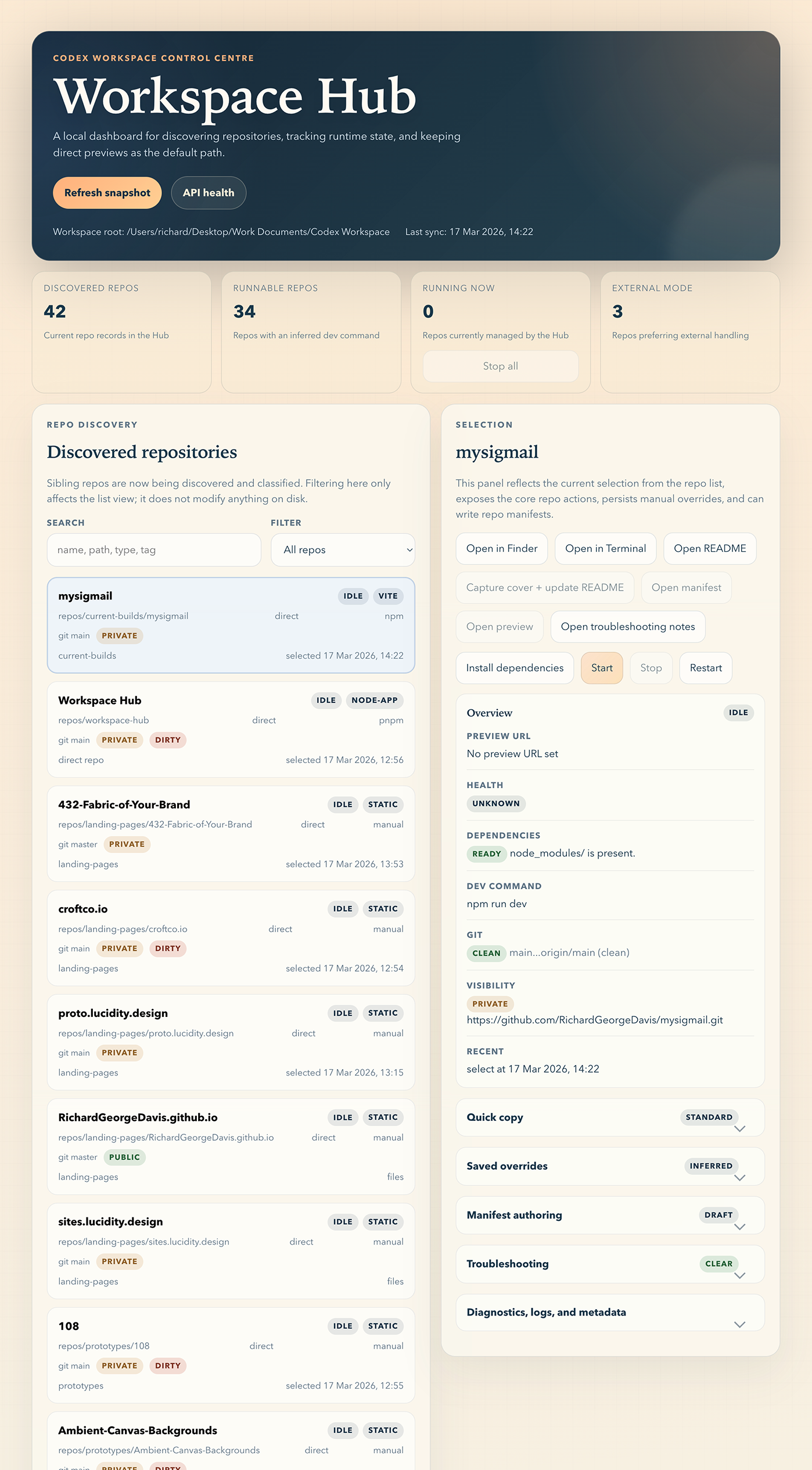
Codex Workspace is my solution to that mess: one central workspace on a Mac desktop, one predictable place for active repositories, shared tooling and caches where that makes sense, and a separate Workspace Hub app to browse, launch, stop, and preview projects without forcing every repo into one brittle runtime model.
You can explore the project here: RichardGeorgeDavis/Codex-Workspace.
The real problem is not “too many repos”
The problem is inconsistent assumptions.
One project wants Local. Another wants a plain static server. Another runs on Vite. Another is WordPress but still needs to sit neatly inside the same working environment. Then someone decides the answer is one giant shared setup that makes everything technically connected and practically worse.
That is the trap.
Codex Workspace takes the opposite view: repositories should stay independent, while the workspace around them becomes more predictable.
That matters. Because “centralised” and “monolithic” are not the same thing.
What Codex Workspace actually is
At the top level, the system is built around three layers:
Codex Workspace as the parent folder on disk
Workspace Hub as a separate repo that acts as the local control centre
Repo-native runtimes so each project can still run in the way that best suits it
That third point is the one that keeps the whole thing honest.
The guiding rule is simple: every repository should remain runnable without becoming hostage to one master environment. Shared structure is useful. Forced uniformity is not.
Why this model works better than the usual “one setup to rule them all”
A lot of local dev tooling gets seduced by uniformity.
Uniformity looks tidy in a diagram. It often falls apart in daily use.
Real desks are messy in more useful ways. One project is static. One is WordPress. One is a Vite app. One is an experiment. One needs a proper local domain. Another only needs a port and a browser tab.
Codex Workspace is built around that reality instead of pretending everything should behave the same.
Not every project wants to be proxied.
Not every site should be launched the same way.
Not every repo deserves the same amount of orchestration.
The Workspace Hub is the real leverage point
The interesting part is not the folder structure. The real leverage is the Workspace Hub.
That is where the workspace becomes practical rather than theoretical: a local control layer that makes it easier to browse repos, launch what needs launching, stop what needs stopping, and get to previews faster.
The point is not to replace Git, package managers, or project-specific tooling. The point is to reduce friction around them.
In practical terms, that means a setup that can:
scan sibling repos
classify projects conservatively
read optional per-repo metadata
launch and stop local commands
open previews quickly
preserve lightweight project context without overengineering the stack
That is a better ambition than trying to automate absolutely everything.
Structured, without becoming overbuilt
One of the biggest risks in an internal tool like this is overreach.
It is very easy to move from “useful local launcher” to “bloated platform nobody wants to maintain”.
This project works best when it stays disciplined: build the useful layer first, keep overrides manual where needed, and avoid pretending version one needs to solve every runtime edge case.
That is not a compromise. It is product judgment.
A lot of internal tools fail because they try to become universal before they become dependable.
Codex Workspace is stronger when it stays focused on being dependable.
What makes the idea valuable
The deeper value here is not just repo management.
It is operational clarity.
The aim is to create a local working environment where:
projects remain portable
shared caches improve speed without merging project dependencies
metadata stays lightweight
previews stay easy to reach
the orchestration layer stays separate from the repos it is helping manage
That is useful whether you are juggling client WordPress builds, static sites, experiments, utilities, or mixed-stack projects that do not naturally fit a single workflow.
In other words, this is less about building a flashy dashboard and more about building a trustworthy working surface for real local development.
Where this gets stronger over time
The next layer is not more cleverness. It is better confidence.
Which repo is ready to run?
Which one is missing something?
Which one is dirty?
Which one only looks healthy until you click into it?
That is where a workspace like this becomes more than convenient. That is where it starts becoming genuinely useful.
Final thought
The best part of Codex Workspace is that it does not pretend every project should behave the same.
It chooses clarity over cleverness.
It shares structure without collapsing everything into one dependency model.
It centralises visibility without centralising runtime dogma.
And it gives me a more usable way to manage real local development across mixed stacks.
That is the difference between a setup that sounds good in theory and one that actually holds up in daily use.


No published comments yet.