
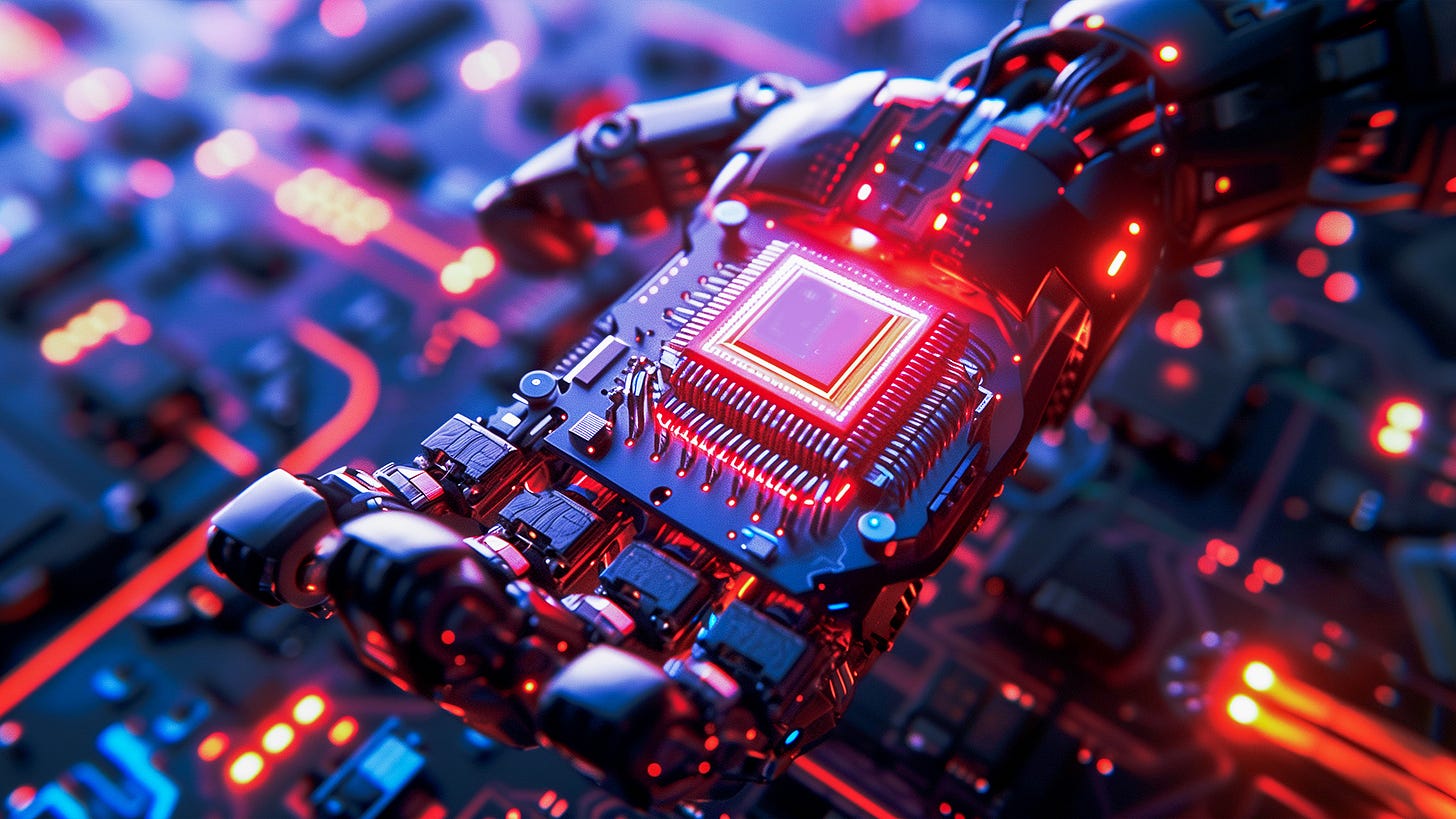
AI’s impact on creativity, design, and society — and why the human touch is about to become a luxury.
TL;DR: We’re in a hype cycle that still has runway. The moral goalposts around copyright and privacy have shifted, the real moat belongs to Big Tech, and design work is tilting toward “promptcraft.” The counter-trend? Human connection as a premium feature. Use the tools, keep the soul.
Let’s be honest: if one more product announces “now with AI,” your eyeballs might auto-roll into a factory reset. Same. I’m fascinated and exhausted — which, conveniently, is the perfect mindset for clarity.
The pace is absurd. New models drop monthly; micro-tools spawn daily. Feeds are a bingo card of “revolutionary” launches. Keeping up is a full-time job that pays in FOMO. And yet — we’re nowhere near done. My bet: we’ve got ~20 months of ascent before this thing plateaus into normal life.
Call this Act Two of the AI era: Everything Is AI Now.
The Moral Shift: When “Plagiarism” Rebranded as “Training Data”
One of the biggest vibe shifts is around creative ownership. We’ve quietly slid from don’t copy my work to please feed the machine so it can help all of us. Platforms scrape, ingest, and remix at scale. Some even opt you in by default. Ten years ago, that’s a scandal; today, it’s a checkbox in settings.
The privacy playbook repeated itself. First we gave up data for convenience. Now we’re trading fragments of our creative output for speed. Sometimes that’s a fair trade. Sometimes it isn’t. But the cultural Overton window moved — and it didn’t ask permission.
Net effect: attribution feels fuzzy, compensation is even fuzzier, and the definition of “original” is getting psycho-logically renegotiated.
The Generational (Actually, Mindset) Split
This isn’t strictly age; it’s comfort with chaos. If you grew up when IP, jobs, and privacy felt stable, AI looks like an eraser. If you grew up in the remix economy, AI is just a power tool.
Stability Brains: “What does this do to craft, credit, and careers?”
Velocity Brains: “Move fast, figure it out later.”
Here’s the paradox: the people building the rails (infra, capital, standards) are often the ones most uneasy about the train. Meanwhile, the youngest users are already surfing the wake.
Demystifying LLMs: Autocomplete With Swagger
Large Language Models aren’t sentient. They’re astonishing pattern predictors that guess the next token with style. When they nail it, it feels like understanding. It isn’t. It’s mathematics wearing charisma.
This matters because it sets healthy expectations. LLMs are collaborators, not cofounders. They accelerate, suggest, and simulate — but they don’t care, intend, or take responsibility. Keep humans in the loop where stakes, nuance, and ethics live.
Design After AI: From Figma to “Promptcraft”
Design’s been marching toward standardization for a decade: systems, tokens, templates. AI simply pressed turbo.
Layouts, patterns, and marketing assets? Seconds, not hours.
Variant generation and testing? Infinite.
Average quality? Up. Differentiation? Down — unless you fight for it.
The role shift is real: less pixel-pushing, more taste, orchestration, and editing. You’ll still need designers — but the best ones will think like creative directors who wield models with intent, not like human plug-ins for deterministic tasks.
Romantics (hi) can mourn the craft. Or we can reframe: the scarce asset becomes judgment. Taste is the new throughput.
The Counter-Movement: Make It Human Again
The more our interfaces feel like airports, the more we’ll crave a neighborhood café. Expect “Human Mode” to become a paid tier.
“Talk to a human” buttons as status symbols.
Hotels bragging about concierges instead of kiosks.
Brands labeling work Human-Made the way food labels say Organic — a signal with placebo power.
People don’t only buy outcomes; they buy stories about outcomes. The story of a human who cared will keep commanding a premium.
The Real Winners: Compute Clubs Only
Running frontier models isn’t cheap. As the dust settles, a few providers own the pipes, the chips, and the clouds. Most of us rent the magic by the token.
That doesn’t negate democratization; it just frames it. Access is broadening. Ownership is consolidating. Plan accordingly.
So… Are We Over AI Yet?
No. We’re moving from shock to sorting. The novelty fades; the utility stays. The job now is to choose with intent:
Where will we automate without apology?
Where will we insist on human care, even when it’s slower?
How will we signal that difference to customers in ways they can feel?
Use the tool. Keep the soul.
Try This (If You Work in Design or Content)
Create a Human-First Tier: response times slower, quality higher, a dedicated person you can name. Price it like white-glove.
Add a Provenance Line under deliverables: “Drafted with AI assistance, edited by [Name].” Radical transparency builds trust.
Build a Taste Library: reference boards, brand heuristics, banned clichés. Feed your models better inputs; your team, better references.
Track Delta Time: what took you two hours last year might take 20 minutes now. Reinvest the delta in exploration.
If You’re Still Reading (Bless You)
Hit reply with HUMAN if you want a follow-up on practical, human-first workflows in an AI stack — hiring, process, and pricing. Or tell me where you think I’m completely wrong. That’s the best part of the Internet when it’s working: we make each other sharper.


No published comments yet.