
Two equations in a paper on matter-wave interferometry are presented as expressions for the same pattern under different collapse-model settings. In the pinned version examined here, setting the collapse factor to its unitary value in one expression does not reproduce the other expression as printed. The discrepancy is a source-level observation; it does not tell us which expression the authors intended to change.
The same paper gives a continuous spontaneous localisation (CSL) coherence factor whose limits are easy to misstate. Reading the equations together helps keep three questions apart: what the expressions print, how the stated CSL factor behaves, and whether any resulting pattern difference could be resolved in a particular experiment.
The pinned expressions do not match at the unitary setting
Toroš and Bassi's 2017 paper derives matter-wave interference expressions for several collapse models. In the inspected second arXiv version, Eq. (7) and Eq. (15) differ in two phase terms. Eq. (7) has detector-position coefficient and quadratic term . Setting in Eq. (15) gives and , respectively, where .
Thus the detector-position coefficient differs by a factor of two, and the sign of the quadratic-phase term is reversed. The text following Eq. (16) describes the presence of as the difference between Eqs. (7) and (15), which makes the printed comparison worth flagging. It does not identify an author-approved correction. For the bounded CSL comparison below, Eq. (15) at is used as the unitary comparator; Eq. (7) is retained as the other printed expression.
This is specific to the inspected arXiv v2 and its stated paraxial single-particle expressions. The source comparison does not establish whether the same discrepancy appears in the journal version or whether either printed expression should be corrected.
What the CSL factor bounds
The mass-proportional CSL coherence factor in Eq. (53) can be written as
Using
the integral lies strictly between zero and one for finite nonzero . When , this gives
for finite nonzero separation. Continuity gives , while the large-separation limit is , not zero. These are algebraic consequences of the cited equation, not measurements or fitted bounds.
How this enters the stated near-field pattern
In the near-field grating expression, Eq. (49), the factor is evaluated at the separation associated with each harmonic. The zero harmonic has zero separation and is unchanged. Existing nonzero harmonics are multiplied by their corresponding damping factors. A changed factor does not guarantee a detectable pattern difference for every geometry or apparatus: that depends on which separations contribute and on measurement conditions.
What this comparison does not establish
The comparison is a version-pinned source review and bounded derivation. It does not establish an author correction, a reproduced likelihood or experiment, an apparatus-specific sensitivity, an empirical bound, or a general result about collapse models. It does not resolve the measurement problem or establish a unique outcome. No novelty, priority, human specialist review, or peer review is claimed. The CSL factor's derivation is not presented as new; the source itself credits earlier derivations.
The detailed source locators, review record and provenance are in the Research Artifact Ledger entry at version 0.1.1. The primary source is Toroš and Bassi, Bounds on Collapse Models from Matter-Wave Interferometry: Calculational details, arXiv:1601.02931v2, especially Eqs. (7), (15), (49) and (53). The artifact records AI-assisted source analysis and an independent AI source-only challenge; neither is human specialist review.
AI assistance disclosure
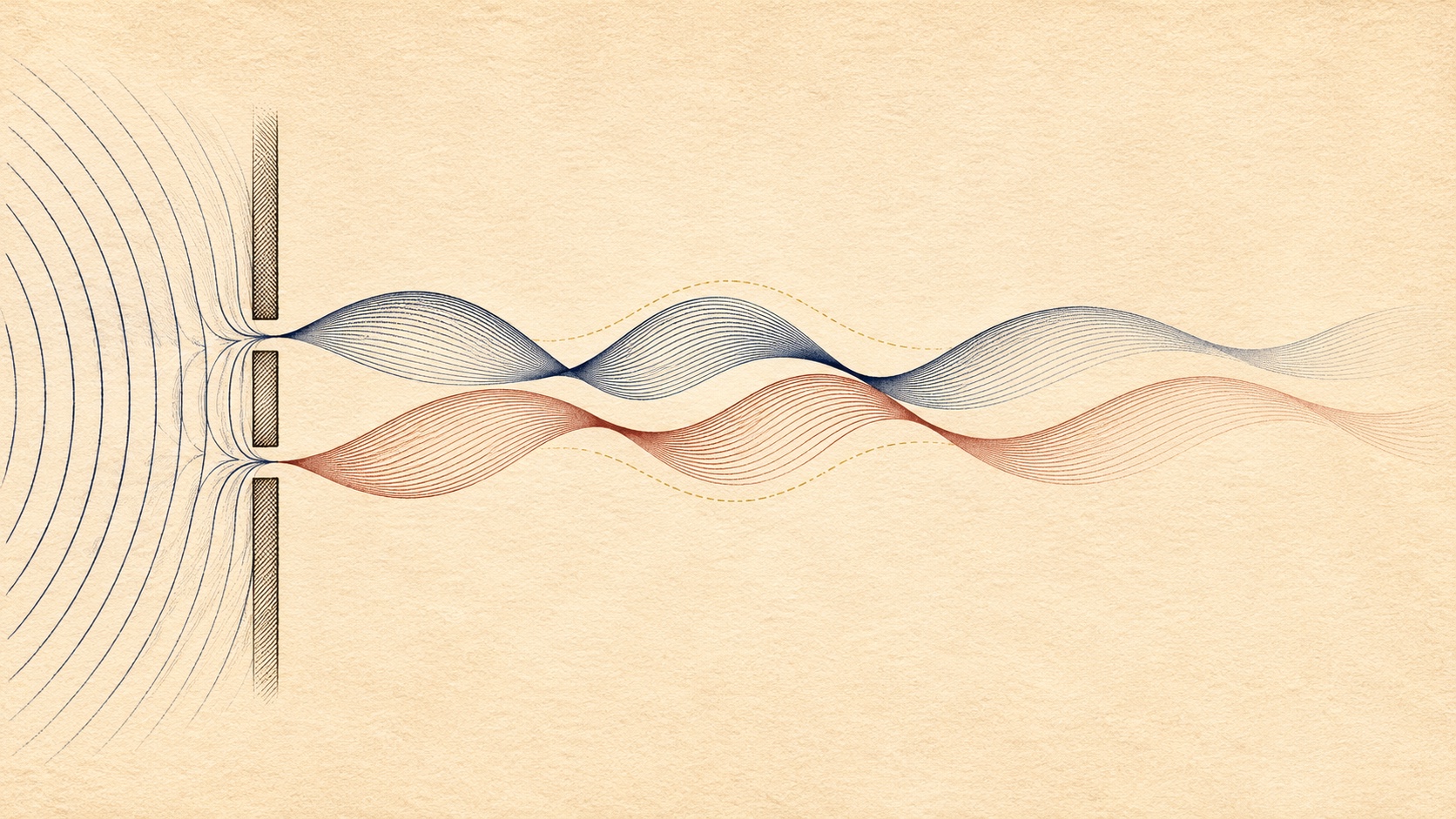
AI assisted with source comparison, derivation checking, drafting and the conceptual cover illustration. The illustration is not experimental data or a diagram of measured results. This article is a private explanatory draft based on the cited version and Ledger record. No new experiment, likelihood, data analysis or human specialist review was conducted for it.

Loading published comments…