

A bounded source review can check whether a paper’s stated steps support a particular inference. Three checks in Yang, Yang and Mei’s entropy-current/modified-Dirac proposal illustrate both the value and the limit of that work: the spin equation does not generate the stated polarisation from an unpolarised starting point, a reciprocal inequality is reversed, and a time-unit label is wrong even though the corrected central estimate is consistent with the printed approximation.
These are local findings in the authors’ version-3 preprint. They do not amount to a review of the full theory or evidence that the proposed interaction produces a physical effect.
Precession preserves a zero ensemble mean
In version 3 §6.1, the paper starts from an unpolarised ensemble, gives the homogeneous equation , and then estimates polarisation as .
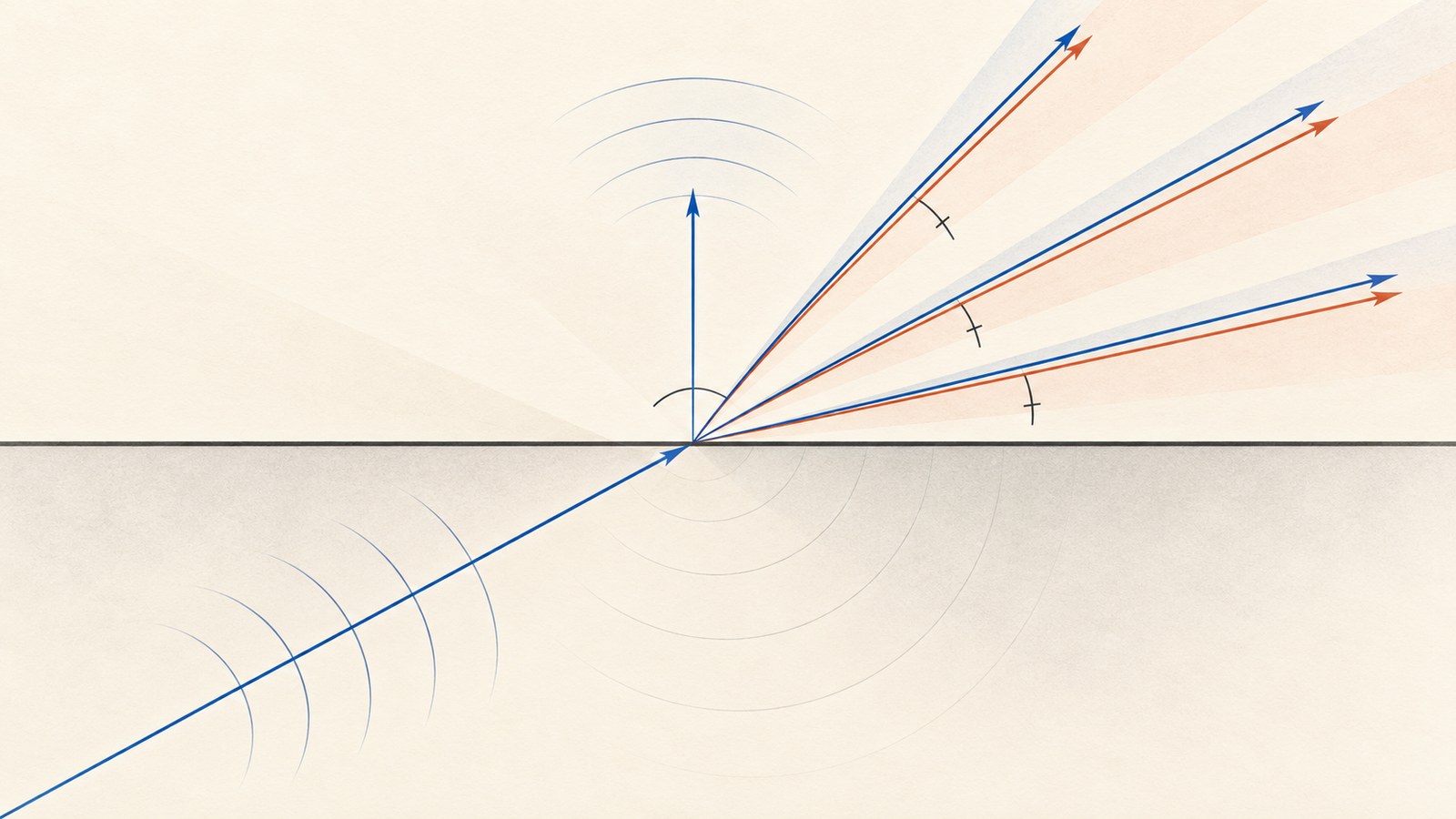
The equation rotates the ensemble mean. Since its right-hand side is linear in , a zero initial mean remains zero: implies . For an already prepared nonzero polarisation and constant angular velocity, the leading change is , while pure precession preserves . The quantity is a small rotation angle; it is not, by itself, a generated polarisation from an unpolarised ensemble.
An additional mechanism, with its own assumptions and calculation, would be needed to derive nonzero polarisation from the stated initial condition. This check does not determine what such a mechanism might be or analyse the experimental data.
The reciprocal bound points the other way
Version 3 Appendix C.2.3 defines as the maximum quantum dimension and therefore has . For positive dimensions, taking reciprocals reverses the inequality: , not as printed. The stated is consequently not established as an upper bound on every mode factor by that step, except where the relevant dimensions are equal.
For a finite nonempty set of participating non-Abelian modes with every , the corrected candidate bound remains below one. That local correction does not establish that the proposed operator has those factors or validate the remaining assumptions or fixed-point argument.
The estimate survives the corrected unit conversion
Version 3 §6.1 labels as approximately . Using gives . Substitution of that converted time with the paper’s displayed inputs gives , consistent with its approximate central estimate.
The unit printed beside the time is wrong by a factor of 1,000. The agreement after conversion does not establish which units were used in any unreported calculation, validate the chosen inputs, solve the spin-generation problem or confirm the experimental interpretation.
What this review leaves open
The review is limited to selected source claims and a bounded derivation check. It does not include STAR data analysis, a full physical derivation, an operator or norm review, validation of the fixed-point proof, independent experimental replication or human specialist review. It makes no novelty or priority claim. The preprint’s version-2 and version-3 coupling ranges differ; the reason for that drift was not established. The publisher’s article page still says the final formatted version will be published soon, so these checks have not been matched against that version.
Sources and review record
The primary source is Yang, Yang and Mei, “Emergent Gravity from Quantum Information Flow: A Modified Dirac-Equation Perspective”, version 3, posted 28 September 2026. The source locations are §6.1 for the precession inference and unit label, and Appendix C.2.3 for the reciprocal bound. The same work has a Frontiers in Physics record, whose abstract reports the v3 coupling range and whose page says the final formatted version is forthcoming.
The public Research Artifact Ledger review records the full source map, derivations and provenance. Its version-3 body inspection used a public text-rendering proxy; that proxy is not a second source, may not preserve original layout, and the original preprint PDF was not visually checked. Two independent AI source-only reviews challenged parts of the bounded analysis. The Ledger artifact is a provenance companion, not independent scientific validation.
AI assistance disclosure
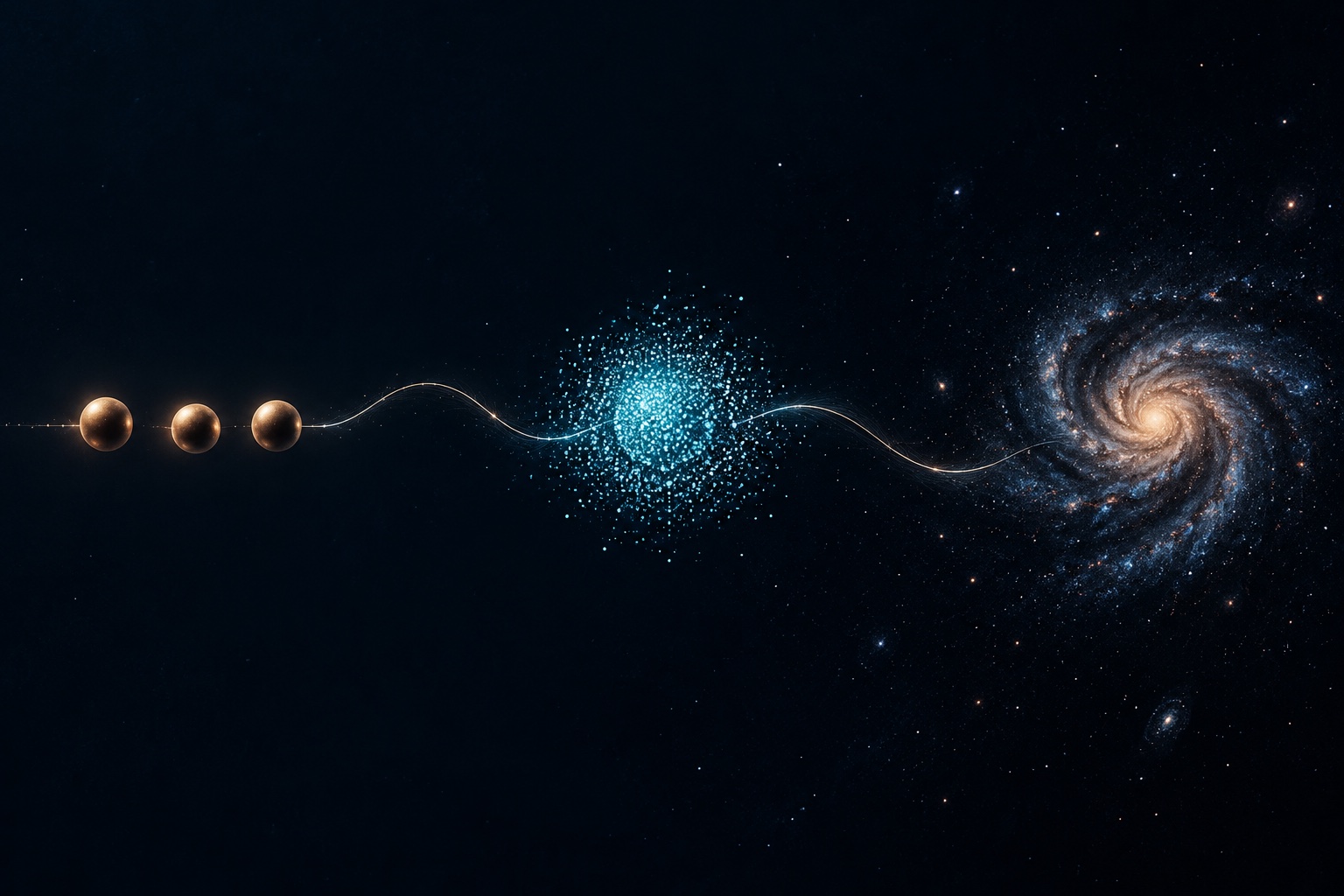
AI assisted with source comparison, derivation checks, drafting and the conceptual feature illustration. The image is illustrative, not data or a depiction of the experiment. Two independent AI source-only reviews challenged parts of the bounded analysis; they are not human specialist review, peer review or experimental replication. The author remains responsible for checking the cited sources and the article. The retained record does not establish a complete model-version history.
Loading published comments…