
Elsa guarded the Museum of Almosts after closing, when the exhibits became restless.
The near-missed train in Gallery Two always gave a small metallic shudder at 22:14. The glass case containing a proposal never made clouded from the inside whenever rain began. In the basement, twenty-seven unspoken apologies clicked their tongues like beetles.
She had learned not to touch anything without gloves.
At ten thirty, a woman in a yellow coat came to the reception desk holding a paper cup with no lid.
“I need to retrieve something,” she said.
“Retrieval is by appointment.”
“It wasn't supposed to be here.”
Elsa looked at the visitor register. The woman had signed Mina, then crossed it out and written Mrs Vale.
“What is the object?”
“A voicemail.”
That narrowed nothing. The museum held voicemails in the Audio Wing: declarations made too late, messages deleted before listening, one remarkable eleven seconds in which a man had almost asked his brother for help.
“Title?”
Mrs Vale looked at the paper cup. “The call I nearly answered.”
Elsa found it in the intake system. UNCLAIMED. DONOR UNKNOWN. CONDITION: ACTIVE. It had arrived that afternoon, without a carrier or form.
“I can let you listen under supervision,” Elsa said.
“No. I want it destroyed.”
The museum did not destroy almosts. It preserved, studied or released them. Release was not the same thing; it returned an object to weather, water, static, sleep or whatever had brought it near enough to be collected.
Mrs Vale's mouth tightened. “You people make a religion of hesitation.”
Elsa had heard versions of that accusation before. She led the woman to the Audio Wing anyway.
The voicemail played from a small black speaker in a glass cabinet. At first there was only traffic. Then a man's voice said, “Mina, it is me. I know I said I wouldn't—” The message cut off.
Mrs Vale put both hands on the glass.
“He died,” she said. “Two days after that.”
Elsa said nothing.
“I was in a meeting. I saw the call and thought, later. Then later became a story other people told about me.” She turned. “Do you understand?”
Elsa understood the word later. That was different.
“You can release it,” she said.
“Will it go away?”
“No.”
Mrs Vale laughed once. “Then what is the point?”
“It will stop being an exhibit.”
The woman looked at the speaker again. “Keep it.”
“That is your decision?”
“No.” She set the untouched coffee on the floor. “That is what I am good at.”
She left before Elsa could answer.
At eleven, Niall arrived with a cardboard archive box.
“Visitors are not allowed after ten,” Elsa said.
“I know.”
He had not changed much. His hair had changed sides. His coat was the one he wore when he wished to look temporary.
“Donation?” she asked.
“I think so.”
The form required a title, date, place and condition. Niall wrote slowly.
THE NIGHT I ALMOST STAYED.
Elsa looked at the box.
“That isn't specific enough.”
“It is to me.”
They carried it to the assessment room. The object inside was smaller than either of them expected: a hotel keycard, white and blank except for the faint crescent where a thumb had worn the coating thin.
Elsa did not need the date. She remembered the rain on the taxi window, the bad conference wine, the way Niall had stood in her doorway with his overnight bag and said he ought to go before either of them became unfair.
“You were the one who left,” she said.
“I almost didn't.”
“That is not the same thing.”
The keycard warmed in its tray.
Behind them, the Museum shifted. Somewhere, a lift door opened and closed on a floor that had not been built.
Niall sat at the steel table. “I kept it because I thought it proved something.”
“What?”
“That I had wanted the right thing, eventually.”
Elsa laughed, and heard how tired it was. “That is a very efficient way of making yourself the hero of my evening.”
He nodded. “Yes.”
The admission form asked whether the donor wished the Almost preserved, studied or released. Most people chose preservation. It was easier to visit a failure than to let it complete itself.
Elsa held the pen over the boxes.
“If we archive it,” she said, “you can keep coming back and looking at the version of you who nearly did something decent.”
“And if we release it?”
“It becomes nothing you can own.”
The keycard made a soft, impatient beep.
Niall put his hand flat on the table. “I don't want it to become a monument.”
Elsa looked through the observation window into Gallery Four. Mrs Vale stood before the unspoken apology display. She had returned without a coat. A label inside one case had changed overnight from PRESERVED to UNCLAIMED.
“Neither do I,” Elsa said.
She ticked released.
“The curator will ask why,” Niall said.
“The curator asks why people don't buy tickets.”
“You could lose your job.”
Elsa thought of the job: night logs, gloves, soft alarms, all the ways an institution could make grief seem well-lit and permanent. “Then I will have an almost of my own.”
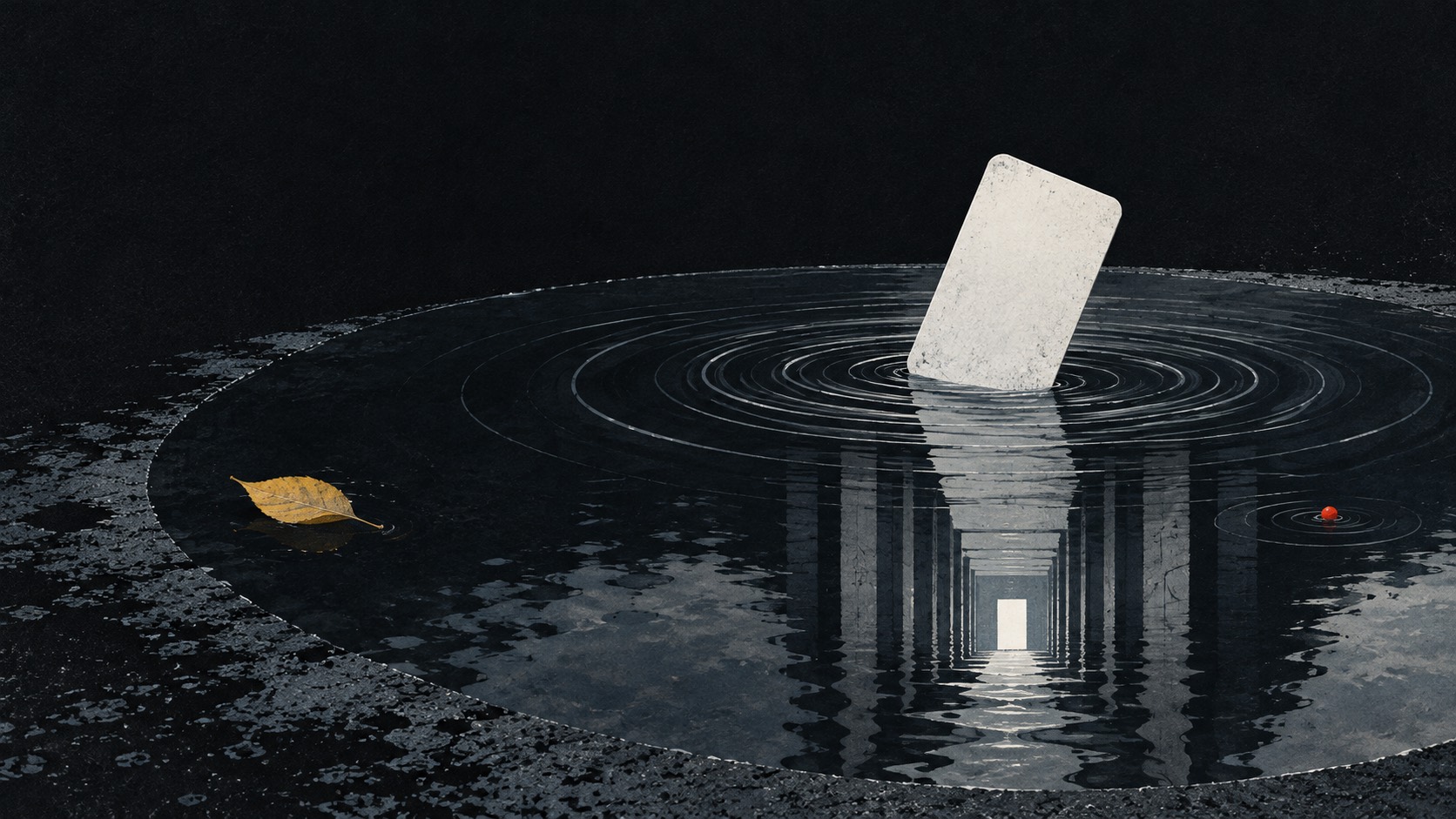
They took the keycard to the roof garden, where almosts were returned by weather. Elsa unlocked the gate. The rain barrel stood beneath the broken gutter, black with reflected windows.
For a second, when she dropped the card into the water, it showed the hotel corridor exactly as it had been: two doors, one light flickering, Niall's bag on the floor.
Then the image broke.
“I'm sorry,” he said.
“I know,” Elsa said. “That is not nothing. It is just late.”
He left by the staff entrance, carrying no box.
Mrs Vale was waiting by the lift.
“Did you release his?” she asked.
“Yes.”
“Was he grateful?”
“No. Not exactly.”
Mrs Vale looked down at the lobby, where the gift shop sold postcards of objects no one had ever held. “I don't want my message in the gallery.”
Elsa checked the clock. The retrieval window had closed. The rules would tell her to make an appointment, complete an assessment, allow fourteen working days for the decision to settle.
At 22:14, the near-missed train gave its usual shudder.
Elsa opened the Audio Wing with her staff key.
“You will have to press it,” she told Mrs Vale.
The woman stood before the speaker. Her finger hovered over the release control.
“What if I hear it differently?”
“You will.”
“What if I still don't answer?”
Elsa put her gloves in her pocket. “Then it will be your silence, not ours.”
Mrs Vale pressed the button. The traffic sound filled the room, then dissolved into the rain striking the skylight. The man's voice did not return.
The panel outside the gallery gave a discreet red blink: AFTER-HOURS RELEASE. CURATOR NOTIFIED. Elsa watched it until the light steadied, then entered the exception number in the night log.
After she left, Elsa wrote the train's movement in the night log. She crossed out usual and wrote still here.
No published comments yet.