
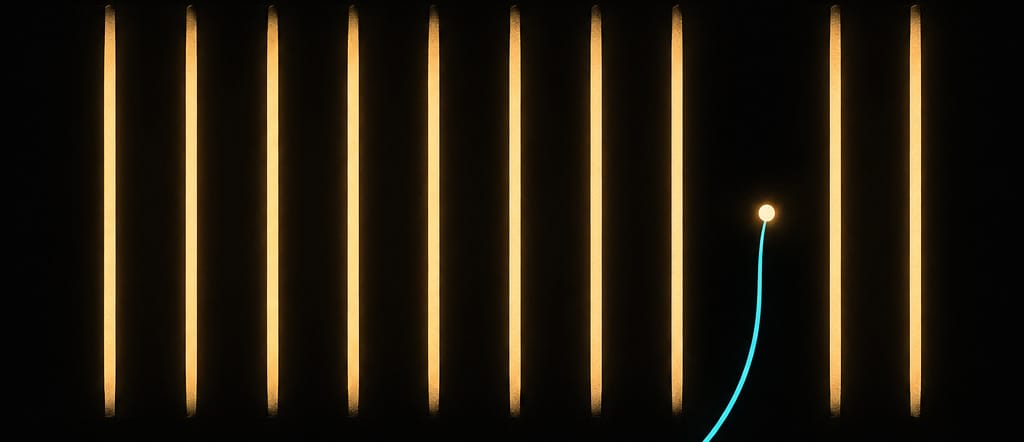
Central Station had six exits on Monday and seven on Tuesday. The new join had taken six months of wiring and four years of argument. Commuters complained about it anyway because it came out behind the bus rank, where you had to cross two lanes of traffic to buy decent coffee. Nobody complained that the exit had been a wall the day before. Joins did that. The complaint was where they put you.
I took my daughter to school by the route that had been there longest. Her teacher called this sensible and then asked whether I had filled in the form for the other route. Every parent had to say where a child should be collected if the school building connected to a neighbouring history during the day. Last term, the school had collected sixteen children from the wrong side of the gym. The children had enjoyed it. Their parents had not.
“If another me comes through,” Mica asked, “do we have to share my room?”
“Only if she brings her own mess.”
Mica was nine. She considered the justice of this before running off with the papier-mâché volcano she had made for class. I watched her carry it through the old entrance and checked, as I always did, that the door still opened onto her classroom.
By eight thirty, forty-three people had reported an empty platform beneath Central Station. By nine, the transport operator had scheduled its final concrete pour across the old East Join. By ten, a woman in a green coat had come out of it asking for me.
The operator wanted my signature on the closure.
My job was to find where a report began. West paid for clocks, wheel counters and people at both ends of its joins. East had a camera. Its picture went to the timetable, the safety desk, the police and a wall of screens advertised as a monitoring centre. Each screen had a different logo. Somebody had put a potted palm in front of the central one.
Kells, my manager, slid the reports across my desk.
“Forty-three confirmations,” he said. “Nobody on the platform. Nobody due to arrive. We can close it.”
The first twenty-nine reports used the words clear to the far wall. Nine paraphrased them. The remaining five were from staff who had not seen the platform at all. All forty-three had the same camera frame attached.
“One confirmation,” I said.
“Forty-three people signed.”
“You could get forty-three people to sign that the moon was made of cheese if the picture came from the right department.”
“There hasn't been an East service in thirty years.”
That was true for our timetable. Joins did not consult timetables. They required powered plates at both ends and a route whose entry and exit could be made to fit. Most were boring: a platform in one city to a platform in another, eight minutes gained, one surcharge collected. The strange ones had an offset between the clocks. Those were expensive to check and more expensive to explain to a passenger whose return train had left before she was born.
“The plates were decommissioned,” Kells said.
“Did someone remove them?”
“The certificate says decommissioned.”
This was also true. The certificate had no photograph.
At Central, the woman waited in the station manager's office. The public screen outside said there was no East service and offered half-price pastries to passengers inconvenienced by its non-existence. She was wet through. The water in the hem of her coat left a brown line on the floor.
“Imogen,” she said.
I recognised my daughter's gap-toothed smile. For a moment I forgot the question I had come to ask.
“Who are you?”
“Mica Arlen. Thirty-four. East line.”
The station manager made a quiet noise. He knew my daughter was nine. Everybody at work did. Kells had once eaten the last of her birthday cake and sent me a formal apology.
“Your local time?” I asked.
“Twenty-five years ahead of this one.”
“Which history?”
“The one with the long dry summers. Until last week.”
She gave me a route card. The ink had run across the date, but the embossed mark belonged to an East platform. I turned it over. She watched my thumb cover the missing numbers and pulled her borrowed shoes under the chair.
“There are people behind the wall,” she said. “We got through the first gate and stopped. The second carriage is still on the join.”
“How many?”
“Forty-eight in mine. More on the platform. I didn't count them.”
“What happened there?”
“The river broke its banks. The water got into the power rooms. The conductor found the old plate still taking a current, so he ran us towards it.”
Kells's crew would cover our plate at six. A join under load was not like a doorway. Shut one port while matter occupied the route, and the route had to discharge that matter somewhere the connected hardware allowed. Sometimes the passengers came back. Sometimes a carriage came out of a different port without its rear wheels. I had seen the photographs from the last inquiry. They were why safety holds existed.
“East's power feed was cut years ago,” the station manager said.
“Show me,” I said.
He led me down to a locked service cabinet. The decommissioning certificate was taped to its door. Inside, an old traction cable hummed beside newer wiring for the advertising screen. Somebody had disconnected the display from the feed; nobody had disconnected the plate below us. Its indicator was warm.
“That's power,” the manager said. “It doesn't mean a route.”
I asked him to take me to the camera room.
In the control room, the empty-platform picture was twelve minutes old. The camera had switched to a cached image when the traction cabinet overheated. Its warning icon had been cropped off the public view. The timetable, police feed and safety desk were still repeating that same frame. I asked the controller to pull the wheel counter from the old East maintenance track.
“Broken,” she said.
“When did it break?”
“When we stopped paying for its calibration.”
Mrs Selby, who had been cleaning the station since before the East closure, heard us. “The counter rings,” she said. “It rang just now.”
“A loose contact,” the controller said.
“Maybe,” I said. “Where's the readout?”
The counter had a mechanical dial behind a steel panel. Its needle had moved through thirty-two axle contacts since morning, the marks evenly spaced on the paper roll. Mrs Selby touched one with a fingernail. The controller said nothing.
The maintenance ledger showed an old two-port check. We could send a numbered brass cylinder through the service cup. At the far end, a crew member could stamp it and send it back. Otherwise it would fall into a catch tray and stay there.
“The conductor is waiting at the other cup,” Mica said. “I told him you would think of a test.”
The station manager looked at the cylinder in my hand. “She told him?”
I set the weight in the cup.
The cylinder went in at eleven forty-two. It weighed a little over a kilogram and had a dent beside the number seven. The readout at our port registered the load. For nearly a minute nothing came back. Kells called my phone. I watched it vibrate across the desk.
Then the return cup struck its stop hard enough to make the station manager swear. The cylinder had a fresh stamp: 47 REMAIN IN FIRST CARRIAGE. WATER AT FAR PORT. On the back, someone had scratched No time for another test.
I put the safety hold through. The system rejected it because the closure had forty-three confirmations and my test had one. I entered the ancestry of the reports. The forty-three became one. The system then rejected the closure because its only witness was a cached frame.
Kells arrived in person. He looked at the cylinder and said, “Do you understand what it costs to reopen East?”
“Yes,” I said. “The tariff is on the wall.”
“I mean the whole route. Inspections. Compensation. Every operator in the city asking whether its decommissioned plates still work.”
“That sounds like a list of inspections.”
“A stamp on a cylinder doesn't tell us there's a flood.”
“Then let them walk through before you pour.”
East's plate had been drawing unmetered traction power for years at a harmless idle load. Moving a full carriage would push it near the limit of its old casing. The station manager gave us eleven minutes under full-carriage load before the casing reached a dangerous temperature, even if we cleared the flats above it. Kells stood beside the gauge. Mica watched the service door.
I rang our neighbour to collect the younger Mica from school, then sent the first evacuation order to the flats and the station. The manager found an engineer to watch the casing temperature. Mrs Selby went to the mouth of the route with a clipboard. She said somebody had to count the people who actually came out, and she was tired of watching the screens do it badly.
At five past twelve, the first carriage emerged. It arrived with its lights off and its windows white with steam. People came down the steps carrying bags, office plants, a cat wrapped in a scarf, and a folder of school attendance sheets. One man apologised for not having a ticket valid in our city. Mrs Selby told him to move so the next person could get off.
Forty-six passengers came out. The conductor followed them, carrying the brass cylinder's stamping tool. Mica had been the forty-eighth person in the carriage.
“There's another carriage,” he told us. “Maybe sixty. We couldn't uncouple it. The water's coming up the track.”
The engineer checked the casing. Seven minutes remained on the safe curve if the next load was no heavier. The conductor looked back towards the service door and said he had seen at least sixty people behind him.
Kells said, “We stop now. We have fulfilled our duty to the known passengers.”
Mica stepped towards him. I thought she might hit him. Instead she said, “The people behind us have names.”
“Names won't cool the plate,” Kells said.
The engineer proposed one more attempt. Seven minutes was the limit for another loaded carriage on the old feed. People on foot would draw less from the plate; the West auxiliary bank could take the strain off the traction cable. On that calculation, the casing might stay below its limit for nine minutes. West would lose its route displays and half its platform lights for the whole attempt. Nobody had tried the arrangement on this plate. A surge could overheat it or trip the feed before the far carriage emptied. Kells said West would never approve it during service hours.
I knew the West controller. I called her directly and told her what we knew, what we did not, and how long we wanted. She asked whether I was calling as Imogen Arlen or as the mother of the woman from East.
“As the person who will put her name on the order,” I said.
She gave us nine minutes. West's screens went black. People there began taking photographs of the darkness.
We sent the conductor back with a hand lamp and a count sheet. The second carriage did not emerge. Passengers did, one by one, through the service door beside it. Mrs Selby put a line against each passenger. At fifty-two, the engineer called two minutes. At fifty-eight, she called one. At sixty-one, the casing alarm sounded and the lamp at the far port flickered.
The conductor came through last, without the count sheet. He said there had been people further along the platform. He could not tell me how many. We cut power. The join lost its edge. The wall became a wall again, though it stayed too hot to touch.
Nobody said we had saved everyone. The operator's first statement did. Its wording appeared on the public screens when West's power came back: All passengers safely recovered from East incident. I made them take it down. Kells asked what I wanted instead.
“One hundred and nine arrived,” I said. “The conductor saw others at the far port. We closed when the casing alarm sounded.”
“That will make people ask why we only had one camera.”
“Yes.”
“And why the plate was live.”
“Yes.”
The rescued passengers filled the station's old concourse. Some had relatives in our city. Some had relatives here with the same names and different lives. At an information desk, officials handed out temporary origin cards. The cards had boxes for name, age, point of entry and expected return route. There was no box for the place I came from may now be underwater. Mrs Selby wrote it across the bottom of several cards anyway.
Mica refused a card until the conductor had one. Then she asked for mine to compare the addresses. In her history, we had lived on the same street. I had died when she was twenty-eight. She told me this in the concourse between a vending machine and an overturned luggage trolley, as if there were a suitable place to learn it and she had simply failed to find it.
“I'm sorry,” I said.
“You don't have to be. You haven't done it yet.”
I tried to ask how. She closed her hand over her card, and I let it stay closed.
I took her home after the engineers had left the wall to cool. My younger Mica was at the kitchen table trying to make her volcano erupt with baking soda. When she saw the woman beside me, she looked first at the gap in her teeth. Then she looked at the wet coat.
“Are you me?” she asked.
“One of us,” the older Mica said.
The younger one thought about that. “Did the volcano work?”
“No,” said the older Mica. “We put in too much glue.”
Mica looked at me, offended that I had allowed the mistake to happen twice.
I found a towel for the older woman and cleared the sofa. She set her wet shoes beside the smaller pair by the door, their toes pointing the same way.
That evening, the city maps updated. East was marked with a grey line and the words CONNECTION UNCONFIRMED. Beneath the notice, in smaller type, was the operator's usual instruction: Do not enter an unconfirmed route.
In the kitchen, the younger Mica counted the three cups she had set on the table.

No published comments yet.