
Listen
Spoken version
A recorded reading of “The Unspent Ladder”. If the player does not load, use the original audio source.
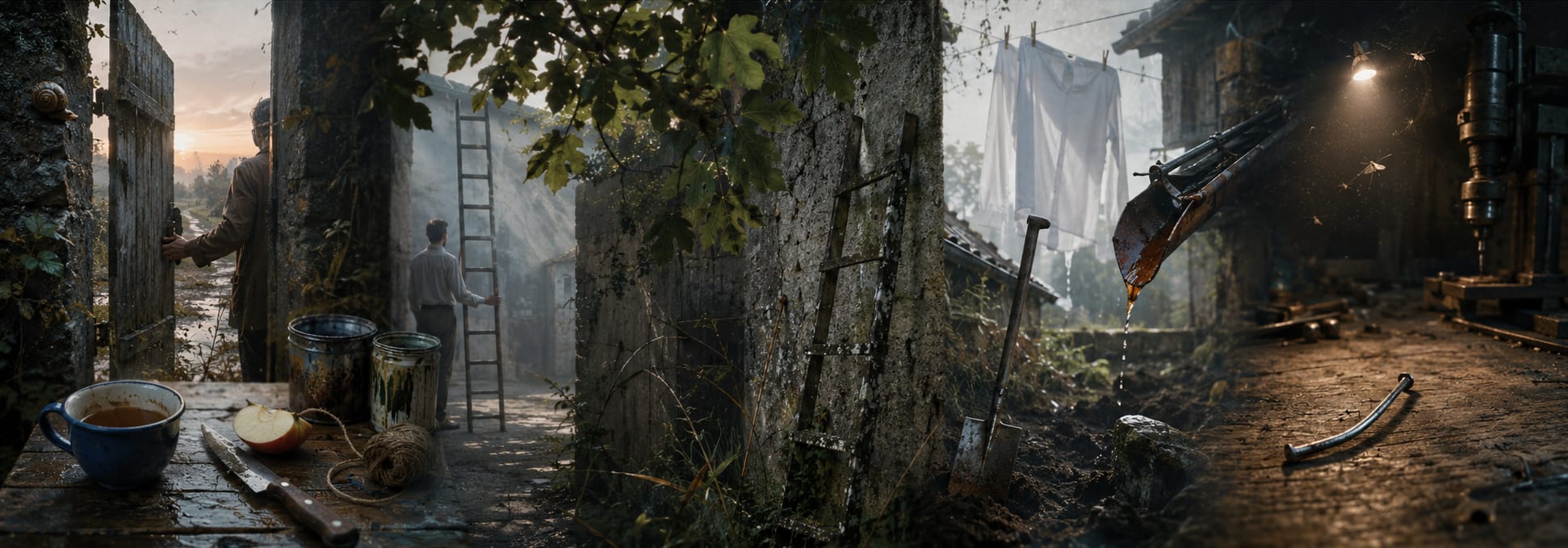
At dawn the gate gives one brown note.
Rain has freckled the hinge; a snail
has signed the post in silver.
I open it with the heel of my hand,
not carefully. Carefully is for vases,
for the white shirt still folded
around its cardboard breath.

My knife is smaller than when I bought it.
Apples, twine, paint-caked tins:
all have taken a bright sliver,
all have left their weather in the handle.
The blue cup keeps a ring of tea
where yesterday cooled beside the sink.

Over the wall, my neighbour hangs his ladder
inside the passage, wiped and vertical,
a ladder practising height
without ever leaving the floor.
No roof-grit in its bolts,
no gutter-sap, no rung gone black
from a boot climbing back from rain.

Mine leans under the sour fig.
Lichen works the side rail.
One rung is bowed like a rib.
When I lift it, the whole yard creaks—
then steadies, giving my weight
a place to be wrong and rise.

By noon the spade has found stone.
The blade flashes, goes brown, flashes again.
Tin gutters open their orange mouths.
A shirt on the line stiffens with salt,
then softens when I put it on.
Even bread, too dark at the edges,
gives the house its bitter sweetness.

It took me years to learn
the untouched are not spared.
Rubber splits in the cupboard.
White leather yellows in its box.
The polished bell forgets its own throat.
Dust is not mercy. It is only time
without witness.

So I spend what can be spent:
the sole, the shoulder, the palm;
the good pan’s blackening lip;
the afternoon’s small coin of heat
laid hard against my neck.

After dark, moths tap the workshop bulb.
The drill-bit cools in its burnt smell.
On the bench, a bent nail
catches moonlight along one side—
not straightened, not thrown away,

but bright where the hammer found it.
No published comments yet.