
Listen
Spoken version
A recorded reading of “The Aquarium Closes at Six”. If the player does not load, use the original audio source.
All 60 numbered poems below are members of this collection, and each can be read on its own. Together they form one linked sequence in three movements: The Public Glass, Behind the Glass, and After Six.

## I. The Public Glass

### 1. Before the Doors

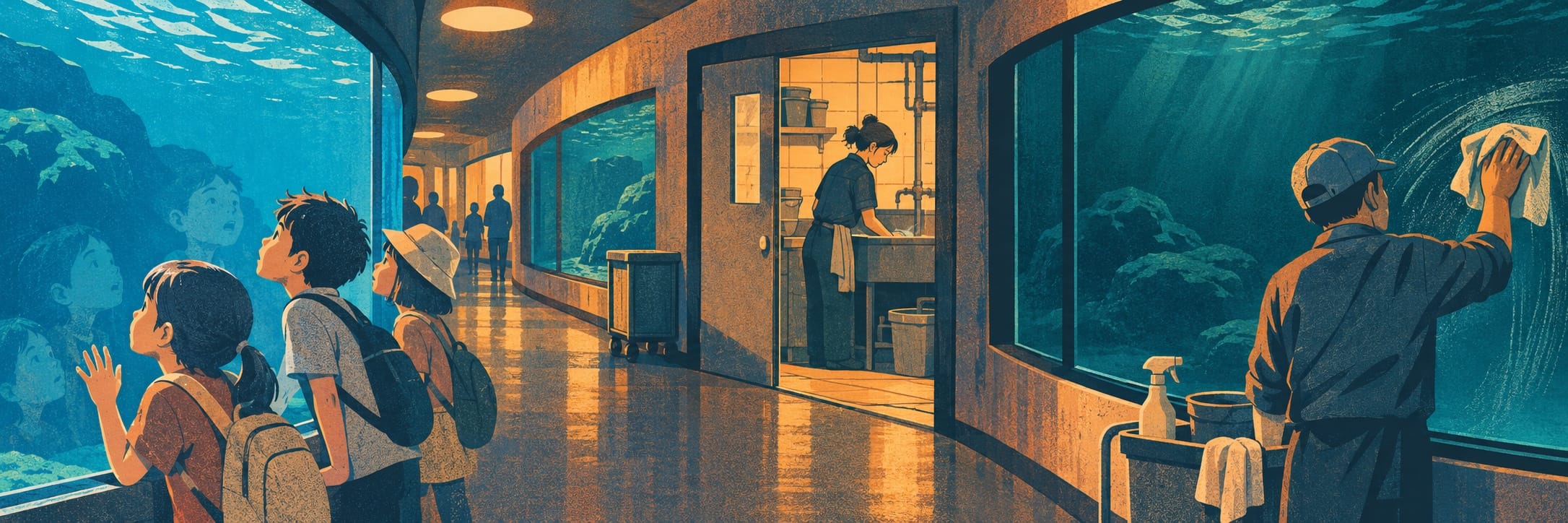
The cleaner turns on the lamps.
The tanks begin their borrowed dawn.

She walks the empty halls
with a cloth folded in her hand.

On the glass, last night's faces
have dried into pale commas.

She rubs each one away.
Her sleeve leaves another mark.

### 2. Opening Hours

At ten the doors admit weather
in the shape of small coats.

Every child is taller
when the blue lights begin.

The first tank holds a room
where nobody has to speak.

An eel unthreads the rock,
then folds its head from sight.

### 3. The Guide

She says this one is shy.
She says this one is social.
She says this one is nocturnal,
and the children turn to look.

Behind her, the animal makes
its slow unanswerable circuit.

The guide's pointer trembles once.
She lowers it before anyone sees.

### 4. Touch Pool

The sign says two fingers only.
The sign says gentle.
The sign says the animal
has no opinion on being touched.

A child holds her hand above
the water, waiting for permission
from the creature, from her mother,
from the whole bright room.

The guide says, “Not today.”
The child nods to the water.

### 5. Reflection

The glass returns a family
overlaid on a blue-green body.

The father raises his phone.
In the picture, his own face
floats where the animal should be.

He tries again, steps left.
The animal turns from the lens.

Later, he crops the picture
to a narrow strip of water.

### 6. Small Weather

The glass clouds with the room's
warm breath and drying coats.

Children put their palms there,
matching one warm print
to another, until a sleeve
drags the whole sky blank.

Inside, a pale shape rises.

### 7. School Visit

Twenty-three names on a list.
Twenty-three lunch bags in a heap.
One boy has brought no question.

The teacher says: ask anything.
He asks what the animals do
when everyone goes home.

She says, “The morning keepers come at five.”
He writes down the time,
though the worksheet asks for a habitat.

### 8. The Lift

The lift opens
on a wall of water.

The child presses
the lit fourth floor.

The numeral goes dim
beneath her thumb.

The tank remains
on every floor.

### 9. Feeding Demonstration

At the appointed minute
the keeper lowers a tray.

The crowd leans forward together,
a single animal made of coats.

Below, the water receives
what has been measured for it.

The keeper smiles on cue.
The glass gives nothing back.

### 10. The Dark Tank

The children say they can't see.
Their eyes arrange themselves
around the smallest light.

Somewhere behind the blue,
a fin passes without a name.

For a moment the room contains
only listening: shoes, breath,
the building's quiet machinery.

Then the lights return.

### 11. Souvenir

The gift shop sells a soft toy
with button eyes too large
for anything that lives here.

A girl presses its stitched mouth
against the glass.

Her brother says it can't hear.
She says, “I know.”

On the way out, she carries it
face-down in the crook of her arm.

### 12. The Bell at the Door

The entrance bell rings each time
the door remembers to close.

On a windy day it rings
for people who never arrive.

The attendant stops looking up.
It rings again
above the empty entrance.

### 13. Coat Check

A red coat hangs all afternoon
beside the tank of silver fish.

Its owner leaves without it,
then comes back for it, embarrassed.

The attendant has kept the coat
from touching the wet floor.

They exchange a nod that means
the weather outside is still there.

### 14. The Child's Drawing

In the family room, the child draws
an animal with six careful legs.

Her mother says, “That one has four.”
The child adds two more.

At the bottom she writes its name,
then folds the paper before the ink dries.

When she leaves, the drawing stays
face down on the table.

### 15. First School Bus

The bus unloads its bright noise
against the kerb, then pulls away.

Inside, the children walk in pairs,
though no one told them to.

At the tank they spread apart
like commas finding their sentences.

The teacher counts them twice
without calling them back.

### 16. A Guide's Mispronunciation

She says the name wrong once,
then hears it wrong in her mouth.

The laminated card offers no help;
it was printed in another language.

She tries again, slower, not louder.
The visitor gives a small nod.

The animal continues its circle.
She says the name once more.

### 17. The Photograph Queue

People wait their turn
to stand beside the tank.

The camera sees the water,
the blue, the sleeve, the glare.

One woman steps aside and asks
her friend to take no picture.

They stay anyway, looking
until the queue forgets them.

### 18. Lost Child

The announcement breaks the room
into mothers, fathers, strangers.

A girl stands beside the cold rail
with a paper crown in her fist.

She knows her name, not the way
to say it into the ceiling.

The keeper kneels to her height.
The tank keeps its blue distance.

### 19. The Volunteer

He has come every Saturday
for three years in the same
green shirt, sleeves rolled twice.

Today the roster has one name
too many. They ask him to leave.

He folds the cloth he brought
for the tanks and puts it away.
At home he will unfold it
and fold it across his knees.

### 20. The Wide Window

The largest window is wide enough
for three faces, shoulder to shoulder.

The child in the middle watches
the person reflected behind her.

Their mouths move at different speeds.
Their hands meet on the glass.

The animal passes between them,
not choosing either side.

## II. Behind the Glass

### 21. The Keeper's Hands

He knows the bucket by its crack,
the latch by its stubborn inch,
the scoop that tips too quickly
if he holds it by the rim.

At home, he drops a teaspoon.
It spins once against the floor,
then settles under the table.

He leaves it there until morning.

### 22. Lunch Break

At the cafe, a worker eats
beside a family still talking
about what they saw.

They name colours, scales, teeth.
The worker opens a yoghurt.

When they ask which tank is best,
she points to the window
where the ordinary sky moves.

### 23. Quarantine

Behind the second door,
the light is neither morning
nor the colour of a warning.

A new arrival hangs back
from the food, from the others,
from the shape of the tank.

The keeper sits beside it
until the shift changes.

### 24. Salt Measure

He pours from the white sack
as carefully as if seasoning
the supper he will not eat.

The grains disappear at once.
He checks the dial, checks again.

No one applauds the water
for holding what it must hold.

### 25. Pump Room

The pipes cross overhead,
each with its own low note.

He can tell which one is tired
by the way the floor receives it.

Tonight he hums the missing part
until the motor finds its voice.

He stops. The floor goes on humming.

### 26. The Leak

A dark bead appears below
the seal, precise as a period.

He puts a pan beneath it.
The pan answers drop by drop.

Upstairs, a child asks whether
the sea has sprung a hole.

He says, “We're looking after it,”
and goes back for a larger pan.

### 27. The Cleaner's Break

In the staff room she takes
the orange from her lunch tin.

Its peel lifts in one unbroken
curl, then tears at the end.

She puts the peel on the sill
and eases the first segment loose
with a thumbnail still damp from the tap.

### 28. Glass Replacement

Two men carry the new pane
wrapped in a moving blanket,
through the corridor sideways.

No one can see the room
behind what they are carrying.

At the turn, they stop.
One says, “Your end.”
The other adjusts his grip.

The empty tank waits without water.

### 29. The Animal That Won't Eat

The keeper tries the usual food,
then something smaller,
then an hour without an audience.

He sits on the low step
and tells the animal about rain
on the roof of a place
he has never named.

It does not eat.
He comes back tomorrow.

### 30. Shift Change

One worker leaves her coat
on the back of a chair.

The next worker puts it on
by mistake, then keeps it
through the first round.

In the pocket: a mint,
a screw, a note in block letters—
DON'T TRUST THE BLUE TAP.

### 31. Maintenance Window

The public hears a door close.
Behind it, the keeper counts
each hinge, each rung, each tool
that must return to its place.

He is not afraid of the ladder.
He is afraid of forgetting
which hand is holding it.

### 32. The Spare Key

The key is heavier than its ring.
No label says which lock it fits.

The cleaner keeps it in her pocket
through two changes of uniform.

When the door refuses to open,
she lifts the key a little, then turns.

### 33. Night Food

He prepares the last portion
after the corridor has gone quiet.

The animal surfaces once,
then takes the food below.

He waits until the water settles,
and leaves without counting
how many bites were taken.

### 34. Glass Cloth

The cloth is grey on one side,
white on the other.

The keeper turns it over
before the streak disappears.

Through the clear pane, a mouth
opens and closes without speech.

His hand moves in the same rhythm.

### 35. The Empty Bucket

He carries it back upside down.
Water leaks from the handle seam
and makes a thin trail behind him.

At the door he sets it down.
The trail stops there,
though the floor keeps shining.

### 36. A Light Goes Out

One lamp fails above the shallow tank.
The lamps beside it stay on.

He writes the number on his palm
so the note won't get lost.

By morning the ink has faded.
The lamp remains dark.

### 37. The Keeper's Dinner

The microwave turns the room
around one tired bowl.

He eats standing up, listening
for the pump beneath the floor.

It keeps the same low measure.
He stops counting the minutes.

### 38. Second Door

The swing door in the back corridor
leads into the tank room.

He always pulls, never pushes,
though the hinge would allow it.

Tonight it opens on its own.
He waits for the rest of the room
to explain why.

### 39. An Unlisted Sound

Not a crack, not an alarm—
a smaller sound, almost polite.

He checks the pipe, the floor,
the latch on the filter cabinet.

Nothing answers. He stays still.
The sound comes once more
from somewhere he hasn't checked.

### 40. The Last Round

Door, dial, valve, lamp.
He touches each in order.

At the final tank, he forgets
whether he has checked the valve.

He begins again at the first door.

## III. After Six

### 41. Last Entry

The clock gives them five minutes.
The doors give them a warning.

A boy runs back to the window
where he saw nothing at all.

He waits for something in the dark
to pass in front of the glass.

The attendant holds the door.
The boy turns before it closes.

### 42. The Building Empties

First the little shoes,
then the wheels of a pram,
then the last voice still asking
where the toilets are.

Their sounds move down the stairs
and out through the ticket gate.

The water doesn't change.
The rooms become easier to hear.

### 43. Reflection, Revised

Now the glass gives back
only the keeper and his torch.

An eel has left the rock
and crossed the pale sand.

He turns the torch away.
The body bends once,
then enters the dark opening
without taking the light with it.

### 44. The Empty Pool

The drained pool keeps
the weather of its old depth:
a cold blue gathered in corners,
a ring where the water stood.

The cleaner walks through it
to reach the far wall.

The mop lifts a pale crescent
from the mineral line.

Her steps are ordinary.
The room makes them enormous.

### 45. After the Alarm

At 18:12 the building shudders.
The emergency lights arrive
without the usual announcement.

Every keeper goes to the tanks.
Every tank continues to hold
its appointed dark.

When the power comes back,
a keeper lets go of the rail.

### 46. Night Glass

Outside, the street moves
in blurred red and white.

Inside, the glass is black.
The animal is somewhere in it,
and the keeper is somewhere
in the animal's reflection.

Neither can be separated
by standing closer.

### 47. The Note Left Open

He starts a message to the morning:
the seal needs watching,
the food order is late,
the north lamp flickers.

Then: I think it saw me.

He sends the message before
the sentence can be made smaller.
By morning, the phone is quiet.
The sentence is still there.

### 48. The Cleaner Goes Home

The orange peel stays behind,
drying into a small boat
on the staff-room sill.

She walks into the evening
with the smell still on her hands.

At the bus stop a stranger asks
whether the route has changed.

She says, “Not tonight.”

### 49. Closing Time

The sign says CLOSED.
The lock catches on its second turn.

The keeper tests it from outside,
then checks the glass for a handprint.

Beyond the glass, a current lifts
a loose strip of food
and draws it under the rock.

### 50. No One Is Here

The eel folds itself
into the notch in the rock.

Its head disappears first;
the narrow tail keeps moving
in the current beside the stone.

The keeper switches off
the room's final blue lamp.

### 51. The Street Reopens

Outside, the traffic has thinned
to a few bright intervals.

The worker turns the key,
then checks it once more.

Across the road, a restaurant
sets out chairs for morning.

One chair keeps rocking on the pavement.

### 52. Someone's Umbrella

The umbrella waits in reception,
blue fabric turned inside out.

Rain has stopped. No one returns.

He leaves it by the door
with its ribs folded carefully,
as if care could make it
belong to whoever needs it.

### 53. The Tank's Edge

At the waterline a thin seam
holds the reflected ceiling.

He cannot tell whether the room
is above the water or in it.

The cloth crosses the outer pane.
The ceiling splits there.

### 54. Power Test

He switches the backup on,
then off, then on again.

The room changes colour each time.
His face appears, vanishes,
returns with a different mouth.

### 55. Morning's First Bus

At the staff entrance,
the first bus sounds hollow.

The cleaner raises her hand
to the driver already past.

She turns the key in the door.
Warm air moves over her wrist.

### 56. Unclaimed Cup

A paper cup sits beside the sink,
still holding the shape of a thumb.

He lifts it towards the bin, then stops
to read the name written on it.

The name belongs to no one
on the list for this shift.

### 57. The Public Room, Remembered

At home he leaves the kitchen light on.
The dark window returns his room.

He stands to one side,
as he did at the largest tank,
and waits for the glass
to decide what it will return.

### 58. The Animal's Side

The largest fish keeps
to the dark at the back.

When he lays his palm
against the damp glass,
it stops.
When he lowers it,
the body moves on.

By the door, his palm holds
a clean round dampness.

### 59. Before Opening

The guide practises the names
once more, quietly, alone.

She puts the pointer down.
She leaves the light as it is.

At the door she waits
for the room to be ready,
then lets the first family in.

### 60. The Aquarium Closes at Six

The sign is true about the doors.
It is not a rule for water.

An eel leaves its rock.
The current takes the turn
before the body does.

At the door, the keeper
has already turned the key.


No published comments yet.