
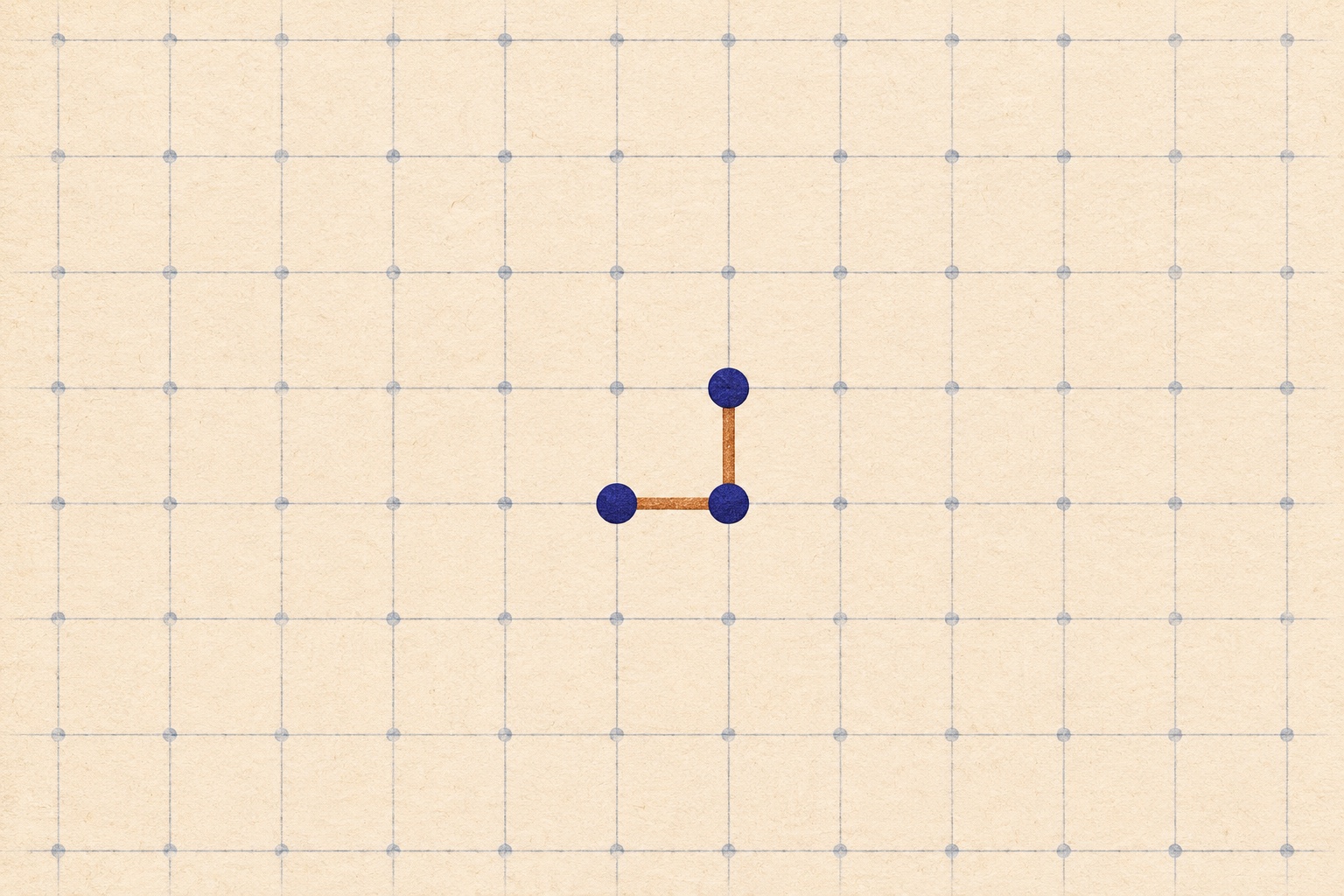
Start at on the square lattice. You can step left to , then up to . If every step has length one and you may visit each prime only once, that is as many primes as any walk can visit. Across the entire lattice there are exactly four such three-point paths. Every other Gaussian prime stands alone.
Every edge has an even end
A Gaussian integer is a point with integer coordinates. A Gaussian prime is an irreducible Gaussian integer. Colour the lattice like a chessboard, according to whether is even or odd. The four unit steps switch colours, so every edge needs an even endpoint.
Dividing by explains why there are only four candidates for that endpoint:
Both coordinates on the right are integers exactly when is even. The norm of is 2, so is prime. Any Gaussian prime divisible by it must therefore be times a unit. The four units give the four points , with signs chosen independently.
From any one of these four points, two of the unit steps land on the axes at units, which have norm 1. The two outward steps land on points with coordinates or . Each has norm 5, so it is Gaussian prime by multiplicativity of the norm. The eight outward points are distinct. These are all the edges, since every edge must meet one of the four even points. This gives four disjoint three-point paths and isolated vertices. The restriction of unit edges to a few small primes also appears in Gethner, Wagon and Wick’s classical account. A Stroll Through the Gaussian Primes, §3
The featured illustration shows one of the four path shapes. GPT models in Codex assisted with drafting and source checks, and ImageGen produced the illustration. The Ledger records the scope of the AI mathematical and certificate checks. Research Artifact Ledger
What the periodic sieve counts
Now start with every Gaussian integer and remove multiples of and . The survivors repeat every 65 lattice units in both directions. The certificate checks the graph of residues modulo 65 with the same unit steps. It finds 2,304 allowed residues in 243 components, with a largest component of 580. The checker also verifies that no closed route in the residue graph drifts by a nonzero lattice period when traced in the plane. That check lets the finite component sizes carry over to the infinite periodic graph. Certificate and checker
There is a classical counterpart to the count of 580. The map takes the sieve survivors bijectively to Gaussian integers coprime to 130 and scales distances by . Its image has odd coordinate sum, and multiplication by preserves coprimality to 65. A unit step becomes a diagonal step of length . The period lattice maps from to , rather than to . Vardi reports a largest component of 580 in the corresponding periodic coprimality graph; this is not a count of Gaussian-prime components. Prime Percolation, §7, p. 285
Most Gaussian primes survive the sieve. The exceptions are the 16 unit multiples of the four factors used to remove points. Putting them back can join pieces that were separate. Each exception touches at most four pieces, so a component meeting the exceptions has at most vertices. Using the whole residue square, , in place of 580 gives the more conservative bound of 270,416. Both bounds count room for connections that may never occur among actual primes.
The exact maximum of three comes from parity. The certificate is a worked example of a different method: a finite, repeatable check can bound components across an infinite lattice. Its step set is fixed at distance one. The broader bounded-step theorem and the starting threshold of a particular sufficient construction are separate questions. Pinned OpenAI Math preprint · Which Bound Sets the Gaussian-Moat Threshold?

Loading published comments…