
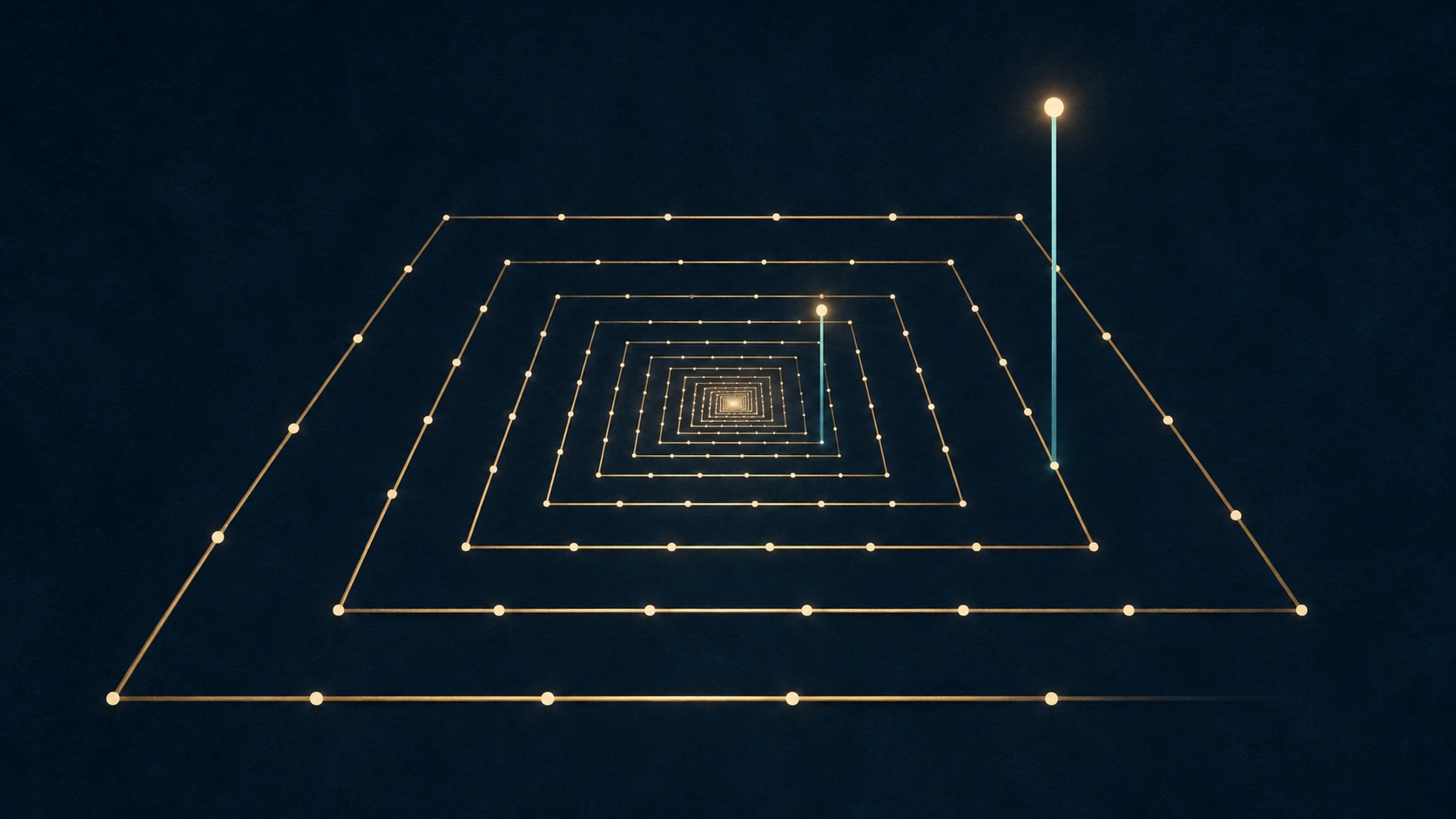
Take two primes, 3 and 23. In the square spiral used here, their positions on the positive real axis have addresses 28 and 2,048. Both addresses end in 8. If the last digit tells us where to put a point around a circle, these two points land directly above one another. How far apart they sit now depends entirely on the rule for height.
From the spiral to a distance
The spiral numbers the Gaussian integers, the lattice points with integer coordinates. Start with address 1 at the origin. Walk right, up, left and down, taking steps on successive legs. The display assigns each address an angle on a circle of fixed finite radius and a height . Keep the addresses that the spiral assigns to Gaussian primes. Join two distinct such addresses if the distance between their displayed points is at most a chosen .
On the positive real axis the address of is . The square term is the address at the preceding ring’s final corner. From there it takes another steps to reach . Every rational prime is also a Gaussian prime, since it is 3 modulo 4. Substituting its last digit into the address formula gives . This supplies a whole sequence of points in the same angular position as the opening pair.
Choose the primes first
List the addresses in that sequence in increasing order, . Give the first point height , the second , and the th point . Fill the intervals between selected addresses by straight lines and use a positive slope before the first. This defines a strictly increasing, unbounded height on all addresses.
Our opening pair is one step apart in the list, so its height difference is even though the addresses differ by 2,020. Further along the list the successive differences are , which tend to zero. Choosing the heights by rank builds the shrinking steps into the construction.
Choose the height first
Now give every address height before looking at its contents. The same opening pair has height difference . What matters further out is whether the ratio of successive addresses approaches one. Infinitely many primes in the chosen class would by itself give no such spacing estimate.
The prime number theorem for the fixed progression supplies it. For any fixed , every sufficiently large interval contains a prime in this class. Hence successive primes in the class satisfy . Since , the corresponding address ratio also tends to one. The difference in the fixed heights is therefore
The prime-distribution input is established mathematics. The Ledger identifies its specialisation to this progression in Thorner and Zaman’s Refinements to the prime number theorem for arithmetic progressions. Analytic source
What the connected tail establishes
Choose any positive cutoff. Under either height rule, there is a point in the sequence after which every successive vertical step is shorter than that cutoff. The angular coordinates agree, so each step is an edge. Following those edges gives an infinite path inside a connected component of the displayed graph. The cutoff can change where the path begins. Neither argument supplies a numerical starting address.
The comparison concerns these two constructions in this display. Its distance test applies only after the points have been moved, so it gives no conclusion about connectivity in the original planar lattice. It supplies neither a prime predictor nor a classification of other height rules. Exact prior art remains unresolved, and the project claims no novelty or priority.
Richard George Davis edited the Ledger artifact. An AI reviewer suggested the fixed logarithmic height, and a separate AI review challenged the derivation. AI also assisted with this article and its conceptual cover illustration. The record includes no qualified human mathematical review, formal verification or independent reproduction. Ledger artifact v0.3.0 · Sources and scope of the prior-art search


Loading published comments…