
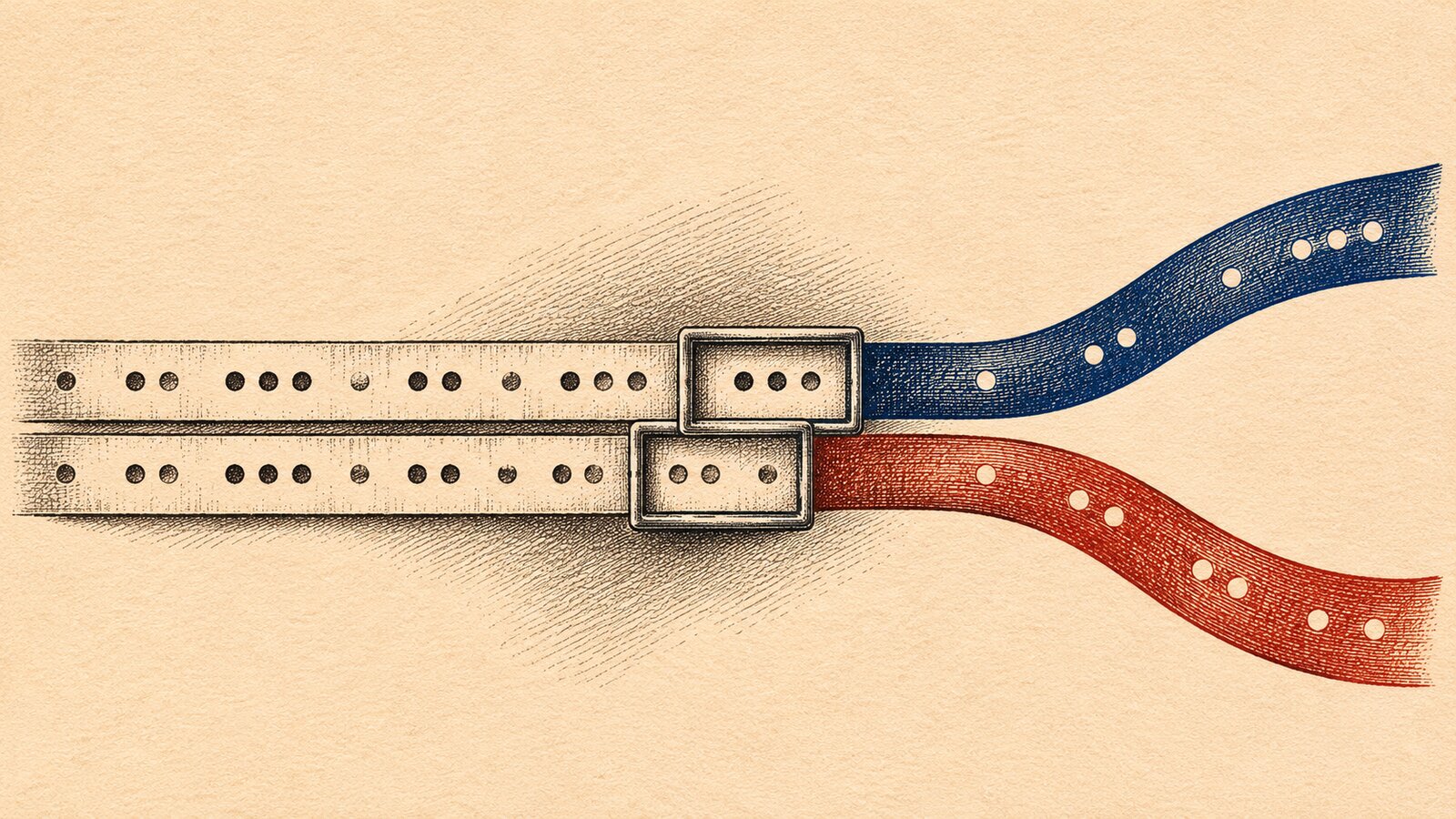
Suppose you keep the seed fixed while testing a change to how a fractal flame is displayed. You might expect turning off the final transform and leaving it enabled at zero opacity to give you the same points to compare. In a two-sample test of one FLAM3 revision, both runs began from identical ISAAC random-generator states. With the final transform disabled, the x-coordinates were (2, 1). With it enabled at zero opacity, they were (2, 2). Both runs recorded zero bad points.
The draw that changes the second point
In the fractal flame algorithm, the final transform acts on the point prepared for display. The next iteration carries on from the recurrent coordinates. In this FLAM3 implementation, the opacity gate and the choice of recurrent transform draw from the same random generator. Draves and Reckase, §3.2 · Pinned FLAM3 iteration and lookup code
The fixture gives two transforms equal weight. The first produces x = 1 and gets the lower half of the lookup table. The second produces x = 2 and gets the upper half. The first random word selects bin 10893, in the upper half, so both runs start at x = 2.
With the final transform disabled, the next word is available for the second transform choice. It selects bin 662 and gives x = 1. When the final transform is enabled at zero opacity, the gate takes that word and checks whether its random value is strictly below zero. The value is non-negative, so the final transform is skipped. The second transform choice now uses the third word, which selects bin 16292 and gives x = 2. Pinned random-number helper
Reproduce the pair
From the pinned Ledger checkout, run sh reproduce/flam3_fixed_seed.sh on arm64 macOS with Git and the Xcode command-line toolchain and SDK. The runner checks the upstream revision and wrapper hash and compiles the functions used by the fixture. The reproduction used Apple Clang 21. A separate AI source and arithmetic check traced the same mechanism using different fixture settings. Pinned Ledger record and reproduction files
The fixture looks for a seed whose second and third words select different transforms. The first candidate, seed 1, already meets that condition. If both words select the same transform at another seed, the generator can advance differently while the second point still agrees. Pinned C fixture
AI assisted with the fixture, source checking and drafting this note. The cover is an AI-generated conceptual illustration. Human specialist and peer review have yet to take place.
The isolated build gives one paired trajectory at one seed and one upstream revision. Image-level effects, other builds and the distribution across seeds remain open. For a like-for-like comparison of displayed points, the first thing to check is whether the underlying point sequences still match.


No published comments yet.