
First off the Van
The coat hooks stayed. The reading lamp went into a box.
Ada wrote both decisions on the handover sheet while Len held the luggage label taut. When she finished the number, he let go carefully so the pencil would not tear the paper.
They had seventy minutes before the van left. The singing group had already carried out its chairs, music stands and the kettle that had lived beside the upright piano. Three members waited by the loading door, trying not to look as if they were waiting. The piano stood on a dolly. Its brass handles projected from the sides.
Ada was making the inventory for the new owners of the hall. The group had rented the room for years and would continue hiring it after the sale. Her first job was to record what belonged to the building. Her second was to give the group a clear handover. The two lists were almost, but not quite, the same.
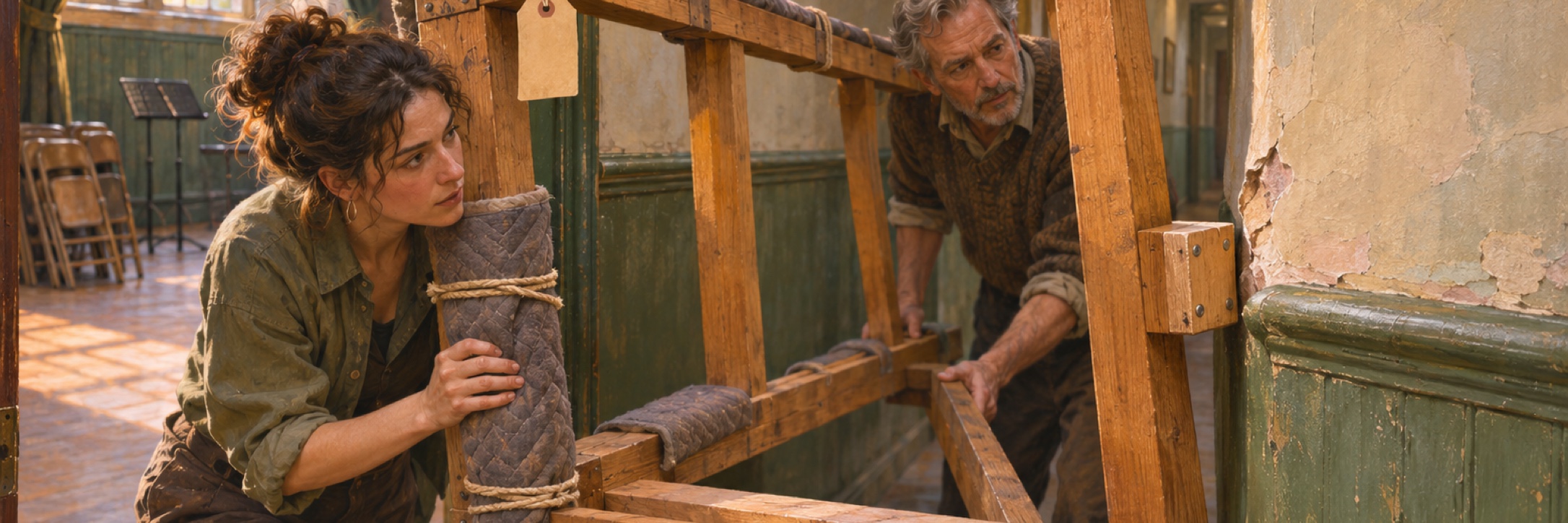
Len, the outgoing caretaker, pointed to a wooden rectangle hanging behind the piano. It was built to the piano's footprint, handles included, with crosspieces at each corner and a small block on one side.
“That goes with the piano,” he said.
“Was it bought for the group?” Ada asked.
“I made it.”
“On the hall's time?”
“During the week, yes. From their packing wood.”
“Then both sides have a claim.”
Len gave a short nod. “That is one way of putting it.”
Ada looked at the handover sheet. There was a box for equipment that stayed and another for items the group was taking. The frame fitted neither. It had no label, no number and no name beside it.
The group wanted the piano in its new room before the first rehearsal on Monday. Nobody in the hall had yet seen that room. One of the singers had measured its doorway from a photograph. Len had made the frame to protect the piano's handles during moves, but the next room had a turn between the entrance and the space where the instrument would stand. A rectangle the piano's size might help test that route. Or it might persuade them that a route worked when the real piano would not.
“I can write down the dimensions,” Ada said. “The frame can stay here until the new room is measured.”
“And then what?”
“Then someone decides.”
“Someone always does.” Len lifted the rectangle from its hooks.
Ada looped a numbered tag through one crosspiece. Len took the tag down.
“Not yet.”
“Then it stays.”
“Not yet.”
He started towards the loading door with the label swinging from one corner. Ada followed to retrieve her number. The turn between the rehearsal room and the exit was narrow enough that he could not keep the frame level. He gave her the leading end.
“Short side first,” he said.
“Which short side?”
He showed her.
They turned the rectangle. One corner tapped the plaster. The little block caught the edge of an old chip, the mark where the piano handle had once struck the wall.
“That's why you put the block there?” Ada asked.
“So it wouldn't do that twice.”
The answer altered her idea of the frame. It was not only a packing aid. It remembered the clearance of this room, though not in any way the inventory could describe.
“Try it the other way,” she said.
Len handed her the far end. Ada tipped the frame, lifted the corner and rotated her wrists until the block passed the damaged plaster with a thumb's width to spare. The frame cleared the door.
She laughed once, relieved. “I thought it would catch.”
“It did.”
“On the first try.”
“That's why you try it before the piano.”
From the doorway, one of the singers called, “Will it fit the new room?”
Ada looked back at Len.
“The new room has a turn,” he said. “The handles need space. The frame tells us the piano's footprint. It doesn't tell us what that other turn will do.”
“Can we measure the new room before the van leaves?”
“No. Their key is with the agent. The singer has a picture and the door width.”
Ada returned to the handover sheet. “Then we should load the frame where we can get it out first.”
“You mean loose.”
“I mean accessible. It can come off before the piano.”
Len held out his hand for the tag. “You want me to put it on the list as hall property?”
“I want the list to say what we know. It was made on hall time from their packing wood. Neither fact settles who owns it.”
He took the pencil and turned the tag over. “Frame for piano. Unassigned.”
Ada added: TAKE OUT FIRST. KEEP ACCESSIBLE. MEASURE NEW TURN BEFORE LOADING PIANO.
“Who is going to be there when they unload?” Len asked.
“I can go.”
“That wasn't the question.”
“No,” she said. “It wasn't.”
The three singers at the door had stopped pretending not to listen. One of them, a woman with a blue scarf tucked into her coat, lifted the piano's dolly handle.
“I'll call the agent,” she said. “If we can get the key, I'll measure the turn before Monday.”
Len looked at her. “And if you can't?”
“Then the frame comes off first. We don't put the piano in until we know.”
Ada passed her the handover sheet. “Can you put your name beside that?”
The singer read the line before signing. She wrote her number beneath her name and returned the paper.
The van driver called from the loading door. “Anything else travelling?”
Len looked at the frame, then at the piano. “First off the van,” he said. “Then we see.”
They carried the frame together. Len set it beside the piano rather than on top of it. Ada tied the tag to a crosspiece where it could be read from the door. The singer with the blue scarf went to make the call.
Before the piano moved, Ada knelt and chalked the frame's outline on the rehearsal-room floor. The rectangle left a pale shape around the dust where it had hung.
“Is that everything?” the driver called.
“Everything on the list,” Ada said.
The frame was already on the van.

Loading published comments…